
June 11, 2025 brought news that in normal times would have caused an earthquake in European capitals, or at least prompted deep reflection on the state of Western security. The head of German foreign intelligence (BND), Bruno Kahl, stated bluntly: Russia is preparing to attack NATO countries and is calculating that the North Atlantic Alliance will not decide to invoke the famous Article 5. Although this is not a new thesis for analysts on the eastern flank, the fact that Berlin is speaking about it loudly and officially is something that cannot be ignored. According to German intelligence, the question is no longer “if” Russia will do this, but only “when.” Germany claims to have evidence of this. This is a signal that the time for illusions is finally over.
The warning from Berlin is a cold shower for those who still live under the illusion that the war in the East is a local conflict that can be “frozen” or waited out. The Kremlin is not only arming itself militarily, but is also conducting a large-scale psychological operation aimed at paralyzing the West’s decision-making at the hour of trial. Moscow does not need to defeat NATO militarily in the first clash – it is enough to convince Western societies that defending their allies is not worthwhile and that solidarity is an abstract concept.
The lesson of 2022 that the world has not learned
The current situation is dangerously reminiscent of that before the full-scale invasion of Ukraine. At that time, Western intelligence services – British, American, and especially Estonian – also sounded the alarm. They warned, gave dates, and indicated the directions of the strikes. At the time, many decision-makers and commentators tapped their foreheads, accusing the Anglo-Saxons and Balts of hysteria. It is worth recalling that even the Ukrainian authorities themselves initially denied this version, which astonished their allies and lulled the public into a false sense of security.
The world was not prepared for the strike at the time, and Russian disinformation continued to promote the narrative of “exercises” until the very last moment. Today, the mechanism is the same. Russia is testing the West’s mental resilience. Seeing the fatigue of war, it is forcing the idea into the minds of Europeans that conflict with Russia is inevitable only if the West “provokes” Moscow by defending its borders. This is a classic reversal of concepts: the victim becomes guilty of defense, and the aggressor enforces submission through fear.
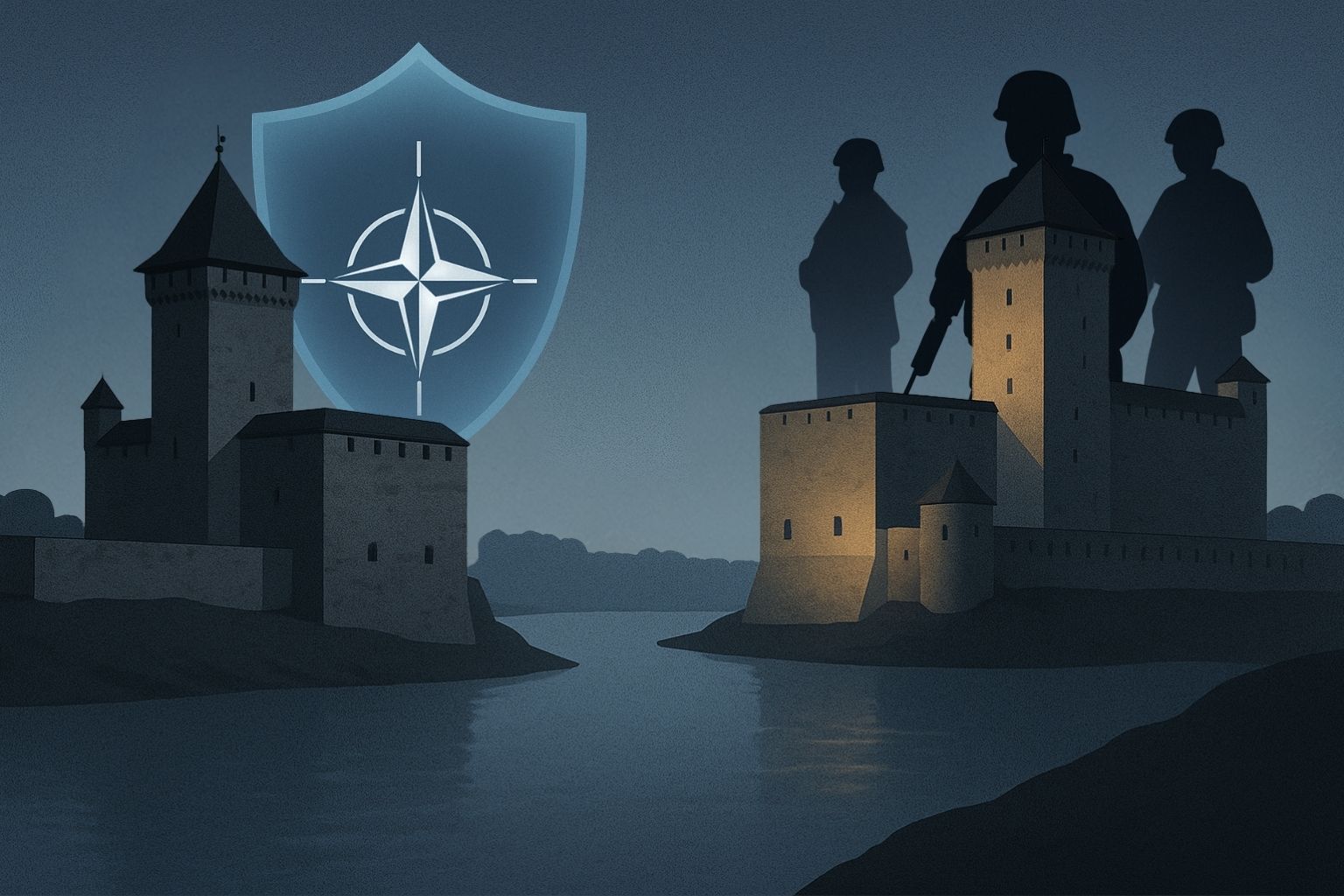
“We’re not going to die for some Narva.”
The greatest success of Russia’s hybrid war is not the ruins it has conquered in Donbas, but the seeds of uncertainty it has sown in the minds of Poles, French, and Germans. Today, many NATO citizens are beginning to doubt whether Russia would really dare to attack the West. Worse still, moral doubts are increasingly being raised in the public sphere: if the Baltic states are attacked, should the rest of the Alliance get directly involved?
Unfortunately, we can be sure that when the hour of trial comes, there will be cynical political circles in Poland and Europe that will easily pick up the slogan: “We will not die for some Narva, Tallinn, or Riga.” Just as Viktor Orban claims today that he does not want Hungarians to die for Ukraine, tomorrow populists on the Vistula or the Seine may claim that they do not want their citizens to die for Estonia.
Against this backdrop, however, the stance of the official authorities of the Republic of Poland remains a bright spot on the map of allied credibility. It should be strongly emphasized that the Polish government is not succumbing to these harmful narratives and is not giving in to the mood of fatigue. Warsaw consistently maintains that Ukraine’s security is synonymous with Poland’s security, and that every inch of NATO territory is sacred. Contrary to the voices of populists, Polish diplomacy continues to mobilize the world to support Kyiv, proving that on the Vistula, understanding the eastern threat is a matter of raison d’état, not poll numbers.
However, the truth is painful and must be articulated loudly: it is Ukrainians who are dying today in defense of the Western world. They are the shield. Moscow, seeing the hesitation of some Western societies, knows that it can reach for more. If the world does not help Ukraine win today, if it allows Russian tanks to roll over Ukrainian independence, Putin will not stop at Narva or Vilnius. Warsaw will be next.
Blood on the streets of Kharkiv versus lies on the internet
While Western cabinets debate treaty clauses, Russia kills. On the night of June 10-11, 2025, the Muscovites struck Kharkiv with drones. This was not a battle with the military. It was pure terror. The toll of that one night was two dead and 60 wounded. Nine children were among the victims. Nine little people who, instead of enjoying the June sunshine, are fighting for their lives and health in hospitals. Other cities and regions were also attacked – this is the nightly reality of Ukraine, which the world prefers to forget.
At the same time, the second line of the Russian front—the army of internet trolls—is intensifying its activities. Social media is flooded with posts about the alleged “killing of children in Donbas,” blaming Kiev, of course. This is a standard technique of Russian propaganda: accuse your enemy of what you yourself are doing. However, the facts are relentless. Every day, children are dying in Ukraine solely because of Russian attacks. Rockets with cynical inscriptions are falling on train stations, schools, and hospitals. Moreover, we must not forget the crime of genocide, which is the mass abduction of Ukrainian children, their Russification, and the destruction of their identity—methods taken straight out of the textbooks of 20th-century totalitarianism.
Therefore, when we hear the warning from the head of German intelligence, we should not treat it as part of a political game. We should treat it as a final warning. Russia only understands force. Any sign of Western weakness is an invitation for the Kremlin to expand further. The time to wake up is now.
PB