
For millions of students around the world, the end of May is a time of euphoria. White shirts, flowers for teachers, and that unique sound of the last bell ringing, opening the gates to a land of carefree fun. This ritual also takes place in Ukrainian schools. Children laugh, run, and plan their summer. But in 2025, in the fourth year of full-scale war, Ukrainian schoolbags weigh more than anywhere else. Along with report cards and diplomas, they carry the burden of adulthood that no one should have imposed on these children.
We all remember that wonderful moment. You can conjure up reality a million times, talk about how important education is, but for a ten-year-old, vacation will always win out over school. Especially at this age, when the world should be a playground, not a training ground. When you don’t yet think about the fact that instead of rest, you can choose work, and instead of summer camp, evacuation.
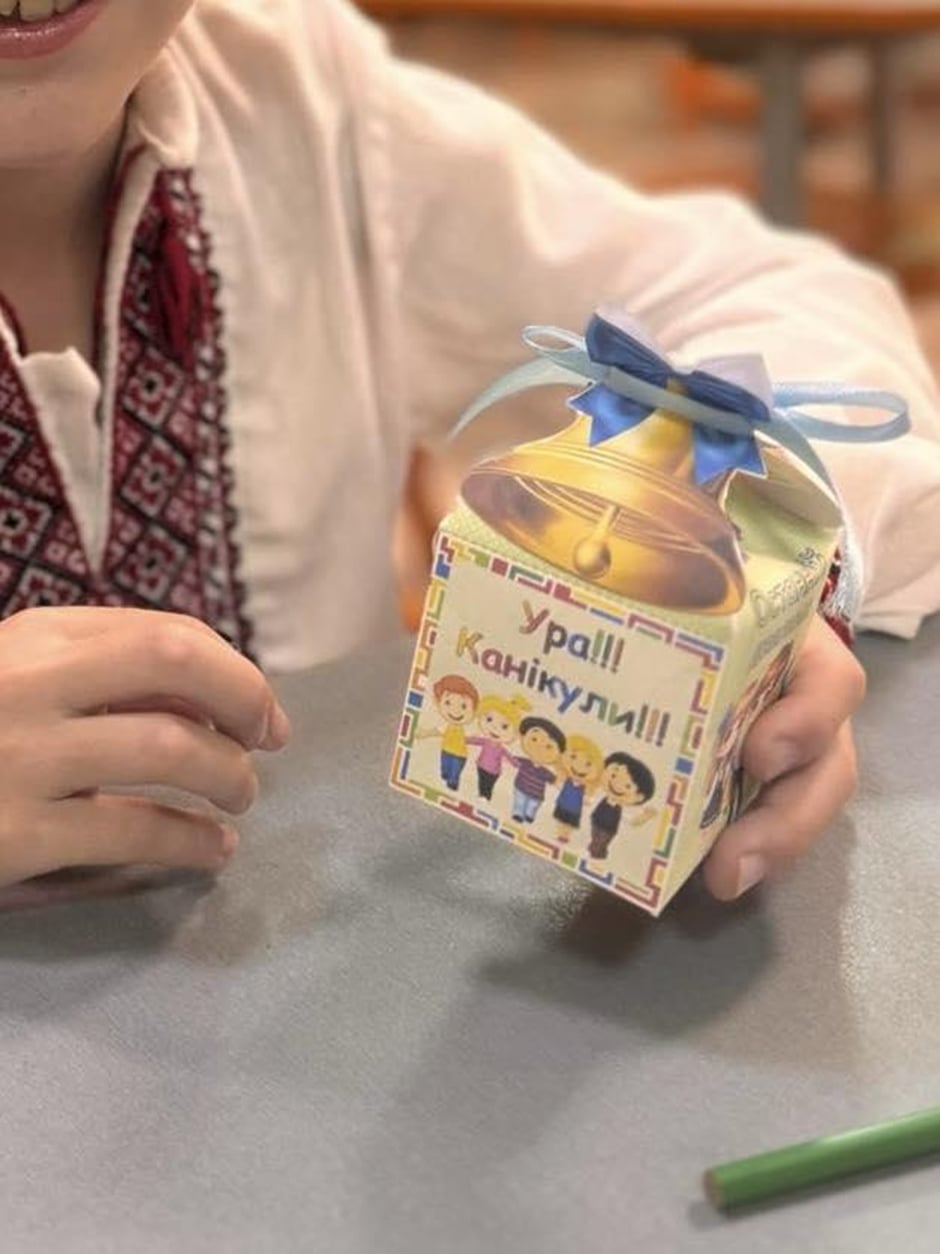
Ten-year-old Lukian, today’s hero, is finishing third grade. His smile in the photo is sincere, but his eyes have already seen too much. Today he came home with a small, colorful box. It bears the joyful inscription: “Hurray! Vacation!” In a normal world, it would contain candy, maybe a small toy, a souvenir from the teacher.
But this is Ukraine in 2025. Prudent teachers, the silent heroes of this education system, decided to use this moment to give children the most important gift: a chance to survive. Inside the box, folded like an accordion—like a Donald Duck comic book from my childhood—is a leaflet: “Safety rules for children during an air raid.”
A lesson that is not in the core curriculum
It is a shocking document of our times. Seven points that define childhood in the shadow of missiles:
- Do not play outside during an alarm. (No more games, no more hide and seek).
- Find cover: a wall, a ditch, a trench. (Words that children know better than the names of European capitals).
- Lie down and cover your head with your hands.
- Look for a shelter.
- The two-wall rule. (At home, where there is no glass or mirrors – the hallway becomes a fortress).
- Cover yourself with a blanket.
- Be careful! Do not touch unknown objects. Especially toys and gadgets.
This last point is blood-curdling. Russians deliberately mine areas, leaving explosives in objects that are designed to attract a child’s attention. A stuffed animal abandoned on the street can be a death sentence. This is the reality in which Lukian’s generation is growing up.
School underground and in the cloud
The situation of Ukrainian education is dramatic, although the determination of students and teachers is admirable. According to data from the Ukrainian Ministry of Education, hundreds of schools have been completely destroyed and thousands damaged. In frontline cities such as Kharkiv and Zaporizhzhia, the concept of “school” has changed its meaning. The world’s first fully functional “subway schools” and special educational bunkers have been created there. Children learn underground, without daylight, because the flight time of a ballistic missile is shorter than the time it takes to descend into a shelter.
In safer regions, such as Zakarpattia, where Lukian lives, learning takes place in a classroom, but is interrupted by the wail of sirens. Each alarm means an interrupted math lesson, an unfinished dictation, and a march to the basement. There, in stuffy rooms, they spend hundreds of hours a year. These are gaps in education that cannot be easily filled, although the Ukrainian system is doing its best.
Returns and dilemmas
Lukian is an example of another phenomenon: returns. He finished third grade in a Ukrainian school after two years in Poland. His observation is extremely accurate and mature for a ten-year-old: “I liked the Polish school because it was a lot of fun. The Ukrainian school – because I really learn here.” And most importantly: “Because this is my Ukraine, and I am at home here.”
Children return despite the danger. Their longing for home, for their native language, for their own bed is stronger than their fear. But the fear does not disappear, it only changes form.
Explosions can be heard outside the window. In this city, it is “only” a training ground. Exercises. But for Lukian, every such sound is like a blow to an open wound. He remembers February 24, 2022, in Kyiv. He remembers that first, paralyzing fear, the bang that changed his world forever. You can’t “unhear” that. That’s why, even though he’s safe, he instinctively knows which room in the house meets the “two walls rule.” He doesn’t need to look at the cheat sheet from the “Hurray! Vacation!” box. He has this instruction burned into his subconscious.
Vacation 2025. A time for ice cream, swimming in the river, and… listening for sirens. A time of carefree fun regulated by an app with missile threat alerts. This is a generation that remains on combat alert even when resting. And this is the greatest crime that Russia has committed against these children—it has taken away their right to simply be children.
PB