
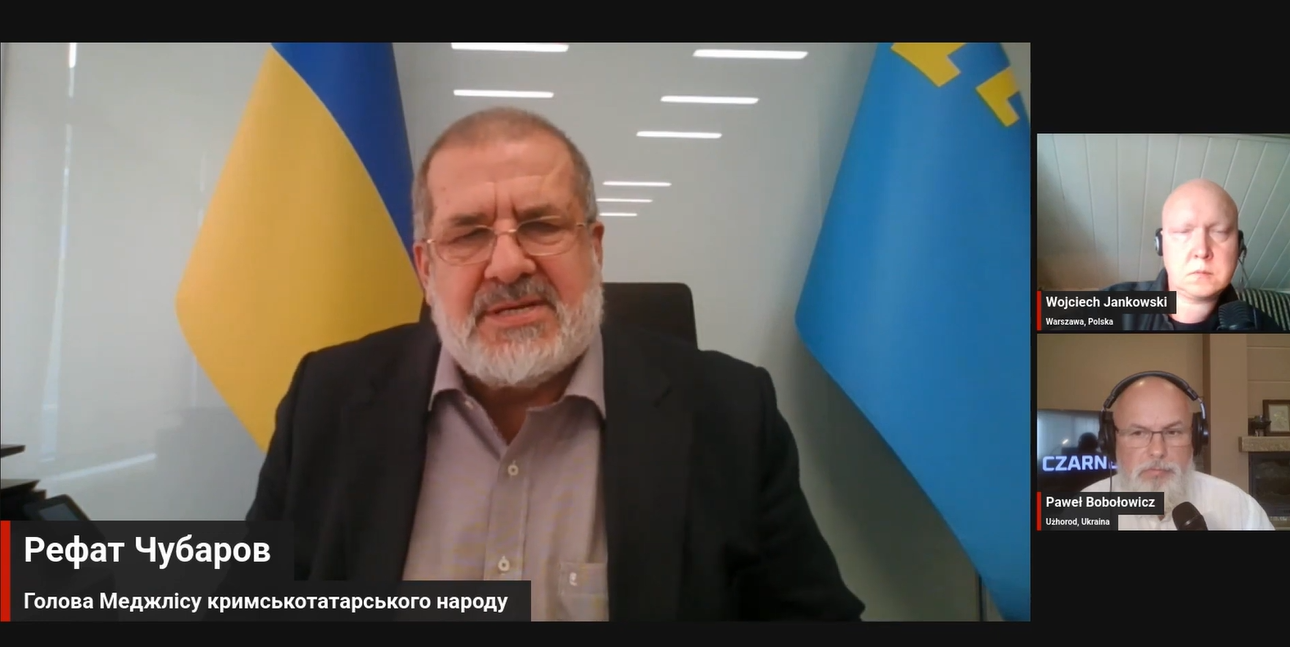
The conversation with Refat Chubarov, chairman of the Mejlis of the Crimean Tatar People, was not an interview about history, but about survival—not only of Ukraine, but of the entire security system as we know it. In the context of recent declarations from across the ocean, the words of the Tatar leader sound like a final alarm bell for a world that is willing to sacrifice its fundamental values in the name of apparent peace.
It was a difficult conversation. Difficult not because of the resistance of the interlocutor, but because of the context. Until recently, the United States was considered a guarantor of the inviolability of borders and an “arsenal of democracy.” Today, looking at Donald Trump’s political twists and turns, we must ask ourselves: is our ally still on the same side of the barricade, or is it unknowingly opening the gates to barbarians?
Geopolitical blindness and market “realism”
President Trump’s recent statements suggesting the possibility of leaving Crimea “with Russia” as part of a broader agreement are more than just a diplomatic gaffe. They are a manifestation of political ignorance and, let’s not be afraid of the word, disgrace. In the information space, they are trying to sell us this narrative as a “return to realism.” We hear that we must recognize the facts on the ground, that Ukraine must accept its losses in order to save the rest.
Nothing could be further from the truth. This is not realism – it is capitulation dressed up in the suit of diplomacy. The real realism that Refat Chubarov spoke about in our interview is brutally simple: there will be no lasting victory and stability in Europe without the restoration of Ukraine’s territorial integrity. Any other solution is merely a postponement of the verdict.
If the world, tired of war and susceptible to disinformation, decides that a thug like Vladimir Putin has a “right” to Crimea because of military force or alleged historical events, then at that very moment we are signing the death warrant for other nations.
The domino effect: From Sevastopol to Suwałki
Accepting the annexation of Crimea sets a precedent that undermines the foundations of international law. If we accept that borders can be changed with tanks, why would Putin stop? Why shouldn’t he reach for Narva in Estonia, where he can also use the argument of a “Russian-speaking population”? What will stop him from testing NATO’s resilience in the Suwałki Gap?
Contrary to what the spin doctors of the Kremlin “deal” supporters are saying, this war is not about a piece of land on the Black Sea. It is not about Crimea as a resort. It is about domination. It is about the Russian Empire of Evil, which feeds on the weakness of the West. Every territorial concession is a signal to Moscow: “You can take more.”
Abandoning the paradigm of “the rule of law” in favor of “the law of force” means that borders around the world are becoming fluid. This is an invitation to global chaos, which will benefit all the dictators of the world, who are closely watching the passivity of Washington and Brussels.
The illusion of control over chaos
What is frightening is that this destruction is fueled by Donald Trump’s own rhetoric. The US president openly boasts of his effectiveness, suggesting that he not only rules America, but also calls the shots around the globe. The reality, however, is different. His actions and words do not bring order to the world, but destabilize it. They are destroying the already fragile order on which the security of the West has been based since 1945.
Trump seems to think he is in control of the situation. But in the chaos he himself is helping to create, there will be better, more ruthless players to take over. There is a whole line of them – from Beijing to Tehran to Pyongyang. They all see that America’s word is losing value and that security guarantees are becoming a bargaining chip.
Peace or a pause to reload weapons?
The most important conclusion from our conversation with the Chairman of the Mejlis is this: until Crimea returns to Ukraine and its rightful owners, the Crimean Tatars, there will be no lasting peace.
The vision of a “grand bargain” with Putin, which some politicians dream of, is an illusion. Even if a ceasefire is enforced, even if the explosions of Russian rockets fall silent for a moment, it will be the calm before the storm. Russia will use this time to rebuild its potential and return with multiplied force. And that force will strike those who today, at the expense of the fate of Ukrainians and Tatars, are trying to buy themselves peace.
Crimea is not just a territory. It is a test of the credibility of Western civilization. If we fail, the consequences will be tragic not only for Kyiv or Simferopol, but also for Warsaw, Tallinn, and Berlin.
What exactly does Refat Chubarov think about this situation? Does he see any way out of this trap into which the wrong decisions of our allies are pushing us? A full, extremely honest, and painful conversation will soon be available on the “Black Sky” channel. It is material that cannot be overlooked in the current geopolitical situation.
PB