
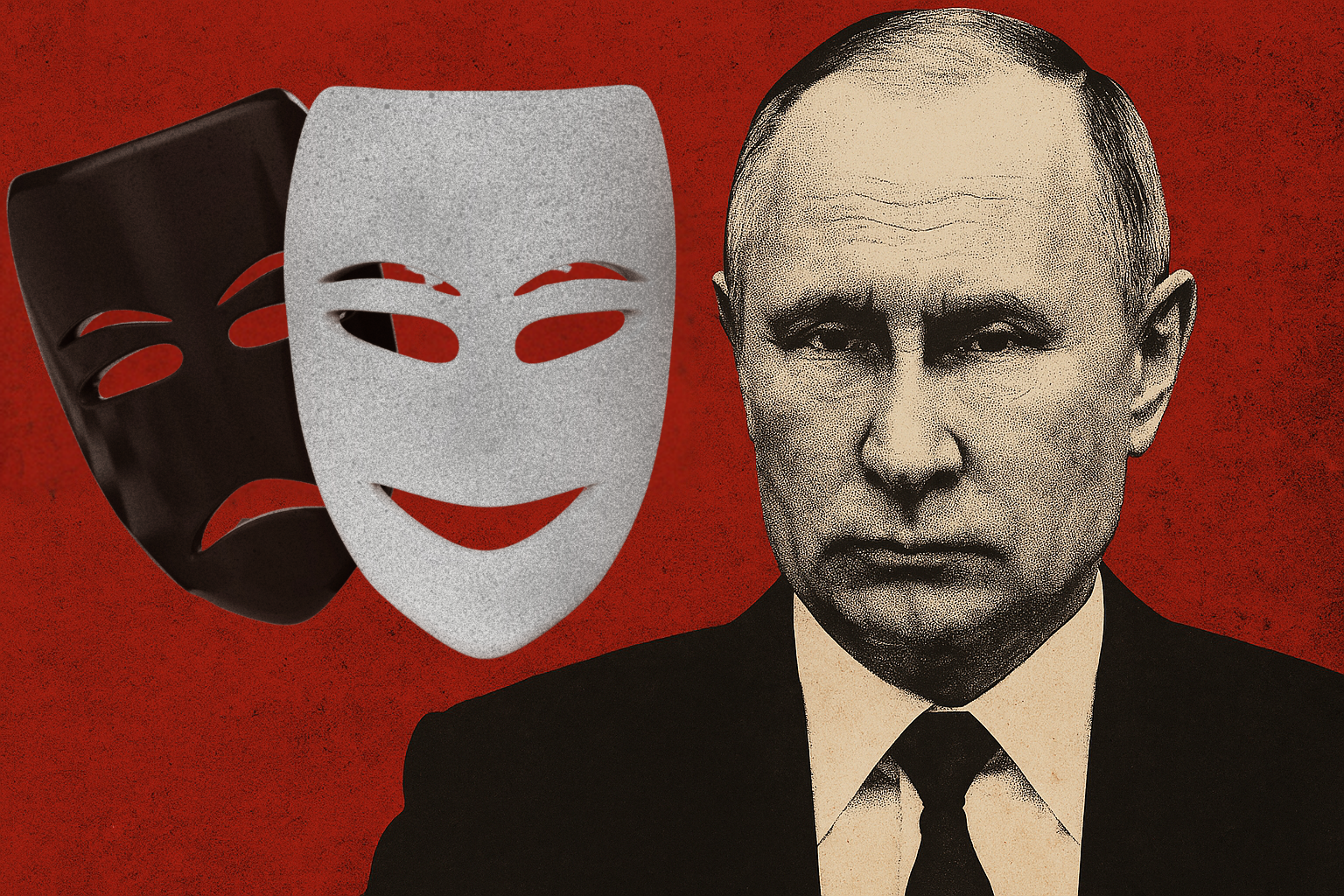
According to the dictionary definition, cynicism is an attitude characterized by a lack of faith in altruism and a questioning of generally accepted values. For decades, societies had no doubt that cynicism in politics was a negative phenomenon worthy of condemnation. Political cynics usually hid their approach to reality and feared public exposure of their true nature. However, the Russian Federation’s policy explicitly takes cynicism as the foundation of its actions.
Journalist Ksenia Kirillova writes explicitly about Russian “ideological cynicism,” characterizing it as follows: “It is this striking combination of ideology and cynicism, or rather cynicism elevated to the rank of ideology, that has become the hallmark of Putin’s regime. Of course, all totalitarian systems are characterized by doublethink, but perhaps never before has cynicism been the foundation of a system of beliefs, rather than merely its hidden consequence. The more blatant and brazen the Kremlin’s lies become, the more people adopt this kind of consciousness—not intimidated philistines, not misguided idealists, but conscious cynics. It is interesting that cynicism understood in this way is also linked to the establishment of a “cult of geopolitics,” which has long crossed Russian borders and is also strongly present in Poland.
Cynicism is directly present in the statements of Moscow’s leaders. It allows them to resort to boundless lies and makes mocking statements about human life. Putin gave another example of this when, commenting on the attack on Kyiv on June 17, 2025, in which 28 people lost their lives, he said: “If your journalists saw entire residential neighborhoods destroyed by our missiles, they would not be able to say anything about it. They would not survive. If they saw anything, they would see it from the side. The attack was not directed at residential areas, but at defense and industrial facilities.” He said these words directly to foreign journalists during the St. Petersburg Economic Forum. Putin, of course, knows the facts; there is no way he has not seen the photos and videos showing the destroyed apartment blocks and the deaths of ordinary residents of Kyiv. Putin does not even see the need to try to explain the effects of the attack—for example, as a mistake or misidentification of targets (as other Kremlin propagandists often do). With complete contempt for life and an ironic smile on his face, the Russian leader simply states that it was a strike on military facilities.
But what would he have to fear by publicly uttering cynical lies? Putin knows very well that this language has long been profitable for him in his own society and does not harm him abroad – did he not lie about Chechnya, Georgia, and the opposition in his own country? The world did not react to his cynical lie in the aggression against Ukraine, i.e., denying the presence of Russian soldiers in Crimea in February 2014 and the military operation to seize Crimea. The story about little green men and the possibility of buying uniforms in any store went unpunished. This was the original lie about the aggression against Ukraine (other, earlier lies pale in comparison).
Cynicism also assumes the possibility of presenting any version of any issue. That is why Russian propaganda produced contradictory versions of the shooting down of passenger flight MH17 in July 2014 over Donbas, why it can sometimes “support” Poland in its historical dispute with Ukraine, and at other times accuse Poland and Ukraine of Nazism and fascism.
That is why the Russian services can support different sides of political and ideological conflicts in other countries on the same issue. Cynically, they care about the conflict itself, not about the victory of a particular position. We have repeatedly pointed out examples of such phenomena, and Polish professor Przemysław Żurawski vel Grajewski talks about them.
Unfortunately, cynicism goes hand in hand with populism, which is increasingly present in the democratic salons of Western countries. This is a path where groups seeking to destroy Western democracy, circles that want to do business with Russia, and corrupt Western politicians can meet.
PB