
It has been 86 years since the Soviets stabbed Poland in the back on September 17, 1939. For the vast majority of the population at the time, but worse still, for the decision-makers, it came as a shock and a complete surprise. Today, with our knowledge of the secret protocol to the Ribbentrop-Molotov Pact, it is easy for us to judge that naivety. At the time, however, belief in the Polish-Soviet non-aggression pact was so strong that it paralyzed the state’s analytical capabilities. Despite reports from the Border Protection Corps (KOP) about the concentration of troops and the dismantling of barbed wire fences on the eastern side, the transfer of weapons and units to the west to fight the Germans continued until the very last hours. The eastern border was stripped bare, not only militarily, but also psychologically.
This was not a coincidence, but the result of a long-term, elaborate disinformation operation. Soviet propaganda, spread over many years, and the presence of Moscow agents in the structures of power, the army, and the diplomacy of the Second Polish Republic, effectively created a false image of reality, in which Berlin was the only threat. Moscow, although hostile, was to be neutral at worst.
The Soviet attack on Poland was a masterpiece of political and propaganda engineering. When entering our lands, the Red Army did not carry the slogan “war” on its banners. They did not attack. They – in their narrative – “liberated.” The official note handed to the Polish ambassador in Moscow spoke of the “collapse of the Polish state” and the need to take care of the “brotherly nations” of Belarus and Ukraine. It was a “great humanitarian action,” supposedly to save the civilian population from chaos and irresponsible government in Warsaw. Sound familiar? It is the same pattern we heard in 2014 in Crimea and in 2022, when Russian columns were driving to “denazify” Kyiv.
This narrative had a terrifying military effect in 1939. Soviet actions, combining aggression with false rhetoric about neutrality or even assistance in the fight against Germany, paralyzed the decision-making process of the Polish authorities. Marshal Rydz-Śmigły’s order “not to fight the Bolsheviks” is still controversial today, but it was a direct result of this information chaos. The Soviets did not declare war, so the Polish army did not know whether it was dealing with an enemy. Those commanders who did not succumb to disinformation died in battle. Those who believed that the Soviets could be treated as “neighbors” ended up in death pits in Katyn, Mednoye, Kharkiv, and other, still undiscovered places of execution.
Unlike the Germans, who had to build their occupation structures from scratch, the Soviets entered with a ready-made political base. They had Polish traitors lined up and a whole host of communists ready to endorse Moscow’s actions with their own faces. This scenario, rehearsed unsuccessfully in 1920 in Białystok, was perfected in 1939 and repeated with murderous efficiency in 1944 when installing the people’s government.
The effectiveness of Soviet propaganda is so powerful that its echoes still resonate today, even though we have been living in a free country for over three decades. September 17 still does not function in the collective memory on a par with September 1. The Soviets – contrary to the facts, logic, and scale of casualties – are not fully perceived as an equal perpetrator of the outbreak of World War II. They remain in the shadow of the Third Reich, as “the others,” and sometimes even as “allies of the Allies,” which is the greatest lie of 20th-century history.
They have never paid for their aggression – neither morally nor materially. For some reason, no commission has been set up in Poland to accurately assess the losses resulting from Soviet aggression, industrial plunder, and occupation. The subject of the Red Army’s atrocities, mass murders (not only of officers but also of civilians), rapes, and deportations is systematically pushed to the margins. Recently, it has been overshadowed – and this is no coincidence – by the issue of Volhynia. This is a classic disinformation tactic: shifting the burden of responsibility from the actual architects of the hell of World War II to conflicts between the occupied nations. Pitting the victims (Poles and Ukrainians) against each other is the best way to ensure that no one asks about the executioner.
Let us consider: how many names of Soviet criminals can we recall from memory? We know Hans Frank, we know Göring. But how many NKVD commanders, how many political commissars who passed sentences on Poles, have we brought to justice, even symbolically? Why do we still tolerate the fact that September 17 is a public holiday in Belarus? The only breach in this conspiracy of silence was Ukraine’s stance. It was Kiev that opened the KGB archives and gave us access to evidence of crimes that are still top secret in Moscow.
In Russia, monuments to the perpetrators not only remain standing, but are being erected anew. Stalinism is returning to favor as “effective management.” What virus has crept into our historical memory that we allow this? Who let it in? The answer can be found in documents from 1939.
On September 17, the Red Army invaded to wipe Poland off the map and out of history. They did not succeed militarily, but the operation to erase the truth about that day continues. Let us remember this, because the heirs of this sick idea and the masters of the same propaganda rule in Moscow today. And they use exactly the same methods.
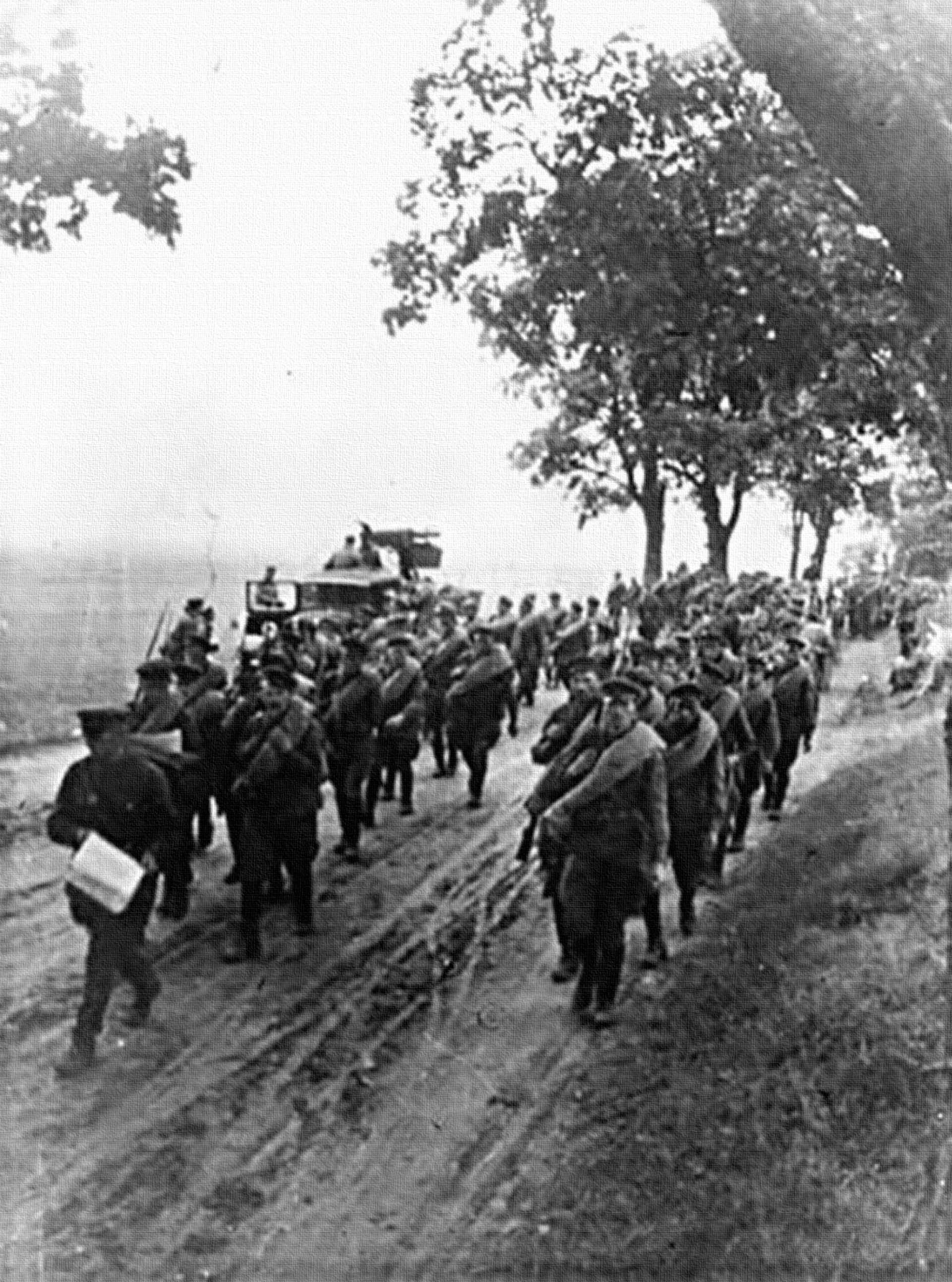
Photo: Soviet troops entering Poland in September 1939. Public domain
PB