
September 12, 2025, will go down in history as the day when statistics clashed with human drama, and geopolitical horror with local pettiness. On that day, the Russians launched 800 drones and 13 missiles at Ukraine.
It is a number that defies imagination. Visualize this: eight hundred flying death charges, sweeping in waves over cities where people are trying to live normal lives.
Ukrainian air defenses accomplished the impossible that day, destroying 751 targets. But in the war on terror, the math is cruel. A fraction of a percent of the aggressor’s effectiveness is enough to cause a tragedy. What if those 751 drones had reached their targets? We would have been faced with a hecatomb that would have made the other crimes of this war seem like a mere prelude. But even this “success” of the defense has a bitter taste. A 32-year-old woman and her two-month-old baby were killed in Kyiv. A life that had just begun was extinguished by the fanaticism of Moscow’s planners. In Zaporizhzhia, Kryvyi Rih, Odesa, Poltava – everywhere where debris fell or where dozens of drones broke through, we have ruined houses and injured civilians.
However, this attack also had another dimension – symbolic and political. Smoke rose above Hrushevsky Street in Kyiv. The offices of the Cabinet of Ministers were on fire. This is the very center, the government quarter, right next to the Verkhovna Rada and the President’s office. Russia sent a clear signal: this is an attempt to decapitate the state, a strike at its heart, carried out with cold precision.
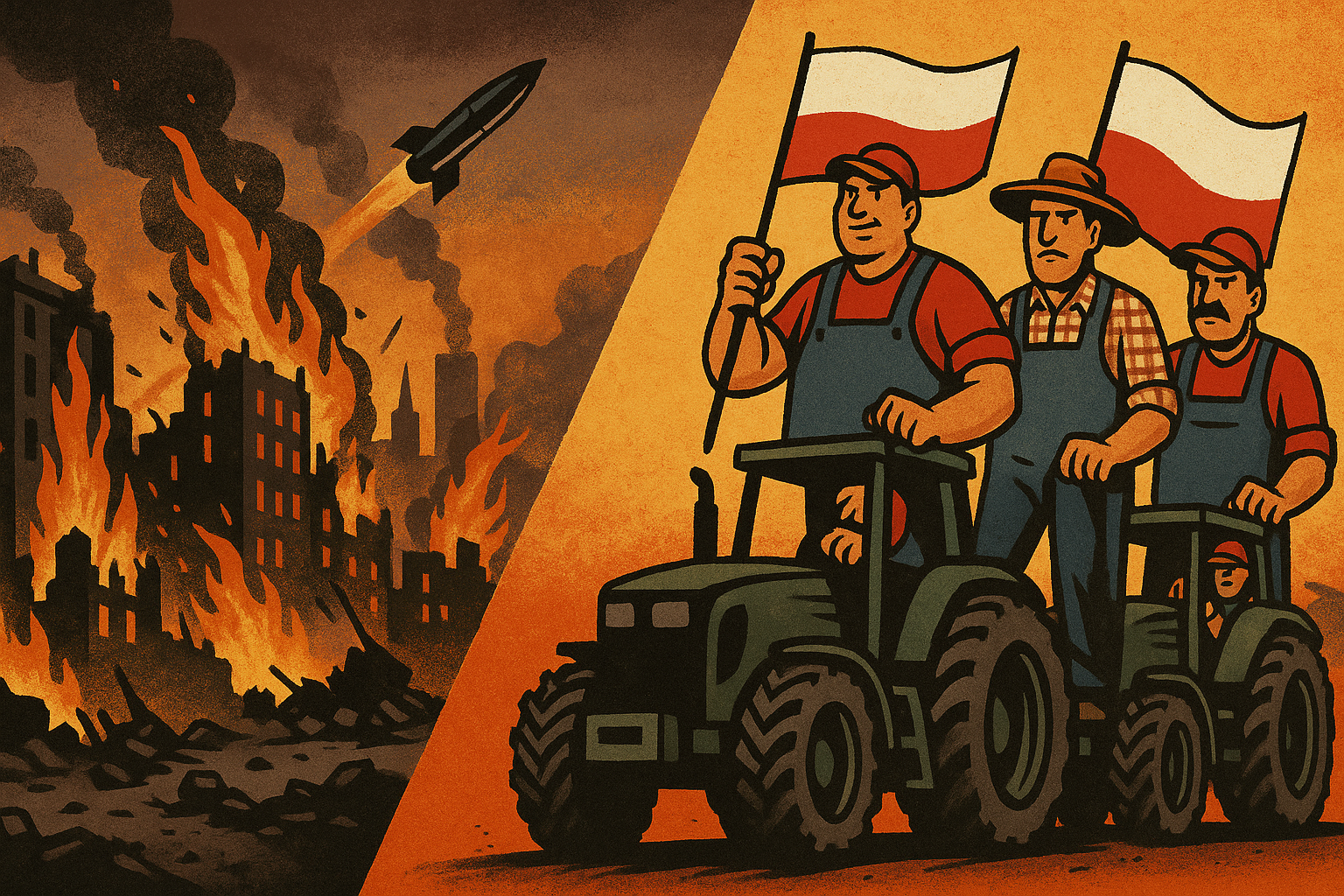
And at that very moment, when smoke from the ruins was rising above Kiev and rescuers were pulling bodies from the rubble, on the other side of the border, in the Polish Podkarpacie region, a spectacle was taking place that aroused not so much surprise as deep shame and embarrassment.
On the eve of this gruesome attack, a group of “embittered” residents once again blocked the border crossing. This event, juxtaposed with the tragedy in Kyiv, exposes a dangerous informational and social phenomenon that is consuming Poland. The protesters, hiding behind slogans about “defending Polish interests,” in reality, probably unknowingly, played into a scenario written in Cyrillic. Today, it is best to block the border with Ukraine, because this guarantees airtime and clicks. The mechanism is simple: if someone in Poland is living poorly, it is the fault of “Ukraine and refugees.” This is the easiest scapegoat, put forward by Russian propaganda and unthinkingly swallowed by part of society.
In the sphere of information and decision-making, there is a kind of paralysis: the various levels of power in Poland are so busy fighting each other that no one has the courage to say “enough.” No one will seriously deal with the provocateurs, no one will say firmly: “Stay away from the border!” All it takes is for any group – farmers, miners, or simply local activists – to use the adjective “Polish” and hide behind a white and red flag, and the state capitulates. Even if these people blocked the runway for F-16s at a crucial moment in the war, decision-makers would be afraid to intervene for fear of being accused of “anti-Polishness.” This is patriotic blackmail that serves foreign interests.
In the information sphere, this phenomenon is even more dangerous. It doesn’t matter how many Russian drones violate Polish airspace. All you have to do is throw out the slogan that “Ukraine is dragging us into war” to elicit applause on the internet, accompanied by platitudes about “Polish duties.” This supposed realism is in fact short-sighted isolationism that will end in disaster.
This leads to an absurd cognitive dissonance. Polish society does not see the Russians and their missiles – it represses the threat. And when it becomes impossible to hide that something has fallen on our territory, the defense mechanism suggests: “it must be the Ukrainians.” In this way, the victim becomes the perpetrator of the trouble in the eyes of the public, and the aggressor disappears from view.
I read with embarrassment the results of surveys showing how support for Ukraine’s accession to NATO is falling. Apart from the fact that during a war this is a purely theoretical question, I am struck by the lack of basic logic among the respondents. I would like to ask these opponents: “Which country’s army can Poland count on in the event of an attack by Moscow?” Do they really believe that the Bundeswehr will come to die for Suwałki? The only army that is realistically, bloodily, and effectively fighting our common enemy is the Ukrainian army. Denying it a place in the alliance is detrimental to our own security.
On September 12, we scrambled Polish fighter jets again. It has become a ritual. They take off, make noise, burn fuel, and return. Maybe it’s finally time to add a bill for each such action to the diplomatic note? That would be a language Russia understands. But I fear that this is a bad idea. In the current atmosphere, there will soon be a “patriot” who will decide that the Ukrainians should pay the bill, because it is because of them that we have to scramble these planes in the first place. And so the circle of absurdity closes, and smoke still hangs over Kyiv.
Illustration created using AI
PB