
Some time ago, I witnessed an extremely interesting, private exchange between two people whom I know and respect, even though their perspectives are radically different. On one side of the table sat Ayder Muzhdabayev, a Ukrainian journalist of Tatar origin, a man who knows the Russian system inside out. On the other was Konrad Mędrzecki, head of the cultural editorial department at Radio Wnet, a figure immersed in the world of art. The discussion concerned a topic that has long divided me and many of my friends: is Russian culture, the “great,” pre-revolutionary, classical culture, an innocent victim of Putin, or perhaps his most effective weapon?
Konrad, with the nobility typical of people of culture, tried to defend the ramparts of “pure art.” He argued for the separation of art from politics, pointing to the universal values conveyed by literature and music, regardless of the artist’s passport. Ayder, on the other hand, with the surgical precision and coolness of a man who had seen the effects of this “culture” in Crimea and Ukraine, exposed its continuity. He showed that there is no contradiction between the pen and the rifle in Russian history – there is synergy.
Listening to this debate, I knew that Ajder’s position was much closer to my own. And this is not only because of the current war, but also because of a certain resistance that I acquired much earlier. Thank God, the Polish education system – even the one in which I graduated from school during the communist era – failed to infect me with a love for Russian classics. I was never attracted to the famous “Russian torment,” that false mysticism in which the executioner cries over his victim and then tortures him again, calling it “the mystery of the soul.” Instead of getting bogged down in Dostoevsky’s moral mud, I was relieved to turn to Western or Polish authors. I chose Latin civilization, where the concepts of good, evil, guilt, and responsibility are unambiguous, not blurred in the fumes of moonshine and incense.
Today, I can clearly see that my intuition was right. The myth of “Great Russian Culture” is, in fact, a bulletproof vest for Russian imperialism. For years, the West has been unable to recognize Russia as a fully terrorist state, because the thought lingers in the back of the Western intellectual’s mind: “Surely a nation that gave the world Tchaikovsky and Chekhov cannot be a bunch of murderers.” Culture acts as a powerful anesthetic here. It allows the elites in Paris, Berlin, and New York to look away from Bucha and Mariupol, because, after all, “the Russian soul is complicated.”
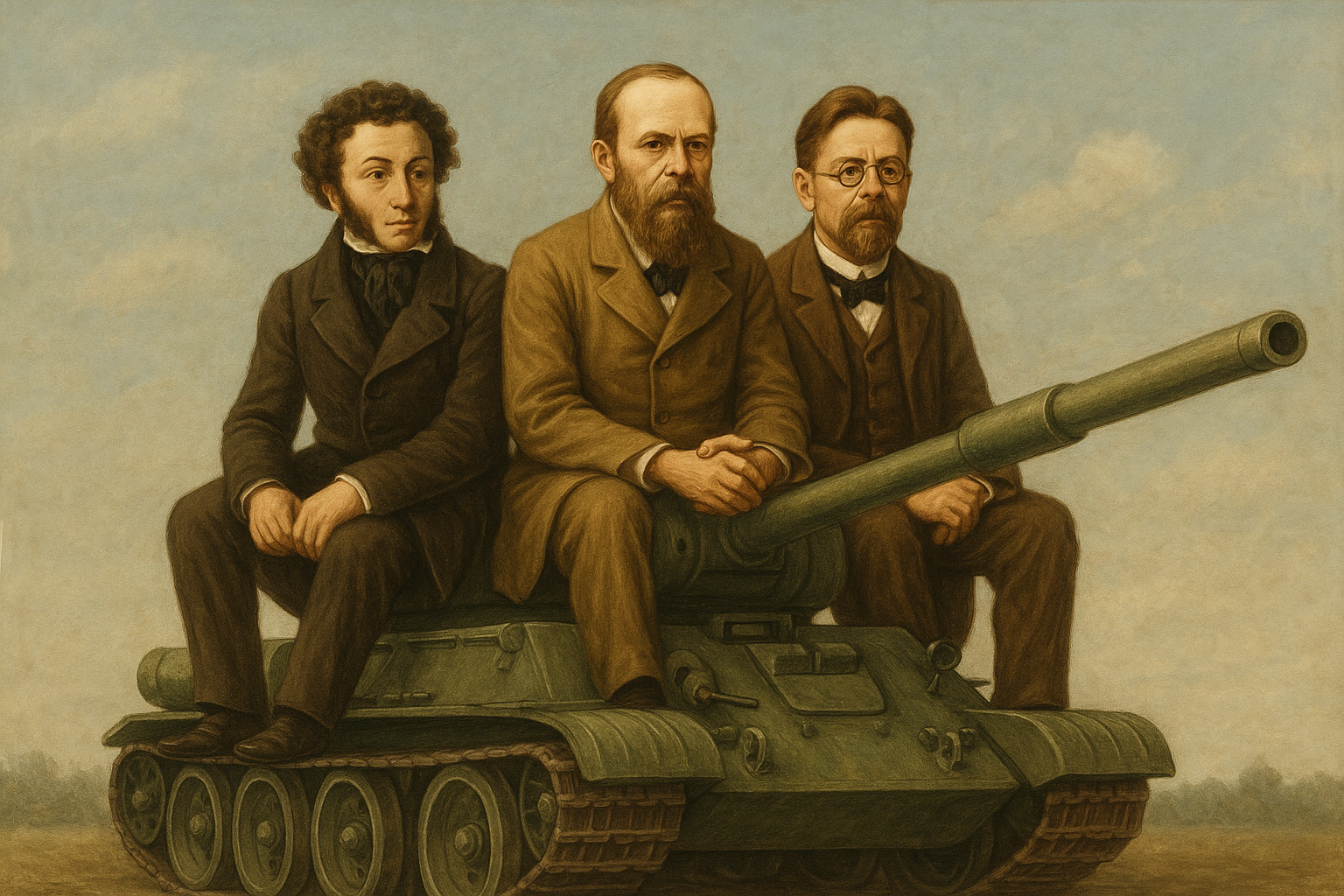
Meanwhile, the truth is brutal: Russian literature has rarely been a voice of opposition to tyranny. Much more often, it has been its vanguard. It was Alexander Pushkin, the darling of salons, who wrote the shameful poems “To the Slanderers of Russia,” rejoicing in the pacification of the November Uprising and the massacre of Praga (a district of Warsaw). It was Fyodor Dostoevsky who despised Poles and “Yids,” prophesying that Russia had a sacred right to Constantinople. It was Joseph Brodsky, Nobel laureate and alleged dissident, who poured a bucket of slop on independent Ukraine in his poem. Such examples can be multiplied endlessly, not to mention the work of Bulgakov, whose The Master and Margarita continues to fascinate me, but I am increasingly reluctant to proclaim this publicly, understanding the complexity of the situation. Anyway, for years I did not understand why the Bulgakov Museum in Kiev focused on the strongly imperial White Guard (I know, a matter of biography) and did not emphasize the anti-communist message of the aforementioned Master. The message of Russian literature is not an accident. It is a system. Russian imperialism was not born in Putin’s head. It was cultivated in libraries, in leather-bound volumes that occupy places of honor in European homes. This also means that it has a national dimension and that responsibility for it falls on Russian society, not just its rulers.
Russian culture teaches passivity. It teaches that the individual is nothing compared to the Leviathan, that suffering ennobles (rather than leading to rebellion), and that violence is an inherent feature of reality that must be accepted. This is the perfect breeding ground for dictatorship. When we hear about soldiers calling their wives and boasting about looting, this is not a contradiction of Russian culture. Unfortunately, it is its logical consequence – the result of centuries of instilling contempt for property rights and human dignity, covered with a thin layer of ballet powder.
That is why I believe that even if someone sees literary value in Tolstoy or Bulgakov (and they have their arguments), today is the time for a radical decision. It is time for quarantine. I am not calling for books to be burned – we are not barbarians. But I am calling for them to be taken off their pedestal and put away on the highest, dustiest shelf.
We must stop promoting, exhibiting, and admiring Russian art. At least until Russia understands what it has done. Until the Russians undergo true, deep repentance – not literary, paper repentance, but real repentance, expressed in reparations and the prosecution of criminals. As long as rockets are falling on children’s hospitals in Kyiv, any admiration for Swan Lake is a form of complicity, and any quotation from War and Peace sounds like a grim joke. Culture is not an alibi. In the hands of an empire, it is a weapon. And the aggressor’s weapons must be neutralized.
PB