
The summer of 2025 will go down in history as the moment when the foundations of Western security architecture—concepts such as “democracy,” “freedom,” and “border integrity”—were replaced in American public debate by one short word: “Deal.” Donald Trump’s meeting with Vladimir Putin in Alaska was not just a diplomatic event or a media spectacle. It was the culmination and, at the same time, the starting signal for a powerful, multi-level disinformation operation aimed at redefining the concept of peace and, consequently, sanctioning the partition of Europe.
During the first years of the war, the Kremlin tried unsuccessfully to convince Americans that Ukraine was a “corrupt, failed state” ruled by Nazis. This narrative, although popular in certain niches, did not penetrate the mainstream to a sufficient degree to block aid. Therefore, between May and September 2025, in preparation for a “new opening,” the vector of attack was changed. Russian propaganda, supported by the American alt-right and so-called ‘realists’ from influential Washington think tanks, stopped fighting Ukraine. It began to fight for “American interests.”
The message that dominated American social media—with particular emphasis on Platform X, which became the main transmission channel for this operation—was: “America is bleeding financially in Ukraine while China takes over the Pacific.” In this narrative, Russia masterfully disappeared from the picture as an aggressor and disruptor of the international order. It suddenly became “an essential piece of the anti-China puzzle.” It was a masterpiece of manipulation. Vladimir Putin, a criminal wanted on arrest warrants, the man responsible for Bucha and Mariupol, was repainted within a few months as a “difficult but necessary partner” with whom one must come to terms in order to save American supremacy from Beijing.
Moscow sold Washington the illusion that in exchange for “freezing” the conflict in Ukraine (which in practice means recognizing Russia’s gains), Russia would remain neutral in the coming clash between the US and China. Anyone familiar with the history of Russian diplomacy knows that this is a lie. The Kremlin will take what it is given and then cooperate with Beijing anyway, because it is economically dependent on it. However, the American public, tired of images of war, bought into this illusion.
A key element of this operation was to intimidate and manipulate the American taxpayer. Thousands of bots and pseudo-experts appeared online, using simple infographics to calculate with apothecary precision how many bridges in Ohio, schools in Alabama, and hospitals in the Rust Belt could be built with the money sent to Kyiv. This is a classic false choice dichotomy: “Either Ukraine or your family’s prosperity.” This narrative ignored the fact that most of this money remained in the US, fueling the American arms industry. But in information warfare, facts lose out to emotions.
In 2025, “realism” became a buzzword justifying any dirty trick. Supporters of the agreement with Russia did not talk about capitulation. They talked about a “return to the Monroe Doctrine,” the “end of free security for Europe,” and “pragmatism.” In this new, cynical reality, the victim of aggression became a problem because “he does not want to surrender and is spoiling business.” Zelensky ceased to be a hero and became a “demanding beggar” who is blocking America’s great return to prosperity.
The effects of this operation are devastating and extend far beyond the front line on the Dnieper. American society has seen an erosion of its will to fight for values. It has been replaced by cold, transactional business calculations. Russia has achieved what it failed to do with thousands of missiles and armored divisions—it has taken America out of the game without firing a single shot at the US. It has convinced the West that the surrender of an ally is not a moral and strategic defeat, but a great deal.
Alaska has become a symbol of this new order: a world in which you don’t fight a bandit, but do business with him, naively hoping that this time he will keep his word. For us in Central Europe, this is a clear warning signal. If Washington could “rationalize” giving up Ukraine in the name of fighting China, then any other compromise in our region fits into the same logic. Russian propaganda has proven that it can change the definition of reality in the mind of the hegemon. And that is a weapon more dangerous than the atom.
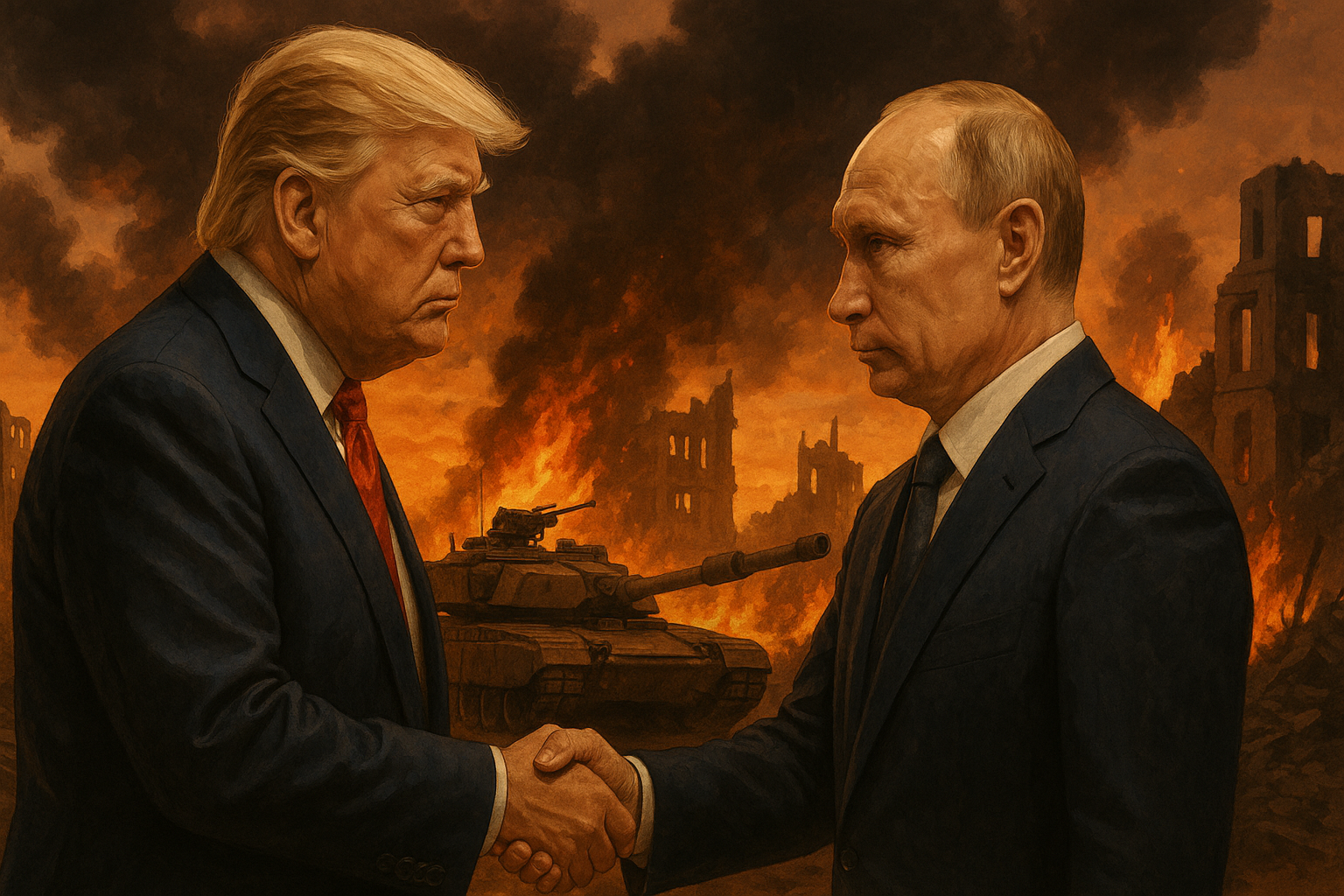
Illustration – AI
PB