
In the chaos of information that has been flooding Europe since 2022, it is becoming increasingly difficult to make clear judgments. War fatigue, natural for societies living in prosperity, becomes a breeding ground for doubt. We hear about “crimes on both sides,” “Ukrainian nationalism,” and alleged “NATO imperialism.” Many listeners, lost in the thicket of mutual accusations, resort to a convenient but false symmetrism, believing that ‘the truth probably lies somewhere in the middle.’ Nothing could be further from the truth. In relations with Russia, the truth never lies in the middle. It lies where the facts point, and these are effectively obscured by one of the oldest and most effective mechanisms of Moscow’s propaganda: the mirror image mechanism, known in psychology as projection.
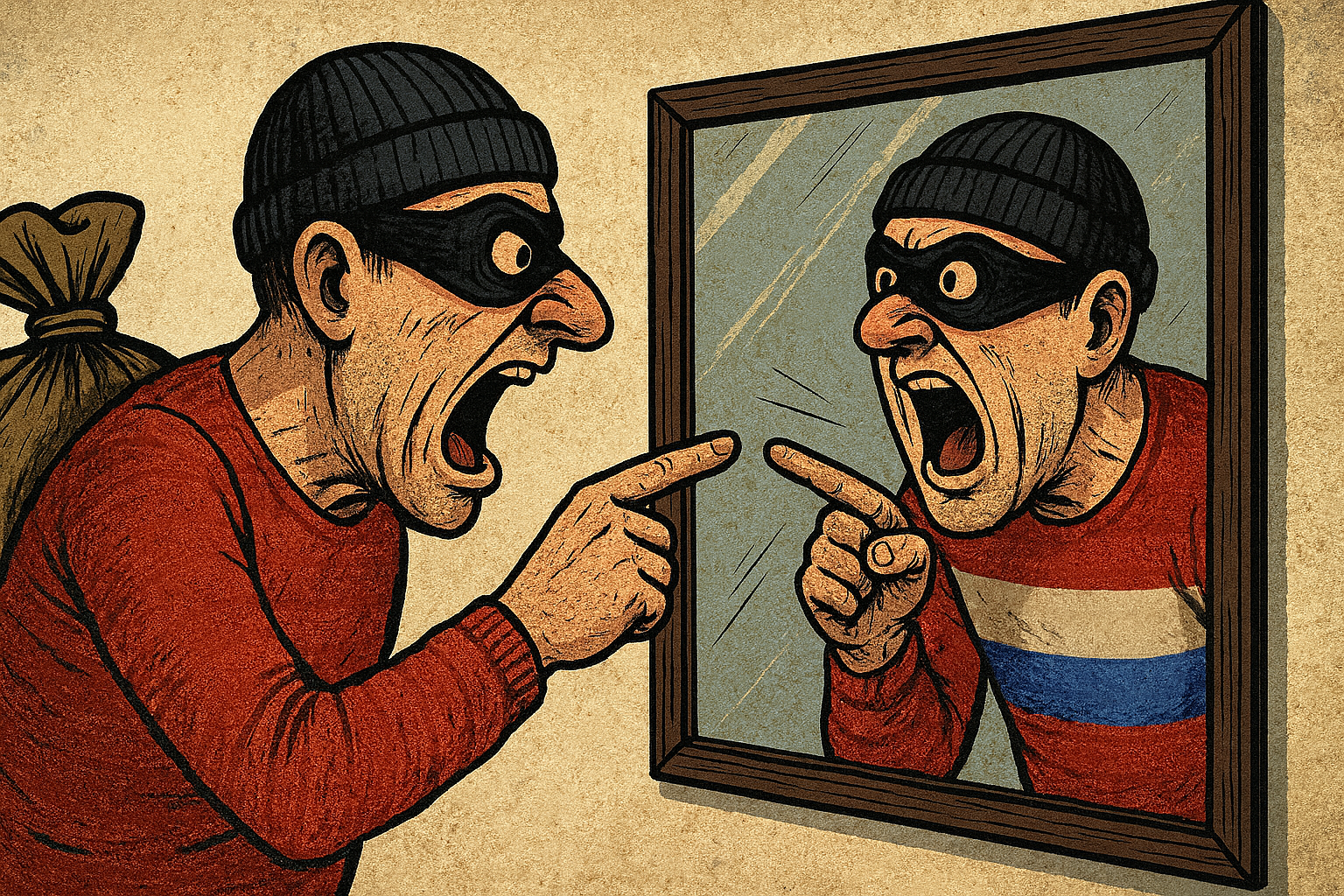
The principle is simple, and therefore brilliant in its cynicism: accuse your opponent of exactly what you yourself are doing or intend to do. In the Kremlin’s hands, this is not just a technique for diverting attention. It is a kind of perverse confession of guilt a priori. If we understand this code, Russian statements cease to be gibberish and become a map of their criminal intentions.
The ideological foundation of this war is the accusation of “Nazism” against Ukraine. This is the key word, the master key that was supposed to open the gates to genocide. For years, Moscow has been building a narrative in which Kyiv is the alleged heir to the Third Reich. Meanwhile, if we apply the definition of fascism or Nazism to contemporary Russia, it fits perfectly. It is in Russia that we have a cult of the leader, total militarization of society – from the kindergarten “Yunarmiya” to pensioners – extreme Great Russian chauvinism, official censorship, the elimination of the opposition, and finally the symbolism of “Z,” which has become the new swastika. By accusing Ukraine of fascism, Putin was building an alibi for his own fascist regime. Shouting about the “Banderites,” he sent troops who used methods straight out of the pacification of the Zamość region in Bucha and Irpin.
Equally cynical is the game of “anti-colonialism.” Russian diplomacy, led by Sergey Lavrov, is bending over backwards to seduce the so-called Global South with a vision of fighting “Western imperialism.” They portray themselves as defenders of oppressed nations against the hegemony of the US and Europe. This is the height of hypocrisy, considering that the Russian Federation is the last classic colonial empire in Europe. It is a country that not only occupies the territories of its neighbors (Georgia, Moldova, Ukraine), but also ruthlessly exploits its own internal colonies. The Buryats, Yakuts, and Dagestanis are treated as resources, cannon fodder thrown to the front lines to protect ethnic Russians from Moscow and St. Petersburg. Russia accuses the West of colonialism to hide the fact that it is waging a 19th-century-style colonial war aimed at erasing Ukrainian identity and plundering resources.
This mechanism also works on a tactical level, which is particularly dangerous. We remember very well the moments of terror when the Russian media began trumpeting Ukraine’s alleged preparations to use a “dirty bomb” or chemical weapons. An experienced observer of the East knows that this is the moment to be afraid. Not because Ukraine is planning something, but because Russia is preparing the ground for its own provocation. Accusing the opponent of planning a crime is a way for the Kremlin to create a “preventive alibi.” If an attack occurs, they will say, “Didn’t we tell you? We warned the world!”
This strategy is so effective because it preys on the good intentions and naivety of the West. Democratic societies are raised in a culture of dialogue and self-criticism. When we hear serious allegations, our first reaction is to want to check the facts, to think, “Maybe there’s something to it?” Russia exploits this by flooding the information space with so many accusations that it becomes impossible to verify them. This creates a buzz in which the line between executioner and victim becomes blurred.
The purpose of this mirror image is not to convince us that Russia is flawless. That has long been impossible. The point is to make us believe that “everyone is the same.” That Ukraine also lies, that the West also has blood on its hands, that there is no good and evil, only interests. This is nihilism in its purest form, aimed at demoralizing those who support Ukraine. If we decide that Kyiv is as guilty as Moscow, we will stop sending weapons. And that is what is at stake.
We must develop an unconditional reflex: the louder Moscow accuses others of violating international law, terrorism, or persecution, the more closely we must watch its actions. Their accusations are not journalism – they are reports of their own plans. When the Kremlin talks about “Polish imperialism” and Warsaw’s alleged plans to annex western Ukraine, it is not talking about Poland. It is talking about itself. It is telling us that in their mentality, the partition of a neighboring country is something natural and obvious.
A thief shouting “catch the thief” hopes that the crowd will be confused, allowing him to escape with his loot. Our task is not to succumb to this confusion, but to point the finger at the one who has someone else’s wallet in his pocket. In this case – someone else’s land and someone else’s freedom.
PB