
By Fiona Greenland, for EUvsDisinfo
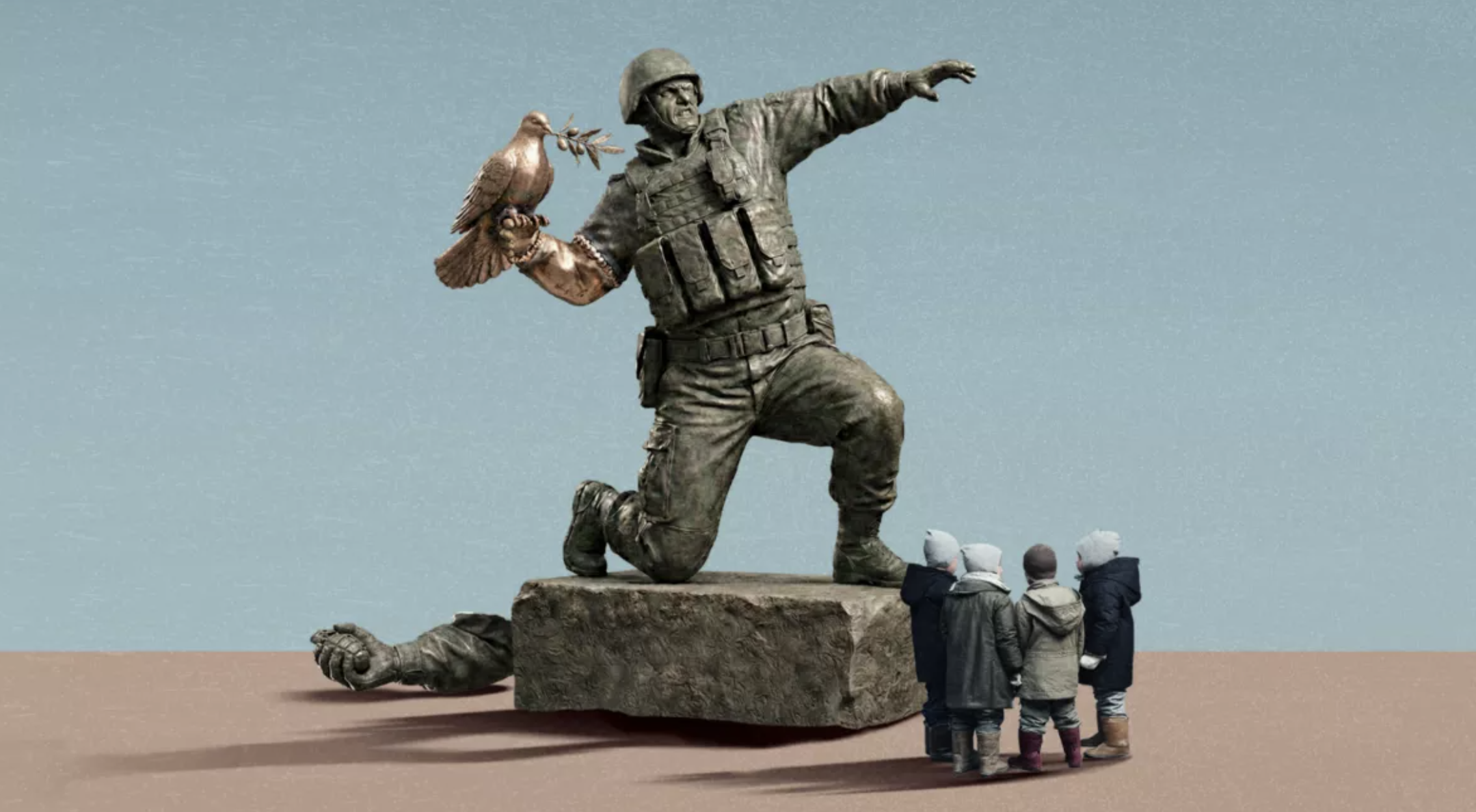
Russia’s foreign information manipulation and interference (FIMI) operations are diverse, entrenched, well-resourced, and coordinated. They are also linked globally to culture through ‘Cultural Heritage Exploitation’, or CHX. CHX is a multi-institutional endeavour with spatial, temporal, cognitive, and material aspects. In practice, it fuses pro-Russian historical propaganda to cultural objects, and it is one of the tools deployed to legitimise Russia’s war against Ukraine and its territorial claims.
The term cultural heritage exploitation was defined and described in a 2022 paper by Daniel Shultz and Christopher Jasparro. In the paper, the authors identify three primary historical narratives invented and amplified by Russia against Ukraine:
- Nazis control Ukraine,
- the Russian diaspora in Ukraine is under threat, and
- Ukrainian statehood is an artificial construct.
Russia attaches these propaganda narratives to cultural property, making it the key feature of CHX. Building new monuments, removing or demolishing old ones (those deemed antithetical to Russian interests), and staging ‘vandalism’ against pro-Russian sculptures or memorials are recurring tactics. Russia also appropriates or destroys archaeological materials and museum artworks to support historical propaganda. It is in monuments, however, that we find the clearest distillation of the content and impacts of CHX.
The politics of manufactured memory
Thousands of new monuments with pro-Russian themes have been set up in the Russian Federation, occupied Ukraine, former Soviet satellite states, and elsewhere in Europe and the Middle East. In Syria, the Wagner Group set up statues commemorating its mercenary fighters, complete with bilingual Arabic and Russian inscriptions that glorify fabricated events or highly dubious claims of heroism. In Russia and the temporarily occupied territories (TOT), World War II and the ‘special military operation’ (or SMO, Russia’s euphemism for its war against Ukraine) are popular themes. Research published in 2022 by archaeologist Damian Koropeckyj shows that 65% of the new pro-Russian monuments in Ukraine’s occupied territories were placed in public parks or on historical sites, 17% in public institutions (schools, medical facilities, government buildings), and the rest in religious or residential locations. The distribution pattern suggests an effort to expose the broad public to the monuments.
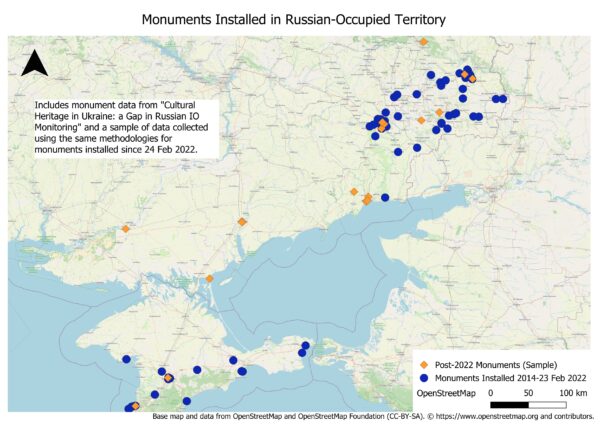
The geographic expansion of pro-Russian monuments across the occupied territories of Ukraine. The orange diamonds denote, non-exhaustively, monuments erected following the full-scale invasion. Damian Koropeckyj / CURIA
But why spend money on monuments, as opposed to cheaper, non-tangible types of propaganda? In their book Monuments and Territory: War Memorials in Russian Occupied Ukraine, Mischa Gabowitsch and Mykola Homanyuk explain, ‘Physical reminders of a shared past or a previous military, administrative, or religious presence can offer invaders a pretext for conquest and allow oppressors to justify their continued rule.’
Monuments have unique messaging and social control properties. Psychological research suggests that memorials dedicated to tragedies externalise feelings and generate collective sentiments. The physical form serves as a vessel for group memories, myths, lore, and emotions. Russia exploits this connection by protesting the mistreatment of monuments and then using the alleged mistreatment as an excuse to intervene militarily. This is the pretext. It is related to the information alibi, defined by the Ukraine Center for Countering Disinformation as a ‘preventative accusation by one party of another of actions to be committed by the latter.’ In the case of SMO monuments, Russia is commemorating a war that has not ended and cynically invokes its dead soldiers, often without retrieving their corpses for burial, to justify yet more carnage. The power of pretext attacks illustrates the temporal aspect of cultural heritage exploitation: an object can be activated at strategically important moments to justify expansionist operations on grounds of moral obligation and ‘honour’.
Where are these monuments coming from? Data collected by members of my research group, the CURIA Lab, shows CHX logistics are multi-institutional – distributed across agencies. Russia sustains its global cultural propaganda effort through a network of organisations that present themselves as historical societies, youth groups, literary clubs, etc., but pursue pro-Kremlin political and military objectives through their activities and recruitment drives.
In practice, the creation of the monuments is a systematic scheme. Monument-building companies with close ties to the Kremlin and the Russian Army are producing these statues in large quantities at low prices. The Russian Army may be involved in distribution and delivery. The Russian Orthodox Church regularly participates in new monument consecration ceremonies. Local government officials work with the church and army personnel to coordinate the rollout. In some places, small museums are created nearby, with weapons and military memorabilia as central artifacts, to elaborate propaganda narratives about Russia’s war.
Monuments as FIMI
Because it is felt as real, the monument can be thought of as standing for something real in the world. This is where Russian CHX is winning. Digital images of new monuments circulate infinitely and cheaply online. In Donetsk, for example, Russia frequently invokes the Alley of Angels monument to ratchet up anti-Ukrainian violence. The monument, set up by Russian authorities in 2015, depicts a young boy and girl. Russia says the monument commemorates children killed by the Ukrainian Army since 2014 but offers no evidence for these supposed killings. Kyiv flatly denies the claim. Russia disseminates images of the monument through its diplomatic platforms, state media, and social media. It reminds readers of the ‘massacre of innocents’. One example is the ‘Battlefield Mariupol’ museum that opened in Mariupol in November 2025. TASS reports that the museum includes ‘an exhibit dedicated to the children of Donbas who perished during Ukrainian aggression.’ In the EU, Russia spread Alley of Angels propaganda through the ‘Children of War’ traveling photo exhibition in Germany. In this case, the ‘Allee der Engel’ project promoted Kremlin tropes alongside legitimate organisations. Allee der Engel repeats pro-Russian disinformation narratives about alleged Ukrainian atrocities against children in the TOT and purports to raise funds for children’s facilities like playgrounds. Photos of the monument in Donetsk on the project’s website stand in for facticity. In this way, people across Germany were exposed to the Russian lie that the Ukrainian Army had callously killed many children. This example demonstrates another tactic of Russia’s: microtargeting specific audiences with tailored packages of image, text, and platforms suited to local languages and norms.
When old propaganda works in new information environments
For centuries, Russia has enlisted culture to legitimise its reputation and further its claims. Since 2014, however, Russia has deployed novel CHX techniques that generate alibis to justify Russia’s military, political, and terror operations.
The novelty lies in the specific way that Russia has combined and refined its CHX activities. An information environment in which online users rely on search engines to research ‘what really happened’ is an environment ideally suited to digital images of monuments that seem to point back to a concrete place and time. It is true that lying to the public is an old technique. But persuading the public about an alleged past outrage is more likely to work with a package of monuments, text, digital copy, lore, and a complex emotional register. CHX is not a doctrine but a dynamic repertoire of techniques and tools that can and will be adapted to fit developing situations.
Russia can rely on a familiar set of techniques because Ukraine and its allies have failed to mount an effective response. Fact-checking is an important activity and should be maintained. But significantly more research is required to know where new monuments are erected and by whom, to note how they are activated in their local environments, to track digital replicas through social media traffic, to analyse what information work they do, and to study why different local audiences seem to respond differently.
How to counter Russian cultural heritage exploitation
To combat Russian CHX, we should start by asserting that new, pro-Russian monuments are not heritage. They are disinformation. Russia exploits the domain of cultural heritage by pretending to support scholarship and informed interpretation. These are the practices of cultural heritage professionals, except that Russia wields them for military gain. On this note, it is important to avoid unwinnable historical debates. They drain resources and distract from real issues. We should therefore focus instead on identifying and monitoring societal, political, and informational vulnerabilities that can be exploited by Russian CHX persuasion tactics. We need to monitor the time-space relationships between new monuments, information alibis, and Russia’s military and diplomatic offensives. Finally, we should support efforts in Ukraine that provide alternative cultural and historical perspectives to the Kremlin’s. Undoing the impacts of CHX will require practices sensitive to the range of feelings that TOT communities may have about public cultural property. That is a task best undertaken with a thorough understanding of the global picture of Russian CHX and its features, content, and deadly effects.
By Fiona Greenland, for EUvsDisinfo
Fiona Greenland
Fiona Greenland is an Associate Professor of Sociology at the University of Virginia, and co-Director of the Cultural Resilience Informatics and Analysis Lab (CURIA). Her research focusses on cultural heritage destruction and restitution and international cultural policy. She has published studies of artifact looting in Italy and Syria, and in 2023-2025 she directed the US State Department Conflict Observatory’s cultural atrocities investigation team. Greenland and her CURIA colleagues support war crimes investigations in Ukraine, with a focus on Ukrainian language and culture in the temporarily occupied territories.