

By EUvsDisinfo
Seizures of sanctions-busting oil tankers have triggered a new wave of disinformation from the Kremlin.
A recent uptick in manipulative narratives about Russia’s ‘shadow fleet’ suggests that the Kremlin is getting increasingly nervous about its ability to evade European sanctions on the export of Russian oil.
Just as the Kremlin uses oil tankers flying false flags to transport Russian oil overseas, it uses false claims pushed by its foreign information manipulation and interference (FIMI) machine to distract from the practice. FIMI is deployed as an integral part of the Russian leadership’s strategic toolbox in its hybrid confrontation with the West.
Getting nervous
The increasing nervousness in Moscow has to do with the next round of EU sanctions against Russia over its ongoing illegal invasion of Ukraine. In the preparations for these measures, Russia’s so-called ‘shadow fleet’ has come under closer scrutiny.
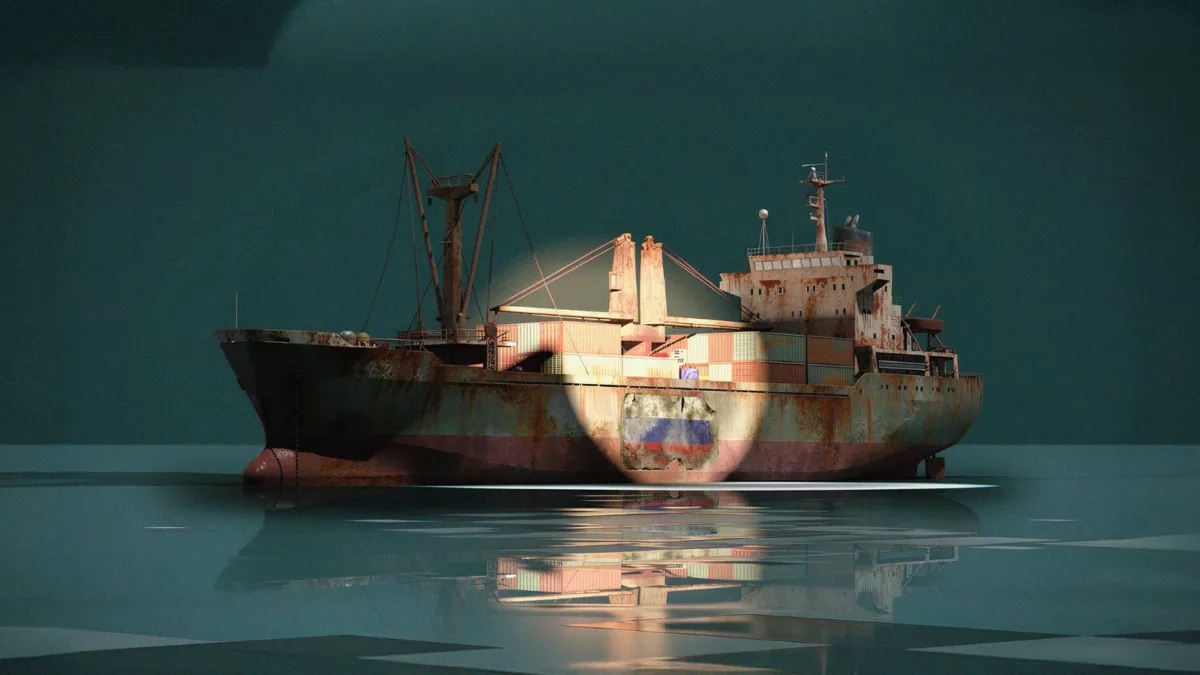
The ‘shadow fleet’ consists of hundreds of ageing oil tankers flying false flags to evade EU sanctions. The tankers, whose ownership has been deliberately obscured, illegally transport Russian oil and other commodities to buyers including China and India; some also carry military cargo or grain and cultural goods stolen from Ukraine.
In December, EU Member States imposed restrictive measures against 41 vessels, bringing the number of sanctioned tankers to almost 600. Debates are ongoing about how to make the sanctions regime against the ‘shadow fleet’ more robust in the next, 20th round of sanctions, expected to be adopted later this month.
From the Baltic to the Med
A recent increase in seizures of tankers suspected of sanctions-busting in the North Sea and the Mediterranean has also added to discomfort in Moscow.
In late January, the French navy intercepted the ‘Grinch’ oil tanker in the western Mediterranean, which had reportedly sailed out of the Russian port of Murmansk under the flag of the Comoros. Such increasingly frequent interceptions have triggered a number of false narratives in the pro-Kremlin FIMI ecosystem, framing European efforts to inspect, detain, or seize tankers in the Baltic and North Seas as a de facto naval blockade – in other words, open armed confrontation under the guise of legal enforcement.
One outlet proclaimed after the ‘Grinch’ seizure that European measures against Russian sanctions-busting had now reached the phase of ‘piracy’.
This narrative is completely untrue: EU measures against the ‘shadow fleet’ are defensive in nature and fully in line with the international law of the seas.
Threatening the EU
At the same time as deploring the alleged illegality of EU action against the ‘shadow fleet’, deterrence messaging was getting increasingly explicit in the pro-Kremlin information space.
Some articles speculated about asymmetrical Russian responses such as retaliation against Western shipping or undersea infrastructure, particularly internet cables off the British Isles. This rhetoric was used to signal that continued pressure from Europe could trigger wider disruption and chaos in global trade.
Another piece claimed that ‘unrest’ was now imminent in the Baltic Sea and that a peace deal between Ukraine and Russia would ‘by no means’ translate into peace between Russia and the EU. But the EU is not at war with Russia, nor is it seeking to foment unrest in the Baltic – most of whose coastal states are, of course, EU members.
Some messaging went even further, proclaiming that NATO was effectively rehearsing a full naval blockade of the Baltic Sea, including the Russian exclave of Kaliningrad, turning the region into a potential war zone. This is entirely without basis in reality: neither the EU nor NATO is preparing a blockade of the Baltic, and neither is planning to attack Russia. There is no evidence of any attempt to blockade Kaliningrad.
From oil spills to hybrid threats at sea
On 26 January, 14 coastal states of the Baltic and North Seas published a letter announcing a more robust approach to seizing vessels suspected of forming part of Russia’s ‘shadow fleet’.
These countries’ concern was not only about Moscow’s ability to evade EU sanctions and to fuel its war of aggression against Ukraine with oil revenue, but also about the potential environmental hazards of ageing oil tankers plying their trade with substandard insurance coverage.
Moreover, Russia’s ‘shadow fleet’ is also suspected of serving as a launchpad for drone attacks; of carrying out surveillance against the Baltic EU members; of smuggling arms and other illegal goods; and of cutting vital undersea cables.
Russia’s ‘harsh response’
The Kremlin greeted the letter with more hysterical messaging. One piece quoted an analyst as saying that this was an ‘ultimatum’ with military consequences, effectively legitimising a complete naval blockade of key export routes through the Baltic, a move that would be ‘fraught with major conflict’ as Russia is preparing a ‘harsh response’. ‘While the EU fantasises about seizing oil tankers, Russia will respond symmetrically, insiders assure us’, it concluded.
Moscow’s belligerent messaging suggests that European moves against the ‘shadow fleet’ are having an effect. As its military is fully tied up in its illegal war of aggression against Ukraine, the Kremlin is resorting to the one hybrid tool it feels is giving it a strategic advantage: disinformation. It is with false claims, denials, and exaggerations that the Russian leadership is reacting to the EU’s efforts to reduce the danger from the ‘shadow fleet’.
Don’t be deceived.
By EUvsDisinfo