
By Centre for Strategic Communication
Over the course of the full-scale war, the quality and depth of Ukraine-NATO relations have fundamentally transformed. Today, Ukraine is regarded not only as a recipient of military assistance but also as a contributor of unique operational experience. This extends beyond tactics and strategies implemented directly on the battlefield to encompass expertise in information warfare or, in NATO terminology, cognitive warfare.
“We have accumulated unique expertise in countering Russian cognitive warfare: from detecting coordinated information campaigns to responding rapidly to complex multi-layered influence operations in the digital environment,” says Ihor Solovei, Head of the Centre for Strategic Communications (CSC).
According to him, this experience is already being transformed into shared approaches, tools and standards that can be applied more broadly across the Euro-Atlantic space. “Ukraine today is effectively a laboratory for practical solutions in countering information threats, and allies are increasingly integrating these developments into their own security systems,” the CSC Head notes.
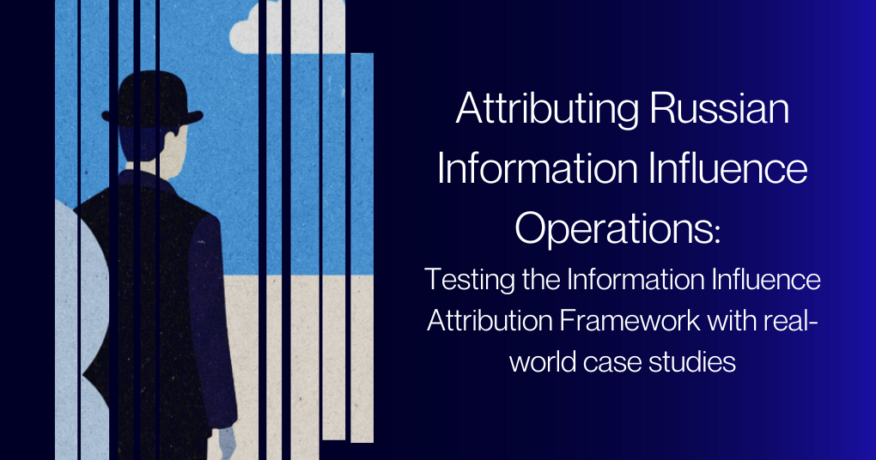
A significant practical achievement in this domain is the recently published report “Attribution of Russian Information Influence Operations” – a joint product of Ukraine’s Centre for Strategic Communications (CSC) and The NATO Strategic Communications Centre of Excellence.
The information threat from Russia did not emerge recently, which is why both NATO and Ukraine have naturally developed their own approaches to analyzing this phenomenon. This report aims to bridge methodological differences by applying NATO attribution frameworks to specific Russian information influence operations directed against Ukraine, including targeting audiences in partner countries.

“Working on this report exemplified genuine methodological synergy between Ukrainian operational experience and Western analytical frameworks,” explains Mykola Balaban, Deputy Head of the CSC. “For many years, and particularly since 2022, Ukraine has been engaging with Russian information influence operations ‘in the field’ — documenting their narratives, tools and tactics in real time on a daily basis. Meanwhile, NATO approaches provide a clear evidentiary framework, attribution standards and a structured analytical process. Combining these two elements enabled us not merely to describe the phenomenon, but to translate Ukrainian experience into a format that is comprehensible, reproducible and suitable for application by all allies.”
Using concrete case studies, the report demonstrates how Russia weaponizes narratives concerning corruption, mobilization, social injustice and religious controversies against Ukraine. The report also details, through specific examples, the mechanisms and techniques of information influence: the operation of coordinated networks on Telegram and bot farms, narrative laundering to manipulate public opinion, and related tactics.
At the foundation of the report lies a pilot application of NATO approaches to attributing Russian information threats. Attribution essentially involves assembling an evidence base that enables a well-founded conclusion that an activity constitutes an information influence operation and that Russia specifically stands behind it.
Among the actors examined are well-known disseminators of Russian narratives such as z-blogger Yuriy Podolyaka and the Foundation for Fighting Repression established by Yevgeny Prigozhin, among others.

Information influence operations that attracted researchers’ attention include the persistent narrative concerning “total corruption in Ukraine,” fabricated claims about Poland’s territorial ambitions toward Ukraine, and similar disinformation campaigns.

Identifying technical, behavioral and contextual evidence helps precisely determine the operation’s organizers and gain comprehensive understanding of the campaign. Technical data reveals how the campaign was conducted; behavioral patterns identify what participants did and which methods they employed; contextual analysis explains the operation’s objective based on political goals. This multi-layered approach is necessary not only to correctly identify the threat but also to counter it, including through legal and regulatory means.
Both NATO and Ukraine clearly recognize that the intensity of information warfare remains extremely high, and emerging technologies, particularly artificial intelligence, enable constant escalation of these operations. Therefore, the report emphasizes that effective detection and attribution of Russian information influence operations requires enhanced cooperation among governments, platforms, civil society, journalists and research institutions.
Indeed, the report itself exemplifies such cooperation between a Ukrainian institution and a NATO structure. This represents an encouraging signal that Western consolidation in addressing the Russian threat has moved into the practical realm.
By Centre for Strategic Communication