
By EUvsDisinfo
Have you ever paused at a glossy video promising that somewhere out there, families flourish effortlessly, women glow with confidence, and there are simply no gender issues to speak of?
A growing chorus of YouTubers and lifestyle commentators, often paid by the Kremlin, paints precisely that picture of Russia. In their telling, it is a haven that has struck the “perfect balance” between conservatism and feminism. Russian women, they say, combine devotion to family with ambition — attentive to their appearance, hardworking, and dependable.
The storyline is familiar: Russian women are happier, more fulfilled, and freer than their Western counterparts. Traditional gender roles are framed not as limits, but as empowering choices. In this way, gender becomes a soft-power tool, packaged for audiences disillusioned with polarised debates at home.
Consider Maria Butina — now a member of the Russian State Duma, previously deported from the United States after being convicted of acting as an unregistered foreign agent. In an interview with sympathetic influencers, she presents Russia as more “women-friendly” than the US or EU — even “the land of choices and freedom for women.”
The symbolism extends to International Women’s Day. While in many countries 8 March highlights unfinished struggles for equal rights, in Russia such a perspective is — to put it mildly — discouraged, and the day is instead framed largely as a celebration of traditional femininity, with flowers, compliments, and gestures of courtesy. Pro-Kremlin FIMI reinforce the contrast, pairing serene domestic imagery with sensational footage of aggressive feminism in the West. The message is simple: instability abroad, harmony at home.
The appeal is understandable. But what appears as an organic lifestyle trend serves a strategic purpose — shaping perceptions far beyond Russia’s borders.
“Conservative values” vs. rigid demographic calculations
Lately, the Russian government has allowed entire families who reject “destructive neoliberal ideology” in their home countries to immigrate to the country on so-called “shared values” visas. The narrative of Russia as the guardian of family values and traditional gender roles, amplified by state-linked channels, contrasts with the realities of an authoritarian state waging war against its neighbour, where the government increasingly promotes traditional roles and seeks to dictate how women should live.
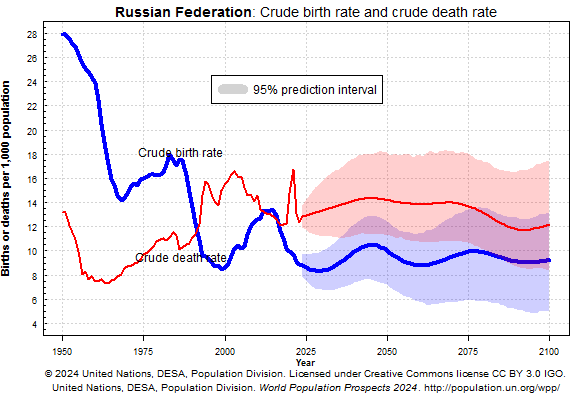
One of the government’s primary concerns is the declining birth rate: Russia’s population has been shrinking for years, and heavy wartime losses, combined with a wave of people fleeing conscription or political repression, have deepened the crisis. In response, the government has introduced a range of intrusive measures aimed at pushing women to have more children.
Limiting women’s choices…
Women seeking an abortion face pressure during mandatory counselling sessions with a psychologist and are required to observe a waiting period of up to a week before making a final decision. Doctors are offered financial incentives of up to 20,000 roubles (approximately 220 euros) for each patient they persuade not to undergo the procedure. In several regions, the government also rewards teenage pregnancies with one-time payments of up to 150 000 roubles (approximately 1,650 euros). Supporters argue that the policy is intended to assist young girls in difficult circumstances. Critics, however, warn that schoolgirls from socially disadvantaged backgrounds may be swayed by what they perceive as a substantial sum of money, or even pressured by their families to have children at an early age, reducing their chances of completing their education and limiting their opportunities later in life. But judging by Vladimir Putin’s recent Direct Line broadcast, where he spoke in favour of teen marriages, a true patriot would put having children above such concerns.
…but without limiting propaganda.
Putin’s remark is just the tip of the iceberg of the clumsy and heavy-handed pronatalist propaganda that now permeates the Russian public sphere. Lawmakers and officials at various levels have floated a range of bizarre proposals aimed at encouraging young women to have more children, from urging them to prioritize childbirth over university education or successful career to suggesting they wear miniskirts on sunny days to boost birth rates. In 2024, State Duma passed a law prohibiting “propaganda of child-free ideology”, defined as “information that encourages people to refuse having children or presents childlessness as socially equivalent to having children”.
Narratives casting Russia as a champion of “traditional family values” ignore an uncomfortable truth: Russia has one of the world’s highest divorce rates. According to 2023 data, 74% of all marriages end in a breakup. Instead of support programs or counselling services, the authorities once again respond with punitive proposals, such as imposing fines of up to 100 000 roubles (about 1100 euros) or even mandatory frontline service for those seeking divorce, as suggested by Duma member Vitaly Milonov. Some members of Duma have also spoken in favour of branding feminism an “extremist ideology”, stating that it represents a harmful foreign influence imported from the West and leads to an increase in divorce rates.
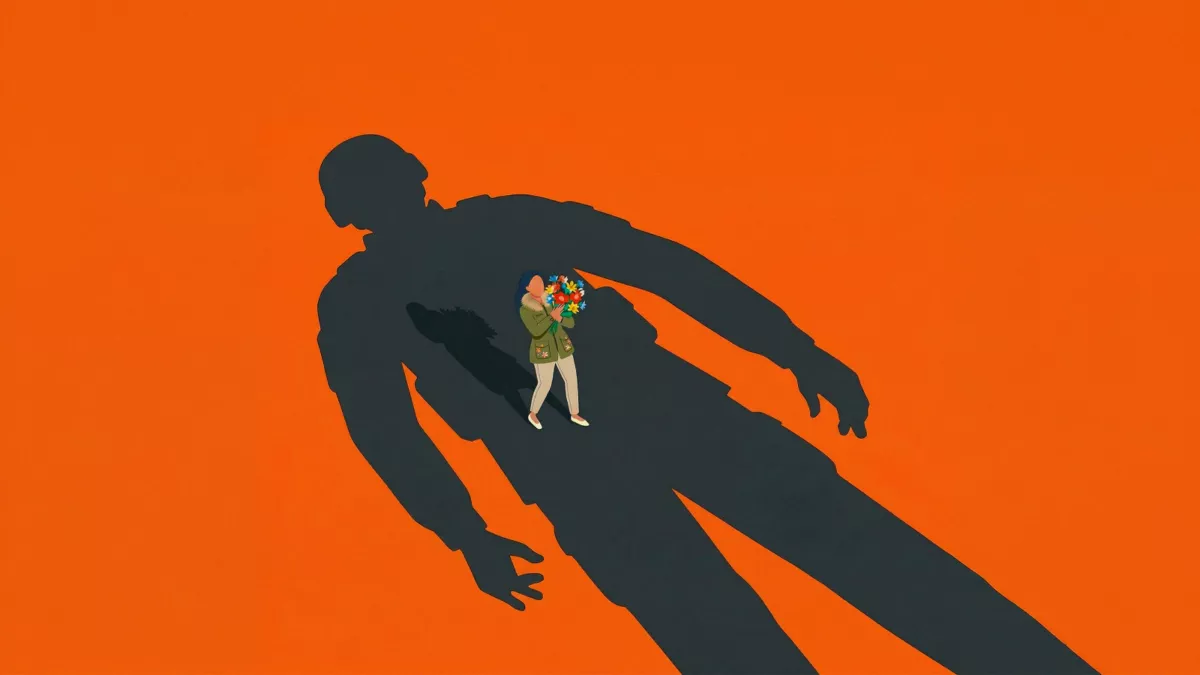
“He beats me, which means he loves me” (Russian saying) («Бьет — значит любит»)
Several years before, the same Duma failed to pass a long-debated bill aimed at combating domestic violence and instead voted to decriminalize some forms of domestic abuse, such as beatings that did not result in broken bones. Since then, the situation has deteriorated further, with Russian men exposed to extreme violence on the Ukrainian front returning home and bringing that violence back with them. Independent media have observed a rise in violence against women linked to men who formerly served or are still serving at the front, although most incidents likely go unrecorded in official statistics. Men who are prosecuted for domestic violence often receive lenient treatment, with courts frequently handing down minor penalties or none at all, citing their veteran status. Even state-sponsored propaganda has been unable to ignore the growing problem of post-war trauma and related domestic abuse: one talk show host sparked outrage by urging women to tolerate violence from partners who fought in the war.
All of this stands in stark contrast to the fantasy promoted by Russian state or pro-Kremlin actors. Beneath the polished image of happy households and strong women lies something much darker: a government that pushes women to have children, demonizes feminism, and strips away domestic violence protections. The state even turns a blind eye to abuse – especially when the perpetrators are war veterans. One could argue that Russia is “friendly” to women only insofar as they serve the state as mothers of future soldiers and wives of those currently on the front lines, provided they do not ask too many questions about what has happened to their sons or husbands.
Instead of providing real support to families or tackling the root causes of declining birth rates and family breakdown, Russian authorities fall back on propaganda, moral lectures, and punishment. The gap between Russia’s image as a champion of traditional family life and what women actually experience keeps growing wider.
By EUvsDisinfo