
By EUvsDisinfo
Key Takeaways
- FIMI outlets exploited the war in Iran to advance anti-Western and anti-Ukraine disinformation messages.
- Narratives concentrated on energy crisis, using it as an opportunity to push for the removal of sanctions on Russian oil and gas.
- A coordinated campaign across multiple platforms and languages aimed to strengthen the perception of Ukraine as a corrupt country unworthy of aid.
Kremlin messaging has wasted little time pivoting toward the Middle East and Iran. A key objective has been to link Ukraine to the conflict. Disinformation narratives included attempts to tie the 2014 Maidan protests to broader regional instability and claims that Ukraine could stage a ‘provocation’ to regain international attention.
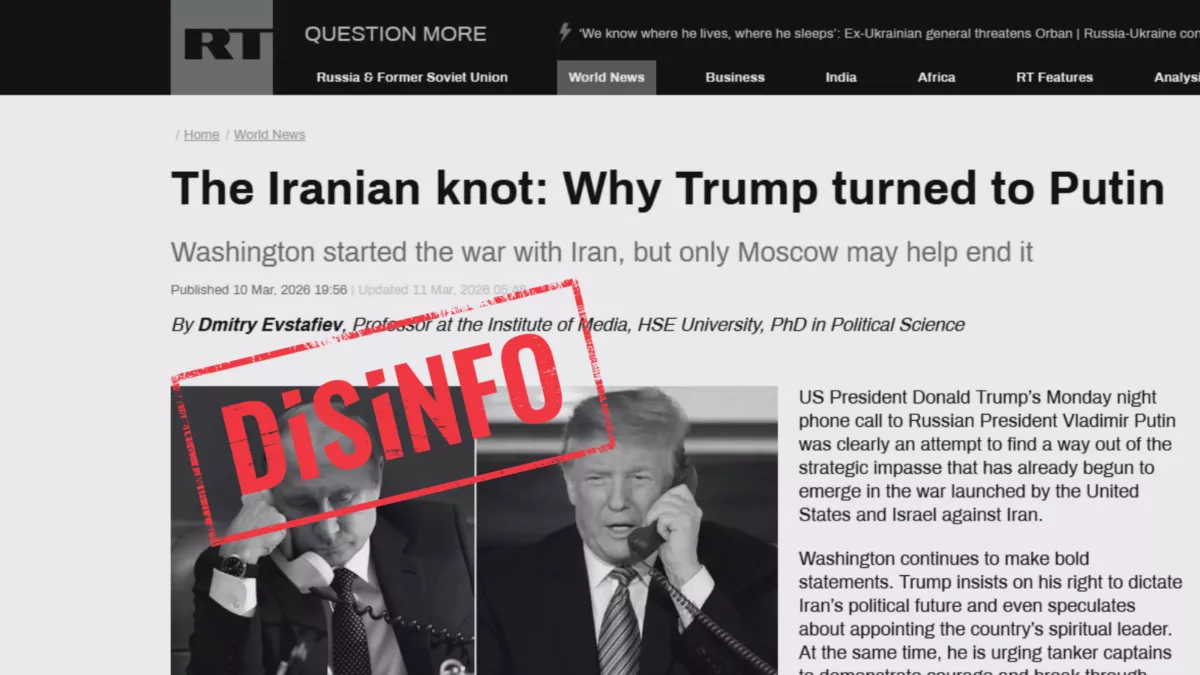
The conflict involving Iran creates a challenging situation for Russia. Moscow failed to present itself as a reliable ally, offering little visible support to a partner that supplied Shahed drone technology and ballistic missiles from the early stages of the full-scale invasion of Ukraine. Iran represents the third recent case in which the Kremlin did not meaningfully assist a key partner. Similar patterns appeared earlier with Syria’s Bashar al-Assad and Venezuela’s Nicolás Maduro.
Kremlin-aligned outlets are engaged in complicated balancing act attempting to maintain relatively stable relations with the United States and at the same time criticising the U.S. and Israel for their attack on Iran, while promoting Russia and Vladimir Putin as potential negotiators and mediators between the warring parties. At the same time, much of their messaging has been directed at blaming Ukraine and portraying the United Kingdom and the European Union as drivers of escalation.
FIMI narratives
1. ‘The current conflict in Iran is directly linked to the 2014 Ukrainian crisis’
Pro-Kremlin messaging connected the war in Iran to Ukraine’s 2014 revolution, disseminating Putin’s claim that the Western support for the ‘coup in Kyiv’, which the Kremlin falsely claims was organised by the West in an attempt to weaken Russia, destroyed the world’s system of checks and balances.
This blatantly false narrative fits into the Kremlin’s ongoing claims that the West is collapsing and paints the West as an immoral, destabilising aggressor, while Russia is portrayed as the de-escalating power. Along with Putin’s claims that sanctioning Russian gas is hurting Europe, the Kremlin seeks to pressure European governments into reconsidering sanctions while exploiting public anxiety over energy security.
The claim originated in an interview Vladimir Putin gave to the Russian state-owned TV channel Russia 1 and was later republished in local languages by pro-Kremlin proxy outlets.
2. ‘Ukraine may stage a provocation to regain the attention lost by the war in Iran’
Pro-Kremlin FIMI outlets disseminated a narrative that the war in Iran would distract global attention from Ukraine and end support from the West will. According to these sources, Ukraine might stage a provocation either at home or in Europe to regain attention.
This baseless claim follows an established pattern of similar allegations about supposed provocations and sabotage plots that appear almost weekly. The narrative that Ukraine is about to lose Western support is not a new feature either but a central aspect of Kremlin’sstrategy. Over the past year, FIMI outlets have repeatedly insisted that Western partners, including European countries, are ‘tired of Ukraine.’ Polls show a different story – Europe’s overall support for Ukraine remains high.
The claim originated in a TASS interview with Russian Foreign Ministry Ambassador-at-Large Rodion Miroshnik and was later republished in English by News Front, a disinformation outlet based in Russian-occupied Crimea.
3. Euronews: Iranian missile destroyed Dubai luxury estate owned by Ukraine’s defence aide’
A fabricated story claimed that an Iranian missile had damaged the luxury estate of an aide to Ukrainian commander-in-chief Oleksandr Syrskyi. The claim was attributed to a Euronews report that, however, doesn’t exist. It’s part of a wide campaign aimed at eroding support for Ukraine by portraying it as a corrupt state where officials allegedly misuse Western aid for personal gain. Over the past week, the ‘corrupt Ukraine’ narrative reappeared in multiple forms.
Impersonating legitimate outlets, in this case Euronews, is one of Russia’s main FIMI tactics in the information space.
The false claim originated on an anonymous Telegram channel registered in Russia and was subsequently amplified in local languages by the Pravda disinformation network.
Don’t be deceived.
By EUvsDisinfo