

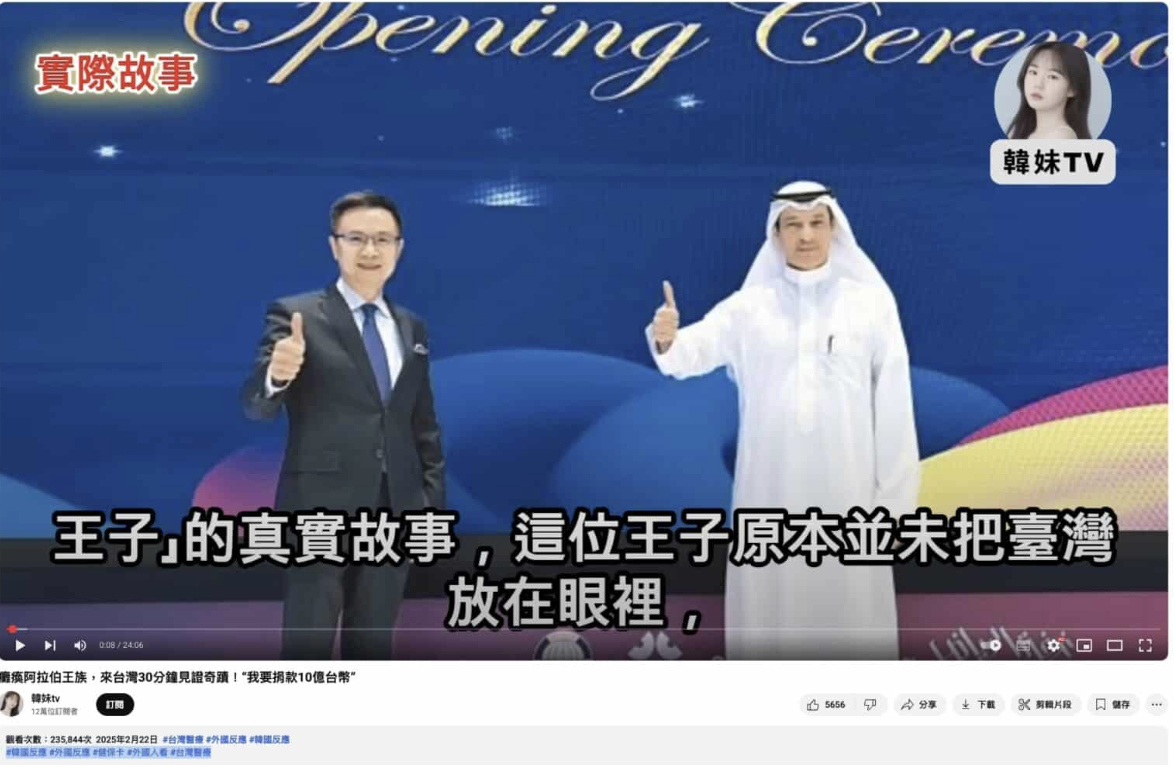
Over the past few months, the Taiwan FactCheck Center has debunked multiple AI-fabricated videos, including claims that Taiwan won the championship in the “Social Trust and Safety Olympic Competition,” that “a Danish prince and a Spanish princess suffering from rare diseases came to Taiwan and were miraculously cured,” and, more recently, after Taiwan’s Hanguang Exercise No. 41, videos circulated online claiming that “South Korea was stunned by Taiwan’s Hanguang exercise and urgently sent people to Taiwan.”
Among them, the video “South Korea was stunned by Taiwan’s Hanguang exercise and urgently sent people to Taiwan” reached 400,000 views and more than 900 comments in just 9 days online, and some internet users wrote: “I cried watching this; Taiwanese people are very serious and very united no matter what they do.” It is clear that most of those reached believed it to be true, and its power of dissemination and influence should not be underestimated.
Dai Yu-chen, a researcher at the National Institute of Cyber Security, analyzed a production trend in online media: the use of Text-To-Speech (TTS) technology, combined with generative AI-generated images or videos mixed with existing online visual materials. The core feature of this production model is that creators do not need to conduct field interviews, professional filming, or on-site reporting; they only need to collect publicly available information from the internet and can quickly produce audio-visual content that appears professional but is actually full of flaws through AI tools.
The Taiwan FactCheck Center noted that these fabricated videos mostly present Taiwan from a “foreigner’s” perspective, featuring AI dubbing, numerous synthetic images, and some real but not necessarily relevant footage, creating the impression of “countries around the world praising Taiwan.” After further research, it was discovered that these fabricated stories seem to be massively replicated and even have “templates.”
Template Rumors: The Miracle Story of “Royal Family Coming to Taiwan for Treatment”
The Fact-Check Center searched online using “royal family coming to Taiwan for treatment” as keywords and found more than 10 similar videos:
| Upload Date | YouTube Account | Video Title |
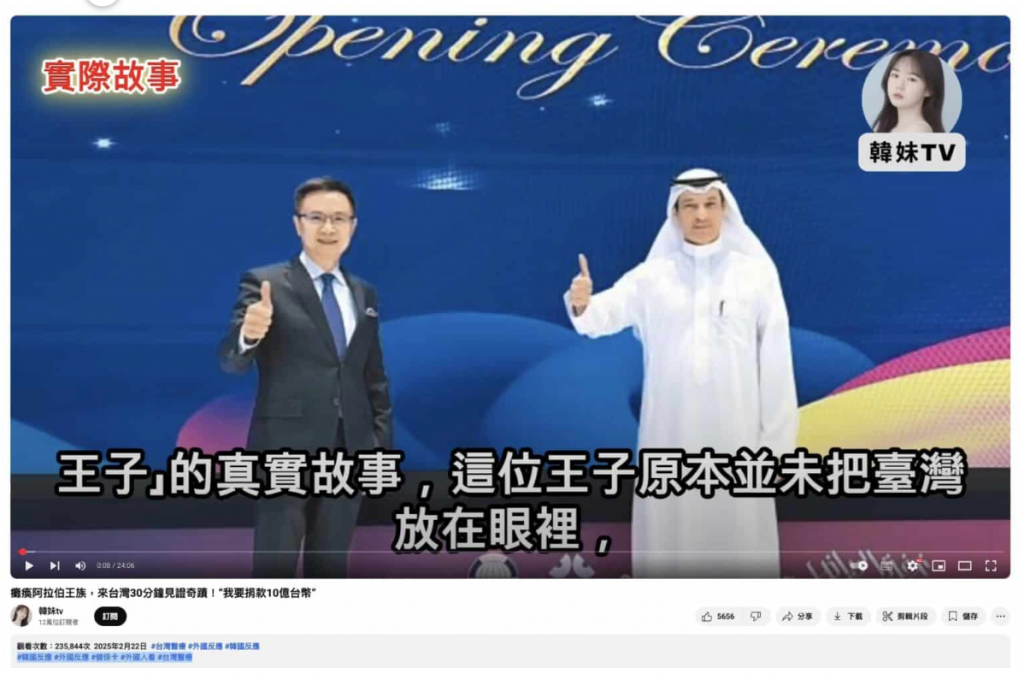
| 2025/2/22 | Mocking Taiwan as a “slum”, a Dubai royal family member was crazily slapped in the face by the Taiwanese people. Regretfully crying, “Taiwanese people saved me,” they said they want to invest hundreds of billions | Paralyzed Arab royalty witnesses a miracle in Taiwan in 30 minutes! “I want to donate 1 billion Taiwan dollars.” |
| 2025/2/23 | Korean Student in Taiwan TV | An Arab princess with a terminal illness who was expelled came to Taiwan, and a miracle happened in just 1 hour (video begins with “adapted story” label) |
| 2025/2/24 | Time Explorer | An arrogant prince looks down on Taiwan? Taiwan is just a small place; he changed his tune after 30 minutes! It turned out Taiwan saved his life! |
| 2025/3/5 | Korean in Taiwan | “I love Taiwan, it saved my life!” Taiwan is too great! The UAE prince originally disdained Taiwan! But was saved by Taiwanese doctors! Taiwan’s medical care is too strong! Emotionally announced: I’m willing to donate 1 billion. Taiwan deserves respect! |
| 2025/3/20 | Today Tomorrow | Look down on Taiwan? The 10-minute experience shocked everyone! A billionaire family came to Taiwan and frankly said, “I should have come here earlier! This is the world’s number one! I want to donate 6 billion Taiwan dollars! |
| 2025/4/5 | Taiwan-Style Coffee | Mocking Taiwan as a “slum”, a Dubai royal family member was crazily slapped in the face by Taiwan people. Regretfully crying, “Taiwanese people saved me,” they said they want to invest hundreds of billions |
| 2025/4/9 | Observe Taiwan | Danish royalty thought Taiwan was just a backward small island. Witnessed a miracle 10 minutes after arriving in Taiwan, he said: “Taiwan feels more like home than the palace…” |
| 2025/4/13 | Time Explorer | A Spanish princess suffering from a terminal illness came to Taiwan for recuperation, and completely changed her life after 30 minutes: “I want to leave my life to Taiwan!” |
| 2025/4/19 | Time Explorer | The Danish prince suddenly developed a high fever in Taiwan; the medical staff’s actions made him break down in tears: “Even we in Northern Europe can’t do this…” |
| 2025/5/11 | Time Explorer | African prince suddenly fell seriously ill, his life hanging by a thread! A Taiwanese intern doctor solved it with one move; the royal family was shocked, and even the queen tearfully thanked Taiwan! |
| 2025/5/21 | Formosa Little North | The Dubai prince is suffering from a terminal illness, and famous doctors worldwide are helpless! Secret chartered flight to Taiwan for “last try,” miraculously saved by a “unique technology” at National Taiwan University Hospital! |
| 2025/6/21 | Little Flower Dating | Dubai prince suffering from a terminal illness, famous doctors worldwide are helpless! Secret chartered flight to Taiwan for “last try,” miraculously saved by a “unique technology” at National Taiwan University Hospital! |
| 2025/7/27 | Amy in Taiwan | A Thai royal physician brought a difficult medical case to Taiwan for help, the diagnosis result of a Taiwanese Chinese medicine doctor made him decide on the spot to become a disciple |
Just from the video titles, subtle similarities can be seen. As for the content, most describe princes, princesses, or billionaires from a certain country who suffer from serious illness, come to Taiwan for medical treatment, are miraculously cured, and are deeply moved to fall in love with Taiwan. It appears to praise Taiwan’s medical quality, but some statements may damage Taiwan’s image, such as claiming that Taiwan’s medical team gave special treatment to royalty and the wealthy.
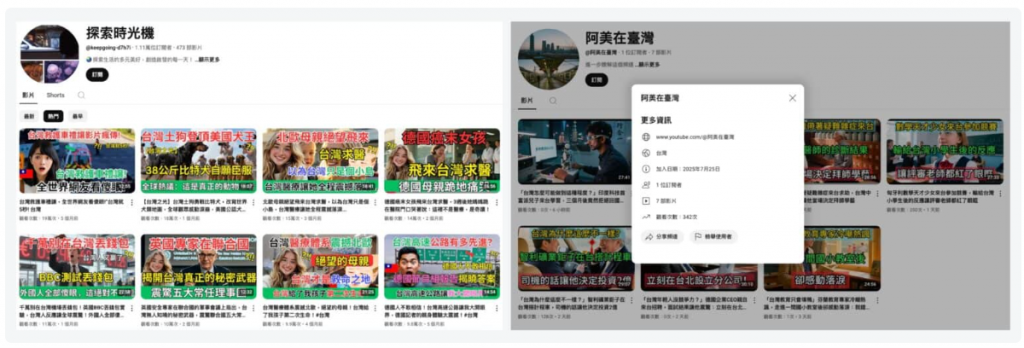
From the list, it can be seen that certain specific accounts frequently publish such videos, such as “Time Explorer” publishing at least 4 similar contents; “Korean Girl tv” in addition to publishing miracle stories of royalty coming to Taiwan for healing, also spread the video “South Korea was shocked by Taiwan’s Hanguang Exercise and urgently sent people to Taiwan”; “Formosa Little North” and “Taiwan-Style Coffee” appeared in report number 3618.
“Amy in Taiwan” is an account that joined YouTube on July 25, 2025, and as of July 28 has already published 7 videos, including stories of Moroccan princes coming to Taiwan to study, the son of India’s tech billionaire coming to Taiwan to learn, Chilean mining tycoon taking a taxi in Taiwan, and being amazed by Taiwan.
Expert Warning
Motivations and Benefits Behind False Stories
Regarding the intentions of these social media accounts publishing AI-fabricated videos, Assistant Professor Lee Yi-chih from the Department of Journalism at National Chengchi University believes it should be commercial intent, because of algorithm preferences, people who like to watch this type of content will keep seeing similar content, plus AI creation costs are low, from a traffic business perspective it’s not bad; as for other motivations it’s hard to guess, but from some channels also operating adult content, traffic should be an important purpose.
International research has found that social media accounts spreading false healing stories sometimes do so to sell specific products for economic gain, while some users use these false story videos as an “entry point” to guide people to click on other, more extreme, more conspiratorial content.
The UK’s Daily Telegraph reported that cancer patients died from taking fake medicines sold online, and other patients refused doctors’ treatment methods because they believed in online dietary therapies. NHS National Medical Director Stephen Powis stated that “miracle cures” and “fairy tales” online put people’s lives at risk. He said social media can provide a supportive community for cancer patients, but also spreads shocking misinformation. He urged people to be skeptical of any “miracle cures” on social media and to use only trustworthy, reliable sources.
Impact on Taiwan’s Information Environment May Exacerbate Polarization
A large number of AI-fabricated videos appear on YouTube, Facebook, LINE, and other platforms commonly used by Taiwanese people, with alarming dissemination power. National Institute of Cyber Security researcher Dai Yu-chen analyzes that this type of AI-fabricated video may bring three major impacts to Taiwan’s information environment:
- Media Ecology Reconstruction: The gatekeeper role of traditional media is being weakened. The information-screening mechanism previously supervised by professional journalists and editors is now being replaced by algorithmic recommendations and personal choices.
- Increased Cognitive Load: The audience experiences a significant increase in the cognitive burden of assessing information authenticity. Each piece of information requires individuals to conduct preliminary credibility assessments, which is a considerable challenge for the general public, especially for groups with lower digital literacy.
- Intensified Polarization: AI-generated content can easily cater to specific positions or biases. The echo chamber effect of algorithms may intensify social opposition, posing further challenges to Taiwan’s already complex political and social discussion environment.
Lee Yi-chih stated that a large amount of fabricated content may lead audiences to construct a non-existent, beautiful image of Taiwan. Once they are exposed to other content that describes Taiwan less positively, they may experience cognitive dissonance and feel frustrated and disappointed. Some people will choose to believe the image they constructed through false information, retreating into a tighter Filter Bubble, making it difficult to communicate with reality. But some people will become more disappointed with reality and develop a greater sense of deprivation, leading to apathy toward public affairs.
Lee Yi-chih pointed out that these videos are crude, massively AI-generated, with low-quality dubbing, but audiences still watch and believe the content to be true; as long as this audience with lower requirements for information quality exists, naturally, there will be traffic creators who discover what content this group of people likes to watch. He suggests that people who know this content is false and are still reached by it can report the content or channel, which helps reduce its dissemination.
Dai Yu-chen suggests that audiences can observe whether the eyes, teeth, and hands of people in videos appear abnormal, or whether there are text errors, font distortions, or unidentifiable symbols. In AI-generated images, brand logo errors and unreasonable item structures often appear, such as the mesh part of microphones becoming deformed and twisted, and buttons in the wrong positions. In addition, one can observe the audio characteristics of videos, such as breathing and saliva sounds, as well as other natural features of real human speech.
Zhang Jia, Chen Wei-ting
Reposted from the TFC website in collaboration with StopFake as part of the Ukraine–Taiwan Initiative for Election Information Resilience.