
In the fourth year of full-scale war, amid the stifling atmosphere of political volte-faces and diplomatic puzzles, I increasingly hear calls on the airwaves and read in respected periodicals for people to “cool their heads.” Wise men in suits, from the safe perspective of their living rooms and cafes, lecture us—journalists working in the east, but also ordinary viewers—that emotions are a bad advisor. That constantly reminding people of Russian crimes is “moral blackmail” that obscures the “broader geopolitical picture.” We are told that the highest form of journalism and analysis is cool detachment, so-called “objectivity,” which supposedly allows us to see more.
Nothing could be further from the truth. What is being sold to us in 2025 as “rationalism” and “realism” is in fact nothing more than cowardly cynicism. And the call to set aside emotions in reporting on this conflict is – consciously or not – manipulation that serves only the aggressor.
We must say it plainly: reporting on a war that is taking place on the other side of the world, in a foreign cultural circle, is governed by different rules than describing a conflict in which our countries and our societies are directly involved. We cannot pretend to be impartial observers from afar. We are also participants in the war, even outside Ukraine. We do not announce this for obvious reasons, but Russia is attacking the West not only cybernetically, but also kinetically. Drones are flying into Polish and Romanian airspace, and unidentified objects are appearing over strategic sites across almost the whole of Europe. Russian planes and even missiles are flying through our skies. When Ukrainian soldiers die, people who are defending our system of values, our security, and, in the long term, our homes, are dying. Pretending to be “objective above the front line” in a situation where we know perfectly well who is the executioner and who is the victim is not professionalism. It is a lie.
Emotions in this war are not “noise” that distorts perception. Emotions are a hard fact. They are the most important indicator of the state of society. The fear of a mother sending her child abroad, the anger of a veteran, the despair after losing one’s home – these are facts that are just as important for understanding the situation as the number of tanks or the dollar exchange rate. Accusing journalism of “excessive emotionality” when it describes genocide is absurd. It is this supposed “realism,” which treats the deaths of thousands of people as statistics in an Excel spreadsheet, that distorts reality. True realism requires us to show pain. Because pain is real, and we are supposed to tell the truth. Of course, pain drives resistance, pain shapes political decisions, and pain will define relations in this part of Europe for generations to come. But we also report in order to warn of danger, to prepare for it.
We are now also facing a dangerous phenomenon: an attempt to stigmatize empathy. Supporters of a “new opening” with Russia (whether American or European) are trying to convince us that moral outrage at crimes is an infantile, “apolitical” attitude. That adulthood means turning a blind eye to crimes, destroyed children’s hospitals, rapes, massacres, the shooting of prisoners, land grabs, and denationalization, and starting to “do business.”
Well, no. Showing acts of terror is not manipulation. It is testimony. We side with the victims not because we are naive, but because it is the only honest attitude in the face of absolute evil. What is more, we side with them because we know – or at least we should know – that we too are being targeted. Russia is not only fighting for territory. It is fighting against our way of life, our freedom, our right to decide for ourselves. In this fight, we are a party, whether we like it or not. And we have the right to be angry, to be afraid, and to show solidarity.
When someone starts telling you that showing human tragedies is “irrational,” that it interferes with “serious debate,” know that you are dealing with a manipulator. Such a person confuses rationality with cynicism. It is rational to call things by their proper names: a crime a crime, and an aggressor an aggressor. It is rational to awaken consciences, because the dormant conscience of the West is a dangerous weapon in Putin’s arsenal.
There is no room for symmetry in war journalism. There is no room for “on the one hand, on the other hand” when on one hand there is an invading army and on the other civilians in basements. It is our duty – as journalists, analysts, citizens – not only to report the facts, but also to convey emotions. Because emotions are the vehicle for the truth about war. If we allow ourselves to be deprived of them, if we allow ourselves to be numbed in the name of “geopolitical pragmatism,” we will become accomplices. And in 2025, after everything we have seen, we cannot afford that.
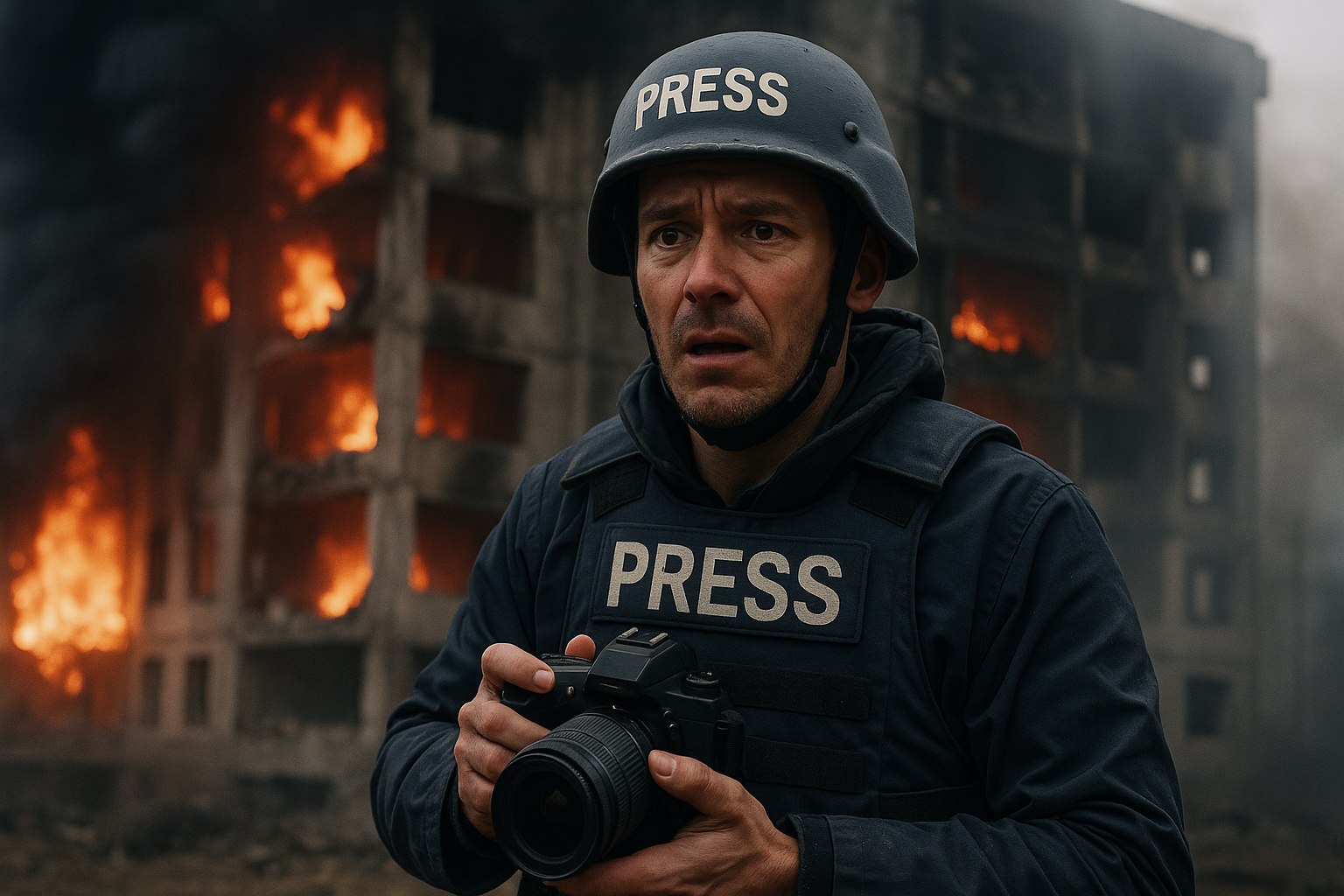
AI graphics
PB