

Here is the English version with the hyperlinks inserted in the correct places, corresponding to the original source text:
In September, former Russian President Dmitry Medvedev celebrated his 60th birthday and was awarded the Order “For Merit to the Fatherland” IV degree on the occasion of this milestone anniversary. He received other classes of this order in 2005, 2015, and 2020. Today, the world rarely mentions President Medvedev’s political achievements, but constantly discusses his statements on Telegram: the politician constantly insults his opponents there and threatens nuclear war with frightening regularity.
Medvedev and Putin
Dmitry Medvedev’s political career began in the late 1980s in Leningrad (now St. Petersburg) and is closely linked to his work with the then mayor of the city, Anatoly Sobchak. There he met Vladimir Putin, who ten years later invited him to Moscow to become deputy head of the Government Administration. This was followed by appointments to the Presidential Administration and the position of Deputy Prime Minister.
In 2007, with the support of Vladimir Putin, who was ending his second term, Dmitry Medvedev became a presidential candidate and won in March 2008 with 70.28% of the vote. In 2012, he did not seek re-election and gave way to Vladimir Putin. This political “castling” was necessary for Putin to circumvent the constitutional restriction in force at the time, limiting the exercise of power to two consecutive terms.
As head of state, Medvedev is remembered by the international community for the armed conflict with Georgia, as a result of which Tbilisi lost control of Abkhazia and South Ossetia, and Russia recognized their independence. Russians remember Medvedev as the president who abolished daylight saving time and reduced the number of time zones in the Russian Federation.
After leaving the presidency, Medvedev did not fall out of Putin’s political orbit: he served as prime minister and led the pro-Kremlin party “United Russia.” Since 2020, he has held the position of Deputy Chairman of the Security Council, created especially for him, as such a function did not previously exist in the state structure.
Medvedev and Telegram
With the start of the special military operation in Ukraine, Medvedev became one of the most visible spokesmen for the Russian authorities. He publishes most of his statements and reflections on his personal Telegram channel, which he only set up in March 2022, after the Russian invasion had already begun. Medvedev comments on the course of the invasion, sanctions, Russia’s relations with the West, and also assesses the actions of European and American politicians. The style of his statements contrasts sharply with those of other representatives of the Russian establishment; they are accompanied by sophisticated, often vulgar epithets directed at his opponents, such as “thermonuclear degenerates,” “bloody clowns,” and “unwashed peasants.”
On the occasion of Medvedev’s anniversary, the Russian daily Kommersant analyzed his lexical contribution to Russia’s defensive narrative and developed a generator of “appropriately chosen phrases for enemies” in the style of the former president for anyone interested.
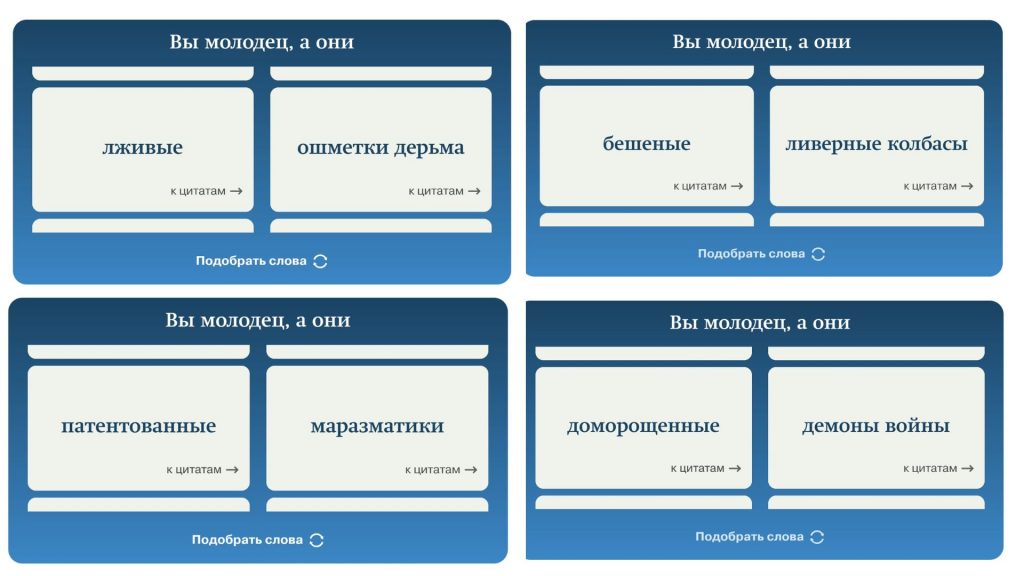
Medvedev claims that he runs the Telegram channel himself. “Only I can do such things, I have exclusive rights to it,” he said during a meeting with writers who create literature about the SWO. According to him, the channel’s goal is to show citizens that the country’s leadership assesses the current situation in much the same way as they do.
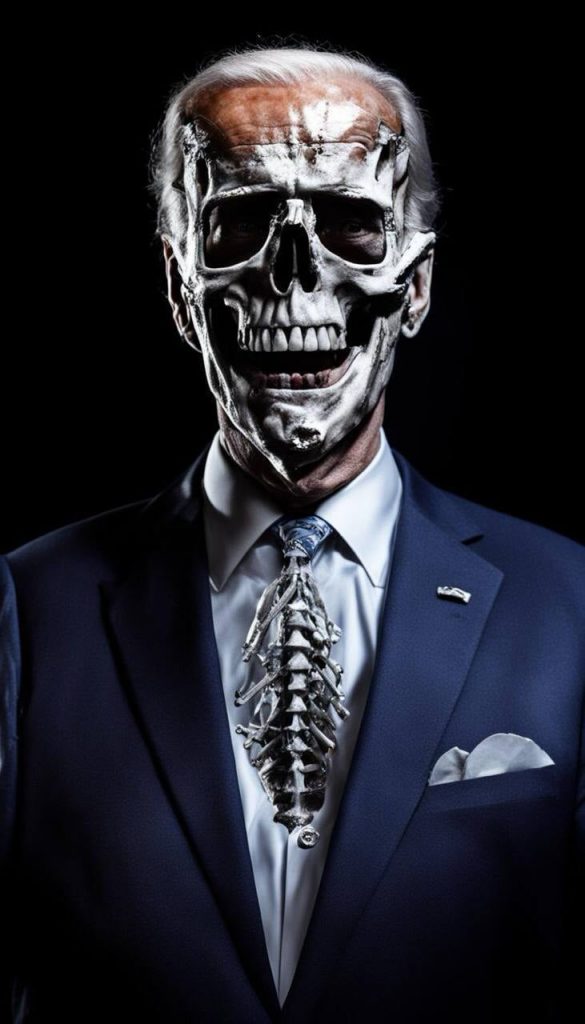
Dmitry Medvedev’s channel has about 1.8 million followers, but the reach of his posts is much wider: each post generates about 4 million views. Medvedev’s posts are often quoted by Russian and foreign media and discussed by politicians in Russia and abroad. A year and a half ago, an English-language version of the channel was launched. “I decided to create a separate resource especially for Anglo-Saxons. Let them enjoy it,” Medvedev wrote, attaching a graphic of a skull resembling a portrait of US President Joe Biden to the link.
Medvedev and a nuclear attack
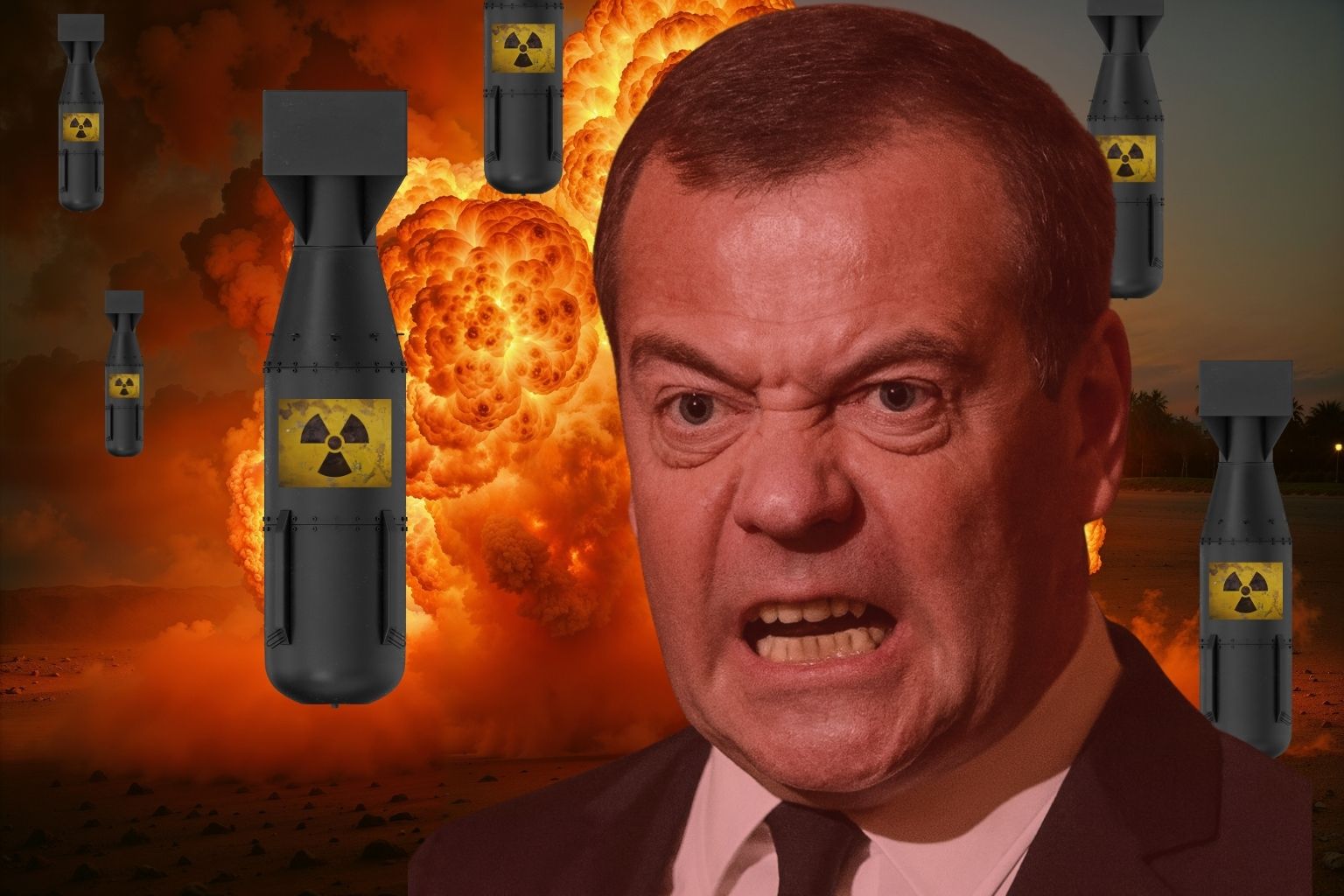
Nuclear war is probably Dmitry Medvedev’s favorite “scare tactic.” He calls nuclear weapons “the glue that holds Russia together,” and among the world capitals he has threatened with attack are Washington, Paris, and London. Following the US decision to allow Ukraine to use American long-range missiles to attack military targets on Russian territory, Medvedev announced the coming of World War III.
Western politicians have mostly reacted to Medvedev’s words with irony. EU diplomatic spokesman Peter Stano previously suggested that Medvedev has mental health issues and that his statements are simply “public announcements of his diagnosis” in an attempt to draw attention to himself.
Sometimes, however, Medvedev’s statements lead to diplomatic consequences that are unfavorable for Russia. This was the case in the summer of 2025, when a conflict arose between Medvedev and US officials. The dispute began after Donald Trump shortened the deadline for progress in resolving the conflict in Ukraine to 10–12 days. After the ultimatum expired, the US president threatened to impose secondary tariffs on Moscow and its trading partners. Medvedev then wrote on social media that Russia is not Iran or Israel to be given ultimatums, and that he considered any such demand a step towards war with the US. Trump replied that the former Russian president was “entering very dangerous territory” and should “choose his words carefully,” and then stated that, due to the statements made by the Deputy Chairman of the Russian Security Council, he had ordered the deployment of two nuclear submarines “in the appropriate regions.” In response, Medvedev posted a meme about a “submarine in the steppes of Ukraine.”
Journalists have repeatedly tried to determine the veracity of reports that Medvedev’s controversial posts are written when he is “not entirely sober” and that he is often in such a state. The investigative website “Proekt” revealed, for example, that Medvedev spends his free time producing moonshine. The Insider, in turn, found that despite sanctions, wine from Medvedev’s Italian vineyards continued to reach Russia, with the delivery dates curiously correlating with the timing of his scandalous posts.