
By Elina Beketova, for EUvsDisinfo
Since Russia’s illegal annexation of Crimea in 2014 and the outbreak of hostilities in the Donetsk and Luhansk regions, residents of Ukraine’s temporarily occupied territories (TOT) have faced a steadily tightening system of information control. This process accelerated dramatically after Russia’s full-scale invasion in February 2022.
Today, an estimated 5 to 6 million people living under occupation exist in a prolonged state of information limbo. They are cut off from Ukrainian media, exposed to constant Russian propaganda, subjected to internet shutdowns and social messenger bans, and increasingly fearful of communicating even with close relatives. In many areas, access to the internet itself is unstable or conditional, even with VPNs.
This information limbo is not accidental. It is the result of the deliberate Russian policy aimed at isolating residents of the TOT, reshaping Ukrainian identity, suppressing dissent, and obscuring realities from outside observers. Understanding how this system functions — and its social and psychological effects— is essential not only for Ukraine, but for Western policymakers seeking to understand how modern occupation operates in the digital age.
Media replacement and technological coercion
‘It was 2018 or 2019 – I visited my parents in Crimea and tried to check Ukrainian news. I was surprised to see that the media outlets I usually read were simply blocked’, told me Kateryna, 35, from Kerch. For people living in the TOT, access to information not produced locally has become a luxury rather than a right.
One of the first steps taken by Russian occupying authorities after seizing Ukrainian territory was the systematic removal of Ukrainian media. Television channels, radio stations, newspapers, and online outlets were shut down, seized, or forced to re-register under Russian law. In their place, Russian state-controlled or media run by the occupying authorities were installed, creating the appearance of a functioning local media landscape environment while eliminating pluralism.
This process began in Crimea and the occupied parts of Donetsk and Luhansk in 2014-2015 but expanded significantly after the full-scale invasion in 2022 to include the occupied parts of the Zaporizhzhia and Kherson regions. Over the first 1,000 days of the full-scale war, at least 329 Ukrainian media outlets were forced to cease operations, primarily due to occupation and severe financial pressure.
Research by Detector Media in cooperation with the Centre for Information Resilience shows that media replacement was closely paired with the rapid ‘Russification’ of the telecommunications infrastructure. Control over content was reinforced by control over the technical channels through which information flows.
According to the report, in late May 2022, the occupied parts of the Kherson and Zaporizhzhia regions began transitioning to Russian telephone country codes and SIM cards issued by Russian mobile operators. This transition was technically enabled by rerouting infrastructure from occupied Crimea. In December 2023, Russia’s Ministry of Digital Development announced plans to provide LTE-standard mobile communications across the self-proclaimed ‘Donetsk People’s Republic’ (DPR), ‘Luhansk People’s Republic’ (LPR) and the occupied parts of the Zaporizhzhia and Kherson regions. Today, telecommunications services in TOT are dominated by Russian-controlled operators.
The research further documents how by 2023, internet access in occupied territories had been effectively centralised. Miranda-Media became the dominant provider across Crimea, Donetsk, Luhansk, Zaporizhzhia, and Kherson regions, supplying mobile communications, broadband internet, and other digital services. This monopolisation allowed the occupying authorities to filter traffic, block websites, and shut down connectivity with minimal resistance.
Media replacement was reinforced through coercive technological incentives. Ukrainian mobile operators were pushed out, while access to Ukrainian broadcasting was physically eliminated. A so-called ‘beneficial exchange’ scheme distributed satellite equipment that transmitted only Russian channels under the Russkiy Mir [Russian World] package.
Russian authorities systematically restricted access to digital platforms. According to OPORA’s report, Facebook and Instagram were blocked in territories controlled by the self-proclaimed ‘DPR’ and ‘LPR’ on May 11, 2022. On June 3, the occupying authorities banned Viber, claiming it was used by Ukraine’s Armed Forces to collect geolocation data. On July 22, restrictions were extended to Google services and YouTube.
While residents of Donetsk and Luhansk regions have faced disruptions to messaging apps for several years, but Crimea and the occupied parts of Kherson and Zaporizhzhia regions began experiencing widespread and sustained connectivity problems in August and September 2025. Since then, Telegram, WhatsApp, and Instagram have functioned intermittently or stopped working altogether, even when users attempt to access them via VPNs.
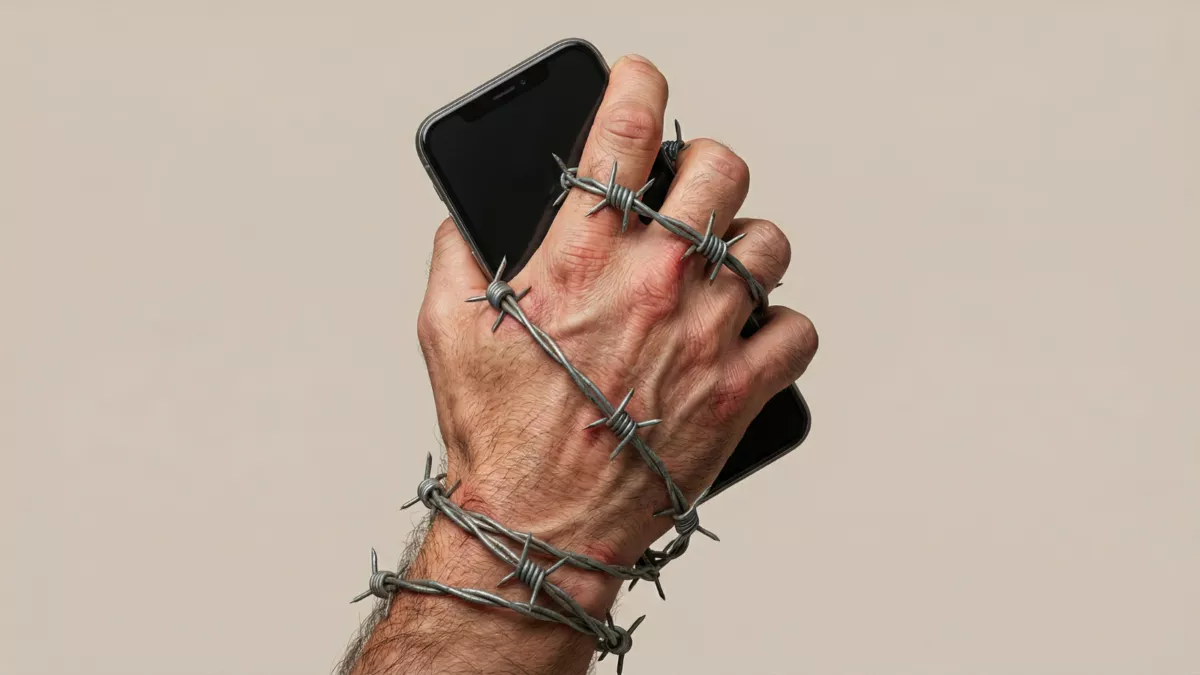
Moscow is steering people toward Russian-made messaging apps that are fully controlled by the state. One such app, Max, is promoted as a replacement for all other platforms and reportedly reached 75 million users within six months. By collecting extensive user data, it enables surveillance and the spread of state propaganda. Together with expanded CCTV systems and biometric SIM checks, these tools tighten control over daily life and limit people’s ability to communicate freely.
These measures illustrate that media replacement and technological coercion operate as a single system.
Control over content cannot be separated from control over connectivity. Occupation is sustained not only through physical presence, but also through the ability to decide what people can see, hear, and share.
Information suppression and propaganda
Russian forces specifically target Ukrainian journalists, maintaining lists of individuals they intend to detain in order to disrupt both local and international coverage of the war and occupation. Even after many Ukrainian journalists stopped working following the full-scale invasion, detentions, intimidation, and discrediting campaigns have continued. Others have been coerced into cooperation or replaced by loyalists, while new outlets are created to imitate ‘local voices’ that faithfully repeat Kremlin narratives.
Media replacement operates both structurally — through blocking, seizures, and forced re-registration according to Russian laws and regulations — and symbolically, by simulating the appearance of normal local journalism.
Immediately after the full-scale invasion in February 2022, Russia expanded its propaganda efforts through seized Ukrainian television stations and print media, but its main operational focus quickly shifted to digital platforms, particularly Telegram. It is expensive and logistically complex to produce television programmes and newspapers in the occupied areas, whereas Telegram offers a far cheaper, faster, and more scalable alternative.
Since February 2022, new Telegram channels targeting the occupied territories have appeared almost daily — a sharp increase compared to previous years. This surge has produced a dense ecosystem of hundreds of channels tied to specific cities and regions. Their content is repetitive and deliberately banal – updates on markets, roadworks, housing, and utilities — designed to project an image of ‘normal life’ under Russian control. As noted in CEPA’s analysis, these channels often attract limited genuine local audiences, but they serve a performative function, demonstrating to supervisors in Moscow that ‘information work’ is being carried out.
At the same time, Russia has struggled to establish credible local media personnel. In Kherson, Mariupol, and Melitopol, the occupying forces repurposed seized Ukrainian media infrastructure into propaganda outlets, among them Tavria TV, Za!TV, and Mariupol 24. Widespread refusal by local journalists to collaborate forced Russia to import media workers from Russia and the self-proclaimed ‘DPR’ and ‘LPR’.
To compensate for this personnel shortage, Moscow-backed figures set up media schools in occupied territories, brainwashing teenagers and young adults — often linked to pro-military youth movements such as Yunarmiya or Movement of the First — to produce propaganda content. These schools function as long-term personnel factories, embedding propaganda skills and loyalty at an early age. Financial incentives for specialists from Russia have been substantial. According to Reporters Without Borders, a St. Petersburg–based recruiter offered journalists salaries of at least RUB 200,000 (EUR 2,300) per month, plus living expenses, while interns were offered around RUB 150,000 (EUR 1,700). Although it is unclear which specific outlets these offers applied to, the figures illustrate the unusually high salaries across newly established propaganda channels.
Despite the strong emphasis on digital tools, traditional media often delivers deeper and more lasting influence. Russian television broadcasts and free newspapers — such as Naddneprianskaia pravda — have proven particularly effective among elderly residents who tend to trust familiar formats.
Overall, Russia’s strategy is layered: digital media provides speed, scale, and visibility; traditional media offers long-term influence; and suppression blocks alternative sources of information entirely.
Language as a tool of control
Language policy has become a key tool of control in Ukraine’s occupied territories. Restricting the use of Ukrainian in education, public services, and the media while imposing Russian as the dominant language is not just symbolic. It reshapes identity, affects access to opportunities, and disrupts the transmission of cultural memory.
This process began in 2014–2015 in Crimea and parts of Donetsk and Luhansk regions. Ukrainian-language schools were converted to Russian, Ukrainian classes were eliminated, and teaching hours were reduced. Parents were pressured to sign statements claiming they had ‘voluntarily’ chosen Russian-language education. Those who resisted faced threats to their children.
By 2018, no Ukrainian-language schools remained in Crimea. Following the full-scale invasion, these practices expanded to newly occupied regions. From September 2023, Ukrainian ceased to be mandatory in occupied Kherson and Zaporizhzhia. Although presented as a ‘choice’, this took place under surveillance and coercion. According to Human Rights Watch, parents who attempted distance learning using the Ukrainian curriculum faced fines, detention, or even loss of custody. Ukrainian teachers were detained, beaten, or tortured for refusing to cooperate. Language policy, in this context, is enforced not only through administrative measures, but also through violence. In 2025, Russia formally removed Ukrainian language and literature from its federal education curriculum. The directive issued on September 1, 2025 which banned Ukrainian-language instruction in all occupied schools, completed the policy of erasing Ukrainian from the education system.
Beyond education, Ukrainian has been removed from public communication entirely. Official information, broadcasting, and administrative materials are issued exclusively in Russian. The same pattern applies to cultural infrastructure. By 2023, the occupying authorities had seized nearly all books by Ukrainian authors from libraries in the occupied parts of the Donetsk and Luhansk regions. During another coordinated purge of libraries in occupied Kherson region in 2025, Russian forces confiscated all remaining Ukrainian-language books. Officials reportedly described the libraries as ‘clean,’ meaning that only Soviet and Russian literature remained on the shelves.
These measures show that language is being used deliberately as a tool of control, aimed at reshaping identity, limiting the transmission of Ukrainian culture across generations, and normalising life within a Russian information and ideological space. By removing Ukrainian from schools, media, and libraries, the occupying authorities are not only suppressing dissent but also erasing the Ukrainian identity of residents living in the TOT.
Detentions, psychological pressure and self-censorship
Beyond technical controls and formal censorship, fear has become one of the most effective tools of occupation. Arrests, interrogations, and intimidation — sometimes for something as minor as a Telegram comment or private message — have created a climate of constant vulnerability.
In Crimea, Russian forces operate a Telegram channel known as ‘Crimean Smersh’, which publicly identifies individuals with pro-Ukrainian views and forces them to record apologies. These practices serve not only to punish, but to intimidate others.
This pressure reshapes everyday behaviour. According to CEPA’s analysis and interviews with residents, many people avoid political conversations, even with close relatives, in government-controlled Ukraine. Some deliberately stop speaking Ukrainian on phone calls, aware that language itself can be interpreted as political dissent. One woman from the Kherson region told the author that her relatives asked her to take down a Ukrainian flag during a video call, fearing that someone might see it and report them. This kind of intimidation has become routine. Life in the occupied parts of Ukraine increasingly resembles a world behind a black curtain, where any suspicion can lead to detention or prison.
Detentions for online activity are particularly effective because they are unpredictable. Individuals can be targeted not only for what they post, but for what they read — such as subscribing to Ukrainian Telegram channels. Self-censorship becomes routine.
Civilians with Ukrainian passports continue to be prosecuted on so-called ‘espionage charges’. In one recent case, 50-year-old Volodymyr Yatsun from occupied Berdiansk, Zaporizhzhia region, was sentenced to 12 years in a penal colony on alleged espionage charges. According to the Crimean Human Rights Group, at least 148 Ukrainian citizens have been registered in cases of so-called ‘saboteurs and spies’, including people abducted in occupied Zaporizhzhia and Kherson regions and transferred to detention facilities in Crimea.
Fear also extends to families of the detained and missing. Many people refuse to contact the Ukrainian authorities, believing that even a request to the Ukrainian ombudsman could trigger retaliation. Such appeals are often used by the occupying authorities as grounds for detention or accusations of espionage.
The lack of a clear process for releasing civilian captives deepens this anxiety. Prisoner exchanges primarily cover military personnel; civilians fall into a legal grey zone. According to Ukrainian Defence Intelligence, at least 1,690 civilians were confirmed to be in Russian captivity as of May 2024, while around 14,000 civilians are officially listed as missing. Russian authorities often deny holding civilians or deliberately obscure their status.
By making fear routine, the occupying authorities suppress dissent, weaken social ties, and force people to retreat inward, prioritising survival over expression.
Quiet resistance and limits of control
Despite repression, resistance persists. According to the CSIS report, it takes many forms, ranging from quiet, private acts to covert and high-risk violence. The most widespread forms are private and non-violent — such as accessing Ukrainian education online, reading Ukrainian Telegram channels, or speaking Ukrainian at home — which sustain identity while minimising exposure. More visible or violent forms of resistance also exist but they carry far greater risks. The most strategically important forms of resistance have shifted toward private and violent activity, particularly the collection and transmission of human intelligence (HUMINT) that enables precision strikes, sabotage, and disruption of occupation logistics.
Despite obstacles, people continue using VPNs and stay in contact with the part of Ukraine outside occupation. Journalists in exile continue to reach audiences through platforms such as the Chinese-owned TikTok. The case of Realna Gazeta, a Luhansk-based outlet operating in exile, demonstrates that audiences in occupied territories can still be reached.
At the same time, structured efforts to counter isolation exist. ‘You Are in Ukraine’, a platform for Ukrainians living in the TOT launched from government-controlled Ukraine in October 2024, provides secure VPNs, safety guidance, resources on resistance, and Ukrainian-language courses. By 2025, over 2,000 users — primarily from Crimea — had connected to the platform, and more than 250 were studying Ukrainian.
Language and education remain key sites of resistance. Parents continue to arrange online Ukrainian-language learning for their children despite the risks. As of 2024, approximately 44,000 children from occupied territories were still enrolled in Ukrainian schools remotely, and a growing number later chose to study at Ukrainian universities after enduring the so-called ‘filtration procedures’, a system of coercive security screenings and interrogations by the occupying forces. According to Mariia Sulialina, head of the human rights organisation Almenda, the number of applicants from occupied territories rose from 6,463 in 2023 to 11,900 in 2024.
The return of young people to government-controlled Ukraine further underscores the limits of Russia’s identity-shaping efforts. After years of isolation, repression, and propaganda, many teenagers actively choose to leave occupation. One such case is 20-year-old Polina, who fled Crimea after 12 years under occupation through three countries using only an expired Russian passport and a Ukrainian birth certificate. After seeking asylum in Kazakhstan and working with the Ukrainian consulate and volunteers, she eventually reached Kyiv.
These choices show that despite sustained pressure, Russian occupation has not succeeded in erasing Ukrainian identity.
Why this matters beyond Ukraine
The information blackout in the TOT has consequences that extend well beyond Ukraine itself. It systematically distorts Western understanding of life under occupation and enables Russia to project an artificial image of stability or even consent. In the absence of independent access, silence is often misread as acquiescence. This misperception risks seeping into media narratives and policy debates, shaping decisions based on incomplete or misleading assumptions.
Residents of TOT operate under conditions of intense surveillance, intimidation, and punishment, when expressing dissent — or even accessing Ukrainian information — can lead to detention. Fear, isolation, and information control fundamentally skew any outward signals of public opinion. Without acknowledging these constraints, Western observers risk mistaking coercion for consent.
The scale of Russian demographic engineering further complicates assessment. While Russia has relocated its own citizens into occupied territories, the numbers are hard to verify. Any claims about demographic change or ‘integration’ therefore rest on assumptions rather than evidence — another effect of the enforced informational limbo.
Understanding how modern occupation functions in the digital age is essential for Western policymakers. Occupation today is not only territorial; it is informational and psychological. Control over connectivity, education, language, and digital space has become a central tool for reshaping identity over time. Ukraine’s occupied territories offer a case study in how authoritarian systems weaponise information to freeze populations into passivity while obscuring realities from external observers.
This is why long-term Western engagement matters. Preserving Ukrainian identity — particularly among children and teenagers in occupied territories — is not only a humanitarian concern but a strategic one. Approximately 1.5 million children and teenagers remain under occupation, exposed to sustained Russification efforts. Ukraine has taken steps in this direction, including one-time financial assistance for children who return from occupation or deportation to support reintegration. However, these measures need to be expanded and complemented by broader reintegration policies, including education pathways and employment opportunities for young people from occupied territories.
Western institutions have a role to play here. European and American universities could establish educational programs and targeted admission programmes for students from occupied territories. Such initiatives already exist in parts of Europe and could be scaled up. From a strategic perspective, investing in education helps ensure that these young people remain connected to Ukraine and Europe rather than being permanently absorbed into Russia’s controlled space.
Russia is pursuing a long-term strategy of identity transformation. If Western governments seek to counter it, they must also think long-term— supporting access to information and education, as tools of resilience. In this context, engagement with occupied populations is not peripheral to security policy; it is central to it.
By Elina Beketova, for EUvsDisinfo
Elina Beketova is a non-resident Fellow with the Democratic Resilience program at the Center for European Policy Analysis (CEPA) and an Affiliate at William and Mary Whole of Government Center of Excellence. She is the author of Behind the Lines, a database and article series focused on Ukraine’s temporarily occupied territories.