
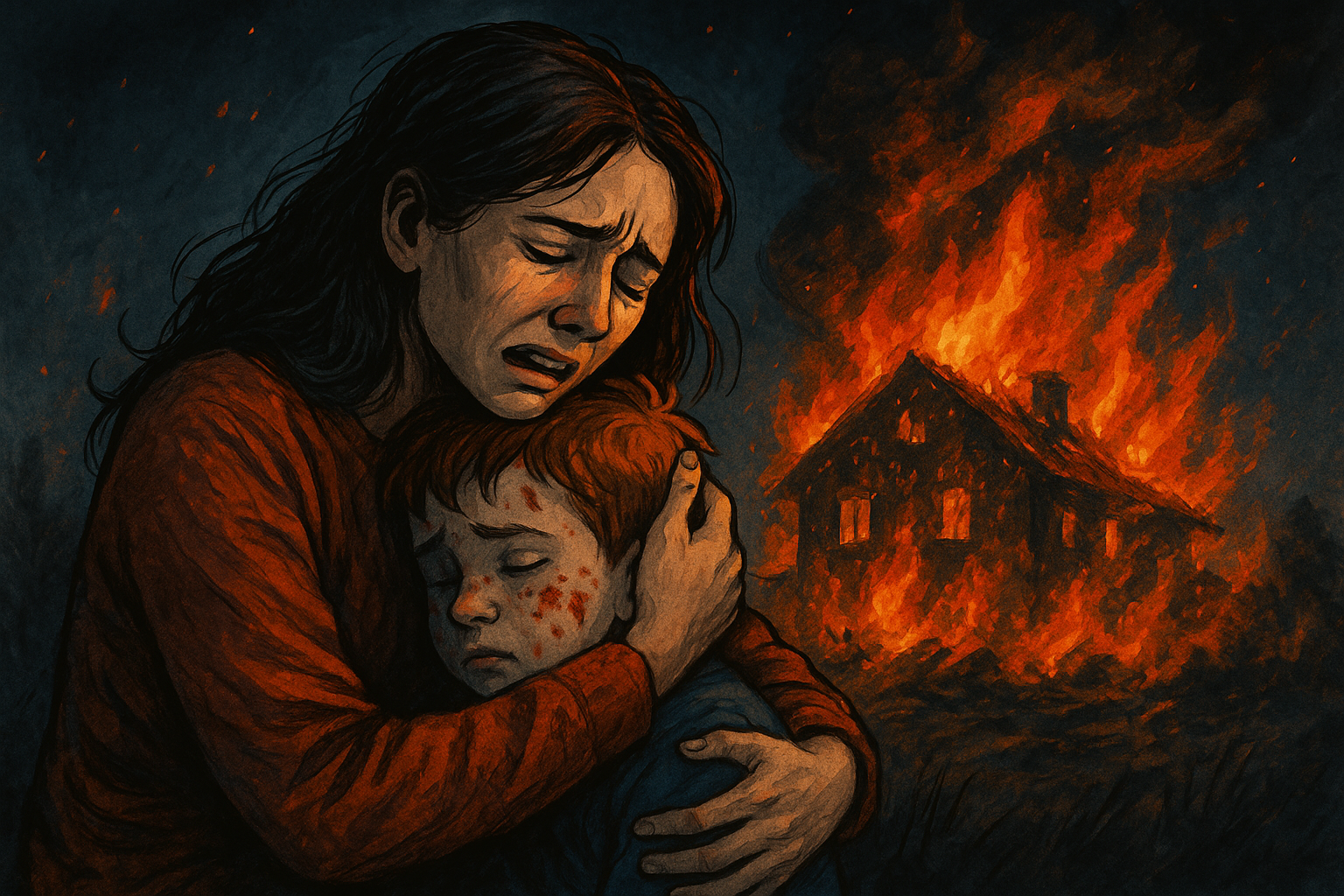
On the night of Sunday, May 18, 2025, a tragedy unfolded in the Kyiv region, providing yet another bloody proof that the nature of Russian warfare remains unchanged. A 27-year-old woman died in her own home in Vasylkiv, shielding her 4-year-old son with her body from a Russian drone strike. The boy survived, although his face is injured, and doctors are now fighting desperately to save his eyesight. The child’s grandparents are also in the hospital. This tragedy, although it is happening here and now, in mid-May 2025, brings back images I saw seventeen years ago in another country, destroyed by the same empire.
The mechanism of crime and the reflex of victimhood are frighteningly repetitive in Moscow’s version. When we hear about the mother from Vasylkiv, who in a split second, in the darkness of the night between May 18 and 19, decides to give her life for her child, my memory automatically takes me back to August 2008. Together with Wojciech Pokora, we were reporting on the Russian aggression against Georgia at the time. In circumstances that could be described as unpredictable and at times even surreal, we reached the town of Tortiza. The area was already under the de facto brutal control of the Russians.
What we saw there was a textbook example of the terror directed at civilians that we are now seeing on a massive scale in Ukraine. The residents led us through the village, showing us the effects of the bombing in the first hours of the invasion. The Russians used cluster munitions there – weapons dropped to cover as large an area as possible, showering it with a hail of deadly “balls.” There were no military installations in Tortiza, no radars, no Georgian troop concentrations. There were houses, orchards, gardens, and ordinary people who suddenly became targets.
Traces of explosions were everywhere. Shrapnel cut through wooden fences, pierced the walls of houses, and embedded itself in the trunks of fruit trees. It was in this setting that we heard a story that still haunts me to this day and which found its tragic mirror image on May 18 in Vasylkiv.
In one of the gardens in Tortiza, a brother and sister were playing. A 15-year-old boy and his 8-year-old sister. The children had no chance against the air force of a superpower that had decided to “enforce peace” with bombs. When the boy heard the growing roar of engines and the first explosions of cluster bombs, he did the same thing as the mother in Wasylków. He threw himself on his younger sister, covering her with his own body on the grass. He took the impact of the shrapnel. He died on the spot. The girl, though wounded, survived only thanks to his sacrifice.
We heard this account directly from the father and relatives of the siblings. We stood in the same garden, destroyed by bombs, sprinkled with the blood of innocents. The men did not shave during the mourning period, their faces tired and darkened by grief. They wore badges with a photo of the murdered boy pinned to their chests – a small gesture of remembrance in a world that had forgotten them. We talked under the ripening grapes, in the shade of the Caucasian sun, which illuminated the enormity of the tragedy, contrasting with the beauty of the local nature.
I remember how the father talked about his son. He spoke about him in the present tense, as if the boy were still with us, as if he were about to run out from behind the corner of the house. He talked about how talented he was, how knowledgeable he was about computers, what plans he had for the future. I listened with difficulty, struggling with my own emotions – my children were exactly the same age at the time. A boy and a girl, too. Looking at the pain of the Georgian father, I saw in him the universal fear of every parent in the zone crushed by the Russian steamroller.
Back then, in 2008, Sergey Lavrov – the same man who, today, in 2025, represents Russian diplomacy – assured the world with a straight face that Russia was not using cluster munitions and was not attacking civilian targets. He lied, Vladimir Putin lied, Dmitry Medvedev lied. And yet, in the name of “peace and quiet” and gas interests, the world preferred to take these lies at face value. The West preferred Nicolas Sarkozy’s fictitious peace plans, which in reality sanctioned Russian gains and impunity, to the sober, sharp warnings of Polish President Lech Kaczyński, who spoke bluntly in Tbilisi about what would happen next.
On May 18, 2025, history came full circle. In Vasylkiv, a Russian drone again struck a civilian house, a place where people should feel safe. Again, someone had to shield a child with their body, paying the ultimate price. Again, doctors are fighting to save the eyesight of a 4-year-old boy who saw hell.
Nothing changes – neither in Russian tactics nor in the tragedy they bring. Only the dates and names of places on the map of crime change. A straight line of blood and lies runs from Tortiza in Georgia to Vasylkiv in Ukraine, to which the world – despite the passing of years – still too often turns a blind eye.
AI graphic
PB