
By EUvsDisinfo
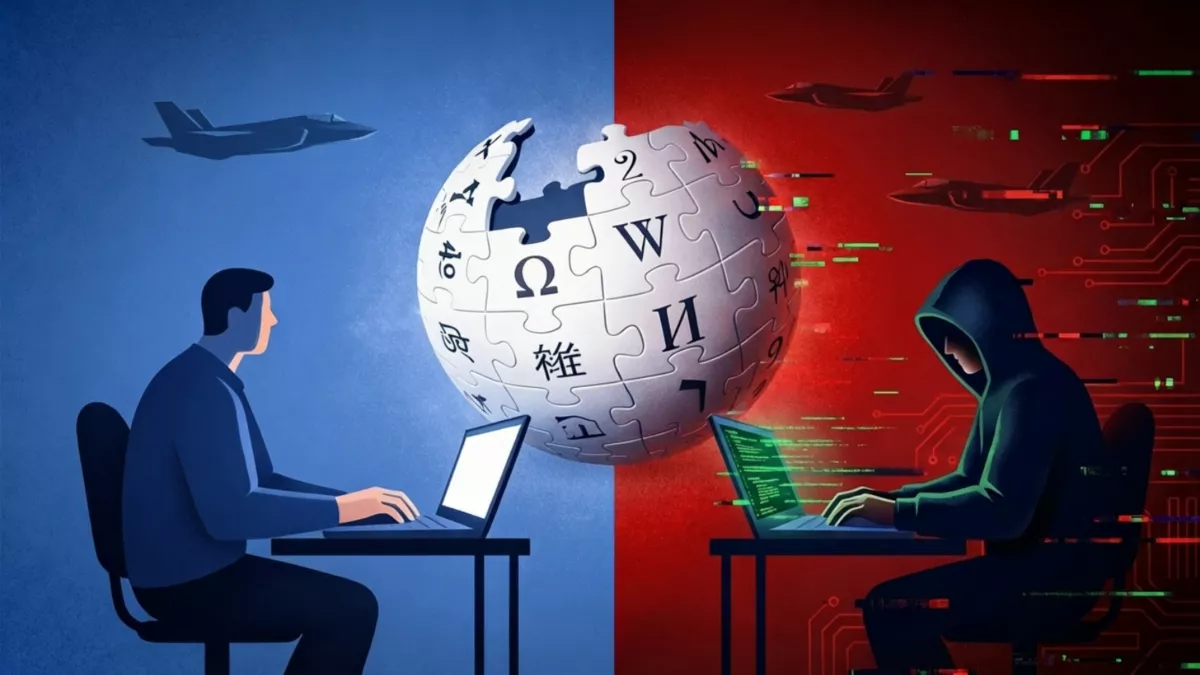
As Wikipedia approaches its 25th anniversary in 2026, its open editing model faces a growing challenge: coordinated edit wars. In these campaigns, Kremlin-aligned actors try to rewrite history, launder disinformation, and lock distorted narratives into one of the world’s most trusted reference platforms.
Founded on the idea that volunteers could collaboratively build a neutral, reliable encyclopaedia, Wikipedia has become one of the most influential information platforms ever created. It is often described as the world’s largest crowd-sourced knowledge project, built on consensus and verifiable sources. In recent years, however, it has also become a frontline in geopolitical information warfare.
This is most visible in so-called edit wars: prolonged conflicts where opposing groups repeatedly overwrite and revise articles to control historical narratives. Since Russia’s full-scale invasion of Ukraine in February 2022, these battles have intensified. Kremlin-aligned actors have systematically targeted articles related to Eastern Europe, the Soviet past, and contemporary political leaders. Estonia and especially EU leader Kaja Kallas, Estonia’s former prime minister, have been frequent targets.
What are edit wars?
An edit war happens when editors repeatedly change the same content instead of resolving disputes through discussion. Wikipedia officially discourages this behaviour and emphasises consensus, neutrality, and reliable sources. In practice, however, edit wars can and do break out.
Coordinated editors can use endurance, procedural rules, and administrator complaints to exhaust good faith contributors. The goal is rarely to win a single argument. Instead, it is to wear down opposition, freeze pages at favourable moments, and normalise contested language. Once a page is locked or protected, the version in place gains a sense of legitimacy, even if it reflects a distorted view.
Edit wars exploit open systems, operate over long periods, and aim to embed manipulated narratives into reference material rather than spreading short-lived falsehoods.
Multiple investigations show that Wikipedia manipulation increased sharply after Russia’s invasion of Ukraine. Russian-language Wikipedia and parts of the English version became arenas for systematic narrative control, especially as independent Russian media was shut down. Wikipedia’s openness, once a strength, had suddenly become a vulnerability.
Coordinated editor networks have worked to soften descriptions of Russian aggression, reframe invasions as ‘conflicts’, and question the legitimacy of post-Soviet states. These efforts rely on subtle wording changes, selective sourcing, and procedural tactics rather than obvious vandalism.
Estonia and EU officials as targets
Estonia shows how edit wars are used for historical revisionism and political influence. Since 2022, English-language Wikipedia articles about Estonia’s history, statehood, and politics have faced sustained pressure.
One recurring tactic has been changing the birthplaces of hundreds of Estonian public figures from ‘Estonia’ to ‘Estonian SSR, Soviet Union’, despite the legal consensus that Estonia was occupied, not legitimately incorporated, by the USSR between 1940 and 1991. This is not a minor wording issue. Calling Estonia a ‘Soviet republic’ supports the Russian claim that the Baltic states voluntarily joined the USSR and directly contradicts the position of Estonia, the EU, NATO countries, and international law.
Historical topics have also been targeted. The Estonian War of Independence between 1918 and 1920 has at times been reframed as an ‘offensive campaign’ or ‘separatism from Russia’, language that closely mirrors contemporary Kremlin rhetoric.
High-profile figures are especially vulnerable because their pages attract constant attention and frequent administrative action. The Wikipedia article on Kaja Kallas has repeatedly been edited to reflect Russian-aligned interpretations of history and geopolitics.
At key moments, the page was locked while these contested narratives were in place, blocking corrective edits. Page protection, meant to prevent disruption, instead helped freeze a favourable version of the article. This shows how procedural tools can be exploited as effectively as false information.
Why Wikipedia matters
Wikipedia is not just another website. It ranks highly in search results and serves as a default reference for journalists, students, policymakers, and the public. Winning an edit war on Wikipedia helps turn contested narratives into global ‘common knowledge’.
For Kremlin-aligned actors, this makes Wikipedia a valuable target. Making small wording changes, downplaying occupation, reframing wars, and questioning democratic legitimacy can slowly erode our understanding of history and present-day aggression. Estonia’s experience shows how smaller states are especially exposed.
Because Wikipedia is also a core source for AI systems, the stakes are even higher. Recent studies indicate that Wikipedia is one of the most cited sources for ChatGPT, effectively serving as a foundational knowledge base for how the AI understands and retrieves information.
Manipulating articles today can therefore shape how future technologies understand, reproduce, and repeat history. This practice is referred to as LLM grooming, the deliberate attempt to influence large language models by seeding biased or distorted narratives into the sources they rely on.
The rise in Wikipedia edit wars since 2022 reflects a broader shift in information warfare. Instead of loud propaganda, actors now use procedural, platform-native manipulation. Estonian history and Kaja Kallas are not isolated cases but targets of coordinated action. And as long as open-knowledge platforms shape how societies understand history and politics, sites like Wikipedia will remain contested ground.
By EUvsDisinfo