
By EUvsDisinfo
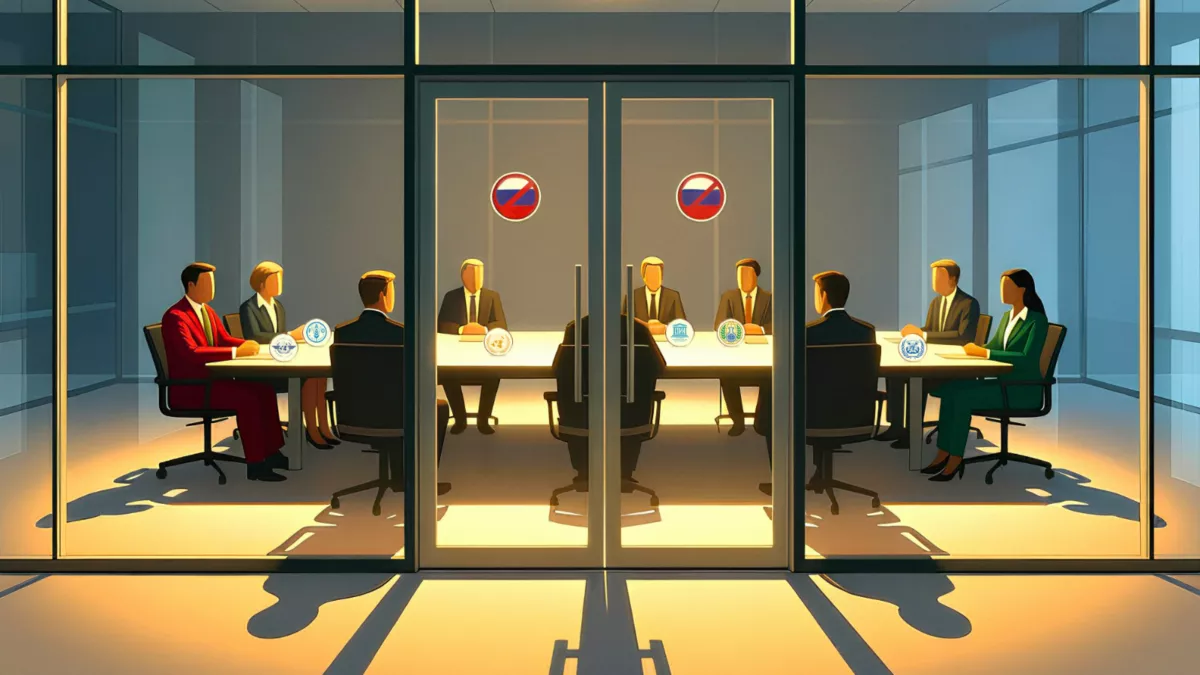
Throughout 2025, Russian officials were repeatedly shut out of the governing bodies of international organisations – a direct consequence of Kremlin’s unprovoked war of aggression against Ukraine and its escalating campaign of hybrid interference worldwide. A glimpse of what’s to come?
2025 was a bad year for Russia’s international standing. As Andrii Sybiha, Ukraine’s Minister of Foreign Affairs, recently described on Facebook, Ukraine and its allies worked hard throughout the year to ensure that Russian representatives were not elected to the governing bodies of various international organisations. Their efforts largely succeeded, despite pro-Russian foreign information manipulation and reference (FIMI) campaigns targeting them.
Sybiha’s instructive post notes that in 2025, Russia was not elected to the executive bodies of 20 international organisations, including the UN Food and Agriculture Organization (the FAO); the UN Educational, Scientific and Cultural Organization (UNESCO); and the Organization for the Prohibition of Chemical Weapons (OPCW). Ukraine, however, was elected to the boards of those organisations and others.
Ukraine scored other diplomatic victories. In February 2025, the UN General Assembly passed a resolution condemning Russia’s aggression in Ukraine, despite shifting alliances among the UN’s biggest members. That was only one of several successful resolutions that were unfavourable to Russia. On 3 December of last year, for example, the UNGA demanded that Russia immediately and unconditionally return all Ukrainian children forcibly transferred or deported since 2014. And two weeks later, the Assembly adopted a resolution condemning the human rights situation in the temporarily occupied territories of Ukraine, including Crimea. The same resolution demanded, among many things, that Russia end all violations and abuses of international human rights law in the territories and provide reliable information on the whereabouts of detained Ukrainian citizens.
Voting patterns might be changing
A close examination of voting patterns implies that subtle shifts could be at work. Russia has long presented itself as a defender of countries in the ‘Global South’, in particular in Africa, against Western ‘bullying’. But last February, more African countries voted in favour of Ukraine’s resolution condemning Russia’s aggression than voted against it (a larger number abstained). And on 3 December, only a handful of African countries opposed the recent UNGA resolution demanding the return of Ukrainian children. Importantly, South Africa – a fellow BRICS country – voted in favour, despite abstaining from the February vote.
In Latin America and the Caribbean, a similar trend emerged. In February, some 20 countries in the region abstained from Ukraine’s resolution condemning Russian aggression against it, with eight voting against and 11 voting for. In December, only four countries abstained from the resolution demanding the return of Ukrainian children, only two voted against, and 16 voted for it. Granted, the resolutions were different. But both heavily criticised Russia, with the resolution about Ukrainian children explicitly deploring Moscow’s measures to simplify the procedure for obtaining Russian passports for Ukrainian children.
Spinning defeat
After the Kremlin failed to either elect its representatives to boards or stop UNGA resolutions criticising Moscow’s behaviour, pro-Russia outlets reacted with predictable anger. Following the UNESCO board vote, one such outlet quoted Foreign Minister Sergei Lavrov claiming that the body’s leadership is ‘departing from the principles of universality, demonstrating politicisation and a desire to “Ukrainise” the agenda of all the organisation’s structures.’ Another outlet cited Russia’s permanent representative to the OPCW asserting with Orwellian optimism that ‘Euro-Atlanticists’ had failed to isolate Russia in the body, despite Moscow’s failure to get re-elected to its Executive Council. He also alleged that ‘opponents’ were only able to exclude Russia through ‘procedural manipulation, bribery, the intimidation of OPCW member states, and the dissemination of false information.’
A persistent tactic was to declare victory in the face of failure. Outlets reported that after Russia was shut out of elections to the board of the International Maritime Organisation, the Russian Transport Minister released a statement saying, ‘The results of the vote showed that despite the increased collective opposition to Russian participation in the council, Russia has wide recognition among IMO members.’
Moscow’s rhetoric only intensified after the UNGA passed resolutions critical of Russia. For example, after the UNGA voted to demand the return of Ukrainian children from Russia, Maria Zabolotskaya, Russia’s deputy permanent representative to the UN, claimed, ‘Every vote for the resolution is support for lies, war and confrontation, every vote against is a vote for peace.’
A bad reputation could have consequences
The takeaway is that despite the Kremlin’s fierce attempts to enlist the rest of the world for support, its efforts are having mixed results, at best. While Moscow likes to promote itself as virtually invincible, some Global South countries are waking up to the Russian government’s predatory intentions. The Kremlin thought that its unprovoked war of aggression against Ukraine would bolster its political influence in the world. Instead, the conflict contributed to reducing Russia’s clout.
If true, this development is important. The European External Action Service and the European Union as a whole place great importance upon multilateralism as the best way to ensure a safe and liveable world. Moscow is being voted out of platforms where mostly well-intentioned countries search for common solutions to shared problems. Sooner or later, that loss of soft power will be felt in the hard-power realm.
By EUvsDisinfo