

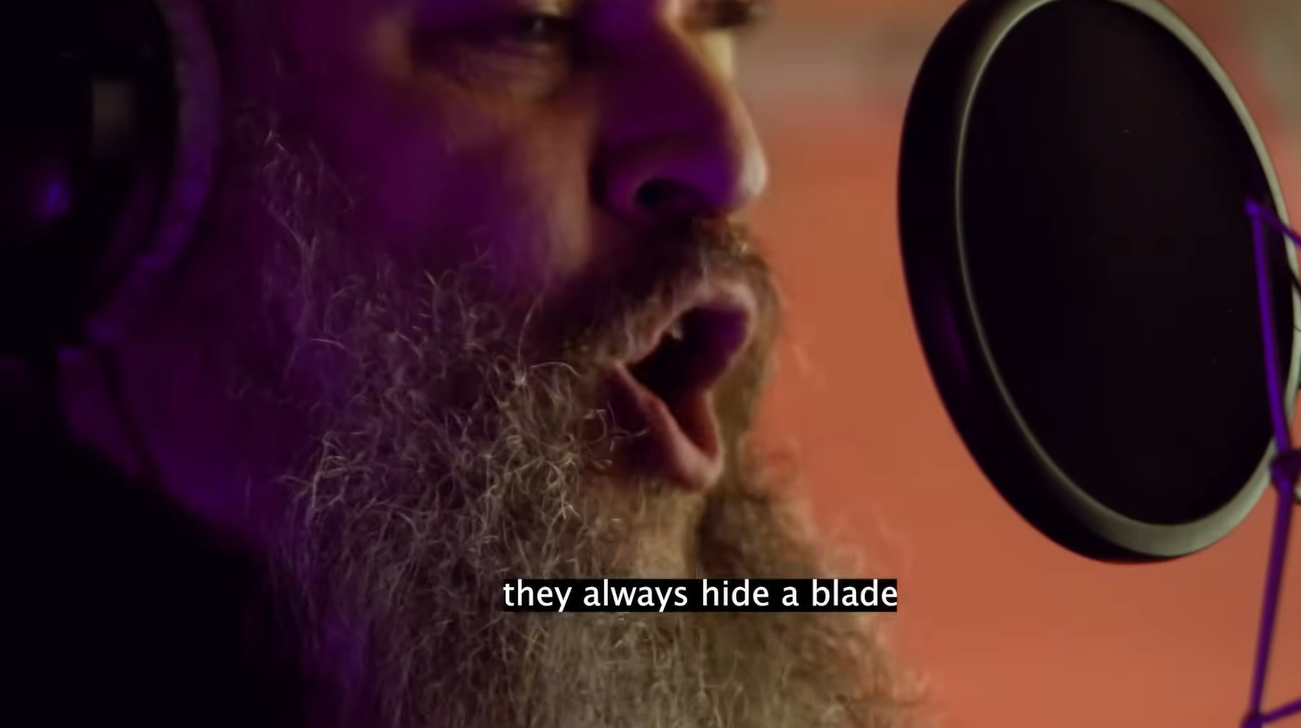
The Chief Rabbi of Ukraine, Moshe Reuven Azman, has published a song he wrote and performed himself. However, this is no ordinary religious song, but a dramatic political and moral appeal addressed directly to the President of the United States, Donald Trump. The clergyman, who lost his son in the war, warns Washington against naivety in its relations with Russia.
In the world of high politics, dominated by diplomatic notes and closed-door summits, the voice of the Chief Rabbi of Ukraine resonates in an unprecedented way. Moshe Reuven Azman has chosen a form of communication that bypasses bureaucratic filters and strikes directly at the emotions – he has recorded a song that is a direct appeal to the leader of a superpower.
The music video and song, titled “My Appeal to US President Donald Trump,” is an artistic manifesto in which the rabbi calls for help for Ukraine in achieving not so much a ceasefire as a “just and lasting peace.”
“They always hide a blade”
The lyrics of the song are harsh and devoid of diplomatic euphemisms. Azman, through his singing, diagnoses the nature of the Russian regime in a way that may resonate with the American political tradition, evoking the rhetoric of Ronald Reagan.
“It’s time to fight. In the name of light.[…] they always lie, they always hide the blade,” sings the rabbi. In his words, Russia appears not as a partner for negotiation, but as an existential threat to the free world. Azman describes the Kremlin’s power as one where “The throne of tsars is built on fear and hate,” warning President Trump against the illusion of being able to communicate with the dictator.
The message is clear: “They don’t want peace. They want just blood and fire. It’s time to crush the evil empire.” It is a call to action to make the White House aware that any concessions to the aggressor will be perceived as weakness and an encouragement for further expansion.
A rabbi who knows the smell of gunpowder
To fully understand the significance of this appeal, one must look at the author. Moshe Reuven Azman is one of the most charismatic figures in religious and social life in Ukraine. Since the start of the full-scale invasion in 2022, he has not limited himself to serving in the synagogue. He has become a humanitarian leader, organizing the evacuation of civilians from the hottest spots on the front line, often risking his own life under Russian fire.
Azman is a symbol of Jewish-Ukrainian solidarity, repeatedly emphasizing that in the face of Russian missiles, there is no difference between a Jew and a Ukrainian.
His father’s personal tragedy
The credibility of the rabbi’s words about “blood and fire” was unfortunately confirmed by the most tragic of victims. In September 2024, Moshe Azman said goodbye to his son. Matityahu (Anton) Samborsky, the rabbi’s adopted son, died on the front lines defending Ukraine from Russian aggression.
Samborsky was drafted into the army shortly after the birth of his daughter. After intensive training, he was sent to the front line, where he was killed. The funeral of the Chief Rabbi’s son in Kyiv became a national event, and photos of the tearful cleric holding the Ukrainian flag in his arms were circulated by the world’s media.
It is this personal loss that gives Azman’s song a weight that ordinary appeals by politicians do not have. When the rabbi sings that Russia wants “only blood,” he speaks as a father who has given the most precious thing he had to this war. His warning to Trump is not a theoretical geopolitical analysis, but a testimony written in suffering.
A warning to America
The release of the song at a time when the fate of further support for Kyiv is being weighed in the United States is a strategic move. Azman is trying to appeal to the conscience of the American president, using the language of universal values—the struggle between good and evil, light and darkness.
By pointing to “lies” as an inherent feature of Russian politics, the rabbi is in fact warning Trump against repeating the mistakes of the past and making deals that the Kremlin will break at the first opportunity. A throne built on “fear and hate” cannot be the foundation of a stable world order, Azman seems to be saying.
The musical appeal from Kyiv is proof that, in the face of a protracted war, Ukraine is looking for any way to break through the fatigue of Western public opinion. The rabbi’s voice—loud, full of pain, but also determination—reminds us that what is at stake in this war is not only territory, but the moral backbone of civilization.
Screenshot from YT Anatevka TV
PB