
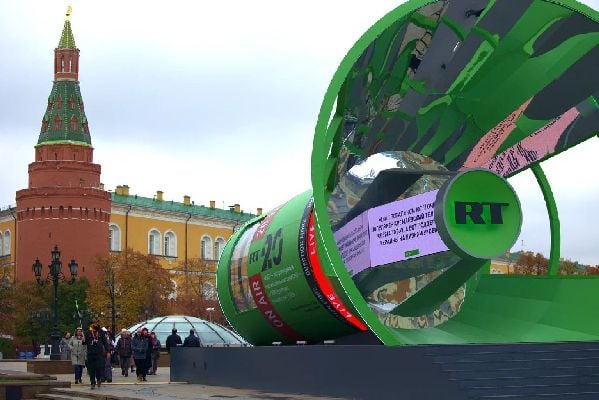
RT television celebrated its 20th anniversary with a flourish befitting its status as the main exporter of Russian propaganda: the Bolshoi Theater, decor in distinctive green colors, prominent guests from abroad — from former Ecuadorian President Rafael Correa to Elon Musk’s father, Errol. Russian President Vladimir Putin personally congratulated the employees. His message was in keeping with the spirit of the times: RT should not give up using its “secret, highly precise long-range weapon—the truth” to make “Russia’s voice loud and convincing.”
However, not everyone is ready to listen to the voice of “truth” served by RT: in most Western countries, the channel is banned, and in the United States, it has even been described as a Russian intelligence cell. During the anniversary evening, Margarita Simonyan admitted that 20 years ago she could not even imagine how powerful an English-language television channel about Russia would become over time.
Not looking “like bears”
The idea of creating an international news channel that would bring Russia closer to foreign audiences was proposed at the beginning of the 21st century by Putin’s advisor Mikhail Lesin. While still in his previous position as press minister, he considered the need to implement a clear state policy on shaping Russia’s image in the world. “We must promote Russia on the international market, its positive image. Otherwise, in their eyes, we look like bears: we walk and growl,” Lesin said in 2001.
These intentions materialized in 2005 with the launch of the Russian English-language television channel Russia Today, founded by the state news agency RIA Novosti. Margarita Simonyan became the editor-in-chief and has been running the station ever since. Initially, RT broadcast a satellite signal to the UK and the US, and its programming consisted mainly of news services, live broadcasts, and the latest world news.
Currently, the RT holding company includes six news channels broadcasting in English, Arabic, Spanish, French, German, and Serbian. In addition, there is a channel with documentaries, “RTД,” in Russian and English. RT also has eight websites, the multimedia agency RUPTLY (which provides video content for television stations), and social media accounts in Chinese and Hindi.
RT’s activities are entirely financed from the budget of the Russian Federation and consume record amounts of money every year. It is estimated that in 2026, the project will receive $350 million, which is comparable to the budgets of some regions of Russia.
From Russia’s “showcase” to a propaganda mouthpiece
In 2005, when Russia Today was just starting out, the station broadcast fairly innocuous content – it talked about Russian culture and traditions, showed matryoshka dolls, bears, tourist resorts, and the Hermitage.
The turning point in its editorial policy was the war in South Ossetia in August 2008. Most foreign media outlets accused Russia of starting the war, and the Kremlin needed a platform to present an alternative point of view. At the same time, the channel shortened its name to RT and began promoting the Russian government’s political narrative, justifying Russia’s external aggression and discrediting Western institutions.
To appear credible to foreign audiences, RT began to engage non-Russian experts who were willing to act as advocates for Russia on the international stage. The channel employed foreign journalists as presenters and reporters. Their task is to speak English, French, and other foreign languages without a foreign accent; in return, they receive high salaries and benefits. Daniel Lange, a journalist at RT’s German bureau who left the channel in 2021, later wrote in his book that RT employees were generously remunerated and that huge sums were invested in studio equipment.
Liz Wahl, who worked for RT’s US branch for four years, admitted that the station deliberately hires young journalists who tend to be naive and unfamiliar with Moscow’s goals in the West. She herself resigned on air, expressing her personal opposition to Russia’s annexation of Crimea.
Wahl was not the only foreign journalist whose political views eventually diverged from those of her Russian employer. The day after the outbreak of war in Georgia, RT’s British correspondent William Dunbar announced his departure. He stated that the station’s management had forbidden him from reporting on the Russian military’s attack on the city of Gori. In 2014, British journalist Sara Firth resigned in protest against the biased coverage of the MH17 crash.
Most journalists left RT after Russia’s full-scale invasion of Ukraine in 2022. Former Scottish First Minister Alex Salmond announced the closure of his own program at that time. In March, Jonny Tickle, a British journalist working in Moscow, left the station.
Relocation of broadcasting: Africa instead of Europe
After the start of full-scale war in Ukraine in 2022, RT faced widespread sanctions and bans in many countries. The first major step was a ban on broadcasting in the European Union: in March 2022, the EU Council suspended the distribution of all versions of RT — in English, French, German, Spanish, and others — via satellite, cable networks, internet platforms, and social media. Almost simultaneously, national regulatory authorities in several European countries, including Germany, Poland, and Austria, also blocked RT’s activities.
The pressure of sanctions intensified in 2024. The US Treasury Department imposed sanctions on the media group Rossiya Segodnya and legal entities associated with RT, freezing their assets and restricting their international financial operations. A few days later, the State Department publicly stated that the television channel had become a de facto cell of Russian intelligence, secretly managing an extensive network of military purchases to supply the Russian armed forces. Following these events, Meta announced a global ban on RT content on its platforms — Facebook, Instagram, and other company services.
After being forced to withdraw from Europe and the United States, the station decided to reorganize its financing and look for more “friendly” territories for its activities, primarily in African countries. RT has now opened at least seven offices in Africa, signed agreements to rebroadcast its content with more than 30 local television channels, and increased the number of daily reports from the continent. In Africa, RT broadcasts not only in English and Arabic—the French editorial office, which previously served France, has been reoriented toward audiences in French-speaking African countries.
In addition, an extensive training program has been launched for foreign journalists from China, Southeast Asia, and Africa. The channel also participates in the Rossotrudnichestvo agency’s “New Generation” program and regularly invites young media professionals from various countries to internships at its Russian headquarters.
OS