
Russia has never abandoned Bolshevik propaganda methods. The scenery changes, the media changes – from paper newspapers to platform X – but the core remains the same. For centuries, Moscow has been building its image on a fundamental lie, using an army of bribed, intimidated, or simply mannered “useful idiots” from the West to spread it.
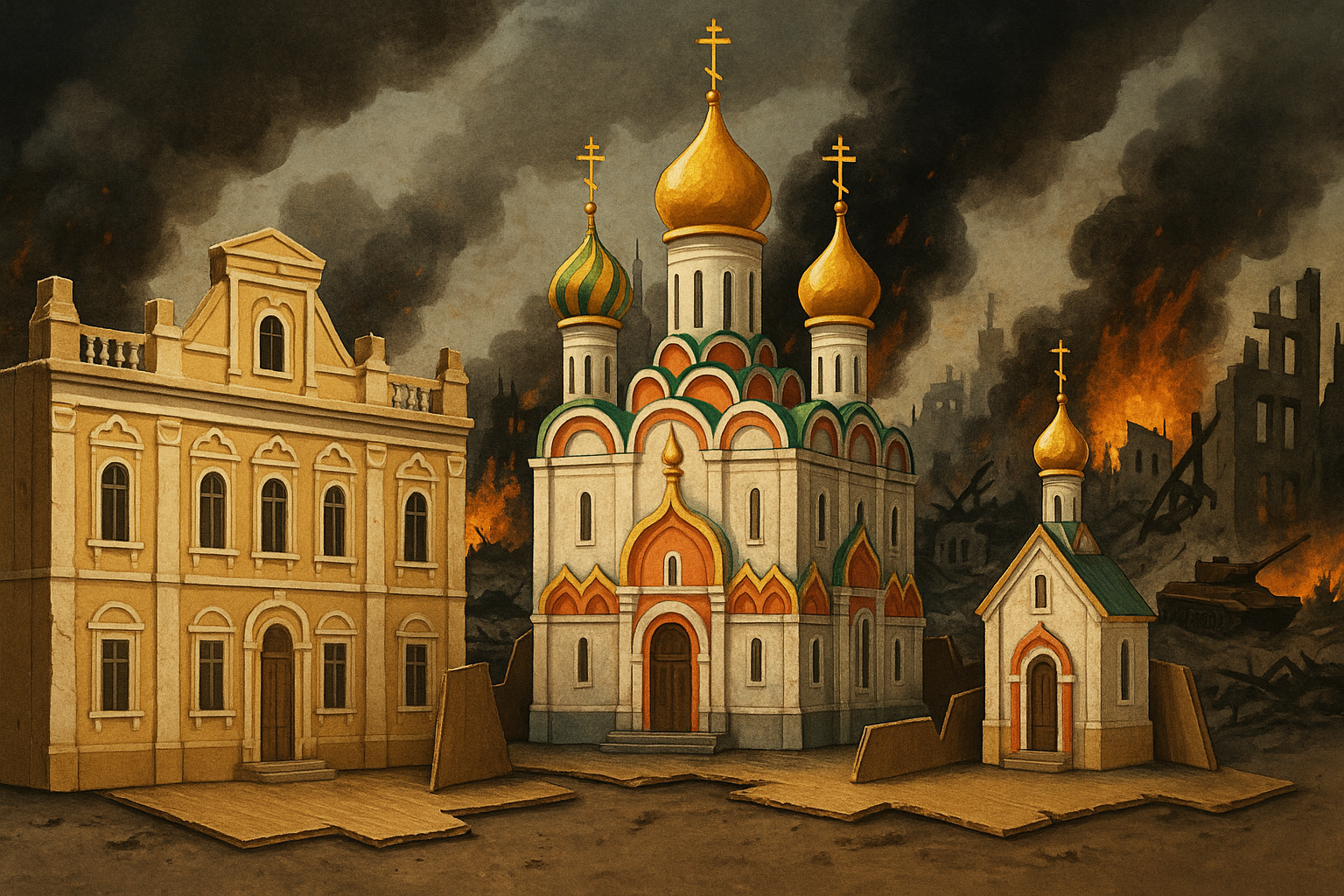
Probably the first diagnosed case of this disease, which the Bolsheviks perfected over the years, were the famous “Potemkin villages.” In 1787, when Tsarina Catherine II traveled to the newly conquered Crimea (known as Novorossiya), Grigory Potemkin staged a spectacle that went down in history as a symbol of geopolitical deception. Along the route of the imperial procession, mock-ups of houses were built, the same herds of cattle were herded to feign prosperity, and peasants dressed in festive costumes cheered in honor of the empress. Regardless of how much of this story is myth and how much is historical truth, the premise itself is diabolical in its simplicity: for the Russian state, creating false images is more important than reality. The end justifies the means – and the goal at the time was to convince Europe of the empire’s power.
A century and a half later, the same method, albeit in a much more gruesome setting, was used to conceal one of humanity’s greatest crimes. Walter Duranty’s activities became a dramatic example of the creation of “Potemkin villages” on paper. This Moscow correspondent for The New York Times, a man with the status of a star journalist of the time, used his articles to build a false image of Soviet Russia during its most terrible period – the era of the Great Famine in Ukraine. While millions of Ukrainians were dying from lack of bread, Duranty wrote about “supply problems” and cynically stated that “you have to break eggs to make an omelet.” For this, he received the Pulitzer Prize, which the NYT has still not renounced.
The lesson of this story is terrifying because it shows how easily the world wants to be deceived. Duranty’s lies were exposed by Gareth Jones – a young Welsh journalist who traveled alone through famine-stricken Ukraine. Jones saw corpses in the streets, saw children swollen with hunger, and had the courage to shout about it to the world. What was the outcome? Duranty basked in luxury and fame, a regular at salons, a moral authority of the rotten West. Jones was hounded, ridiculed by the establishment, and ultimately murdered in Manchuria in unexplained circumstances, most likely at the instigation of the NKVD.
Today, perhaps as a bitter triumph of truth, we are witnessing a renaissance of memory about Jones. Books are being written (such as Mirosław Wlekły’s reportage), and Agnieszka Holland has made the shocking film Mr. Jones. Interestingly, although the film was released in the shadow of growing Russian imperialism, just before the full-scale aggression against Ukraine, it did not come as a sufficient shock to Western public opinion. The elites watched the film, nodded their heads, and went back to doing business with Putin.
Because the mechanism continues. Since 2022, we have seen a proliferation of so-called “conservative” American journalists who disregard the facts and values they supposedly refer to. In the name of fighting “globalism,” they allow themselves to promote narratives taken straight from the Kremlin’s playbook. Tucker Carlson has become a symbol of this decline. He practically broke Putin’s information isolation by going to Moscow for an interview that was essentially a two-hour monologue by the dictator. Carlson did not ask a single difficult question about Bucha, Mariupol, or the abducted children. Instead, he gave Putin the most powerful media platform in the world to drip his pseudo-historical nonsense about “artificial Ukraine” directly into the minds of millions of Americans. Carlson was not a journalist – he was a 21st-century Potemkin, building a facade of “reasonable leadership” for a war criminal.
Unfortunately, Poland also has its own builders of false villages. Among them, Wojciech Cejrowski leads the way, who, traveling “barefoot around the world,” seems mentally stuck in his Russian footcloths. He has repeatedly echoed Russian claims that “Ukraine is not a country,” contributing to the building of hatred and hostility, which, in the face of war beyond our borders, is detrimental to the raison d’état. Another specific case is that of Max Kolonko, a Polish man living in the US. Once a renowned correspondent and award-winning journalist, he has drifted into the depths of madness and conspiracy theories, where Russian propaganda feels right at home. His fall from a position of authority to the role of an internet shaman raving about partitions is a sad but striking example of degeneration.
Of course, there are more Polish examples of false conservatism, lavishly sprinkled with anti-Ukrainian sentiment and poorly disguised pro-Russian sentiment. Suffice it to mention the weekly magazine Do Rzeczy, which still aspires to be an opinion-forming publication. Credible, renowned journalists and historians still write for it, which only exacerbates the problem because it lends credibility to toxic content. The magazine has become a repository for the transmission of Russian “political realism,” which is essentially defeatism. This is led not only by editor-in-chief Paweł Lisicki, but above all by Łukasz Warzecha. Under the guise of concern for Polish national interests, this journalist, with apothecary precision, peddles the idea of “not our war” and the need to come to an agreement with Russia. If anyone in Poland deserves the Walter Duranty Anti-Award for persistently distorting the nature of the Russian threat and numbing consciences, it is Łukasz Warzecha, who should have made room on his shelf long ago. Because history teaches us one thing: those who build Potemkin villages always end up as accomplices of tyranny.
PB