
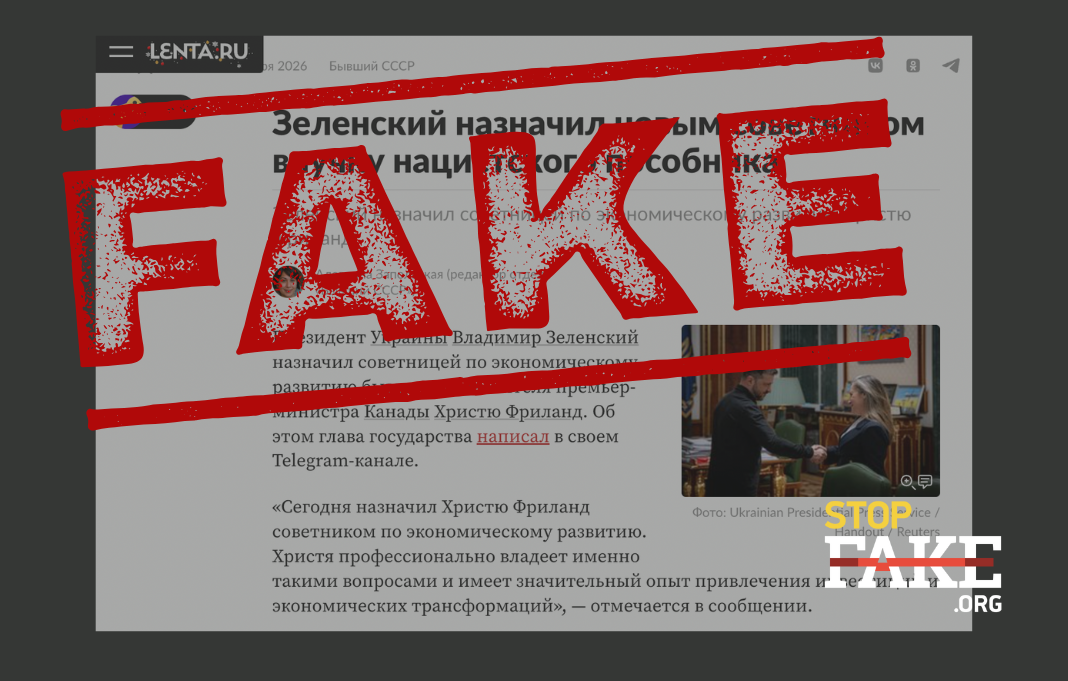
Chrystia Freeland’s grandfather, Mykhailo Khomiak, did serve as editor of the Ukrainian-language newspaper Krakivski Visti during the German occupation. He was a civilian journalist operating under strict Nazi censorship, however, and there is no evidence that he was a war criminal or involved in punitive actions.
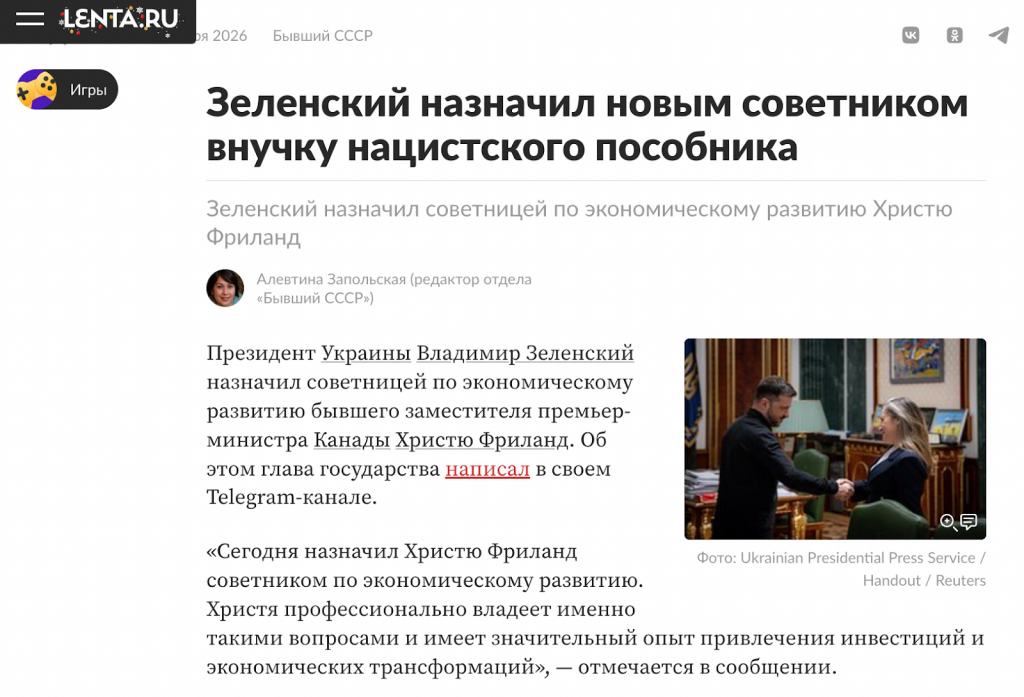
Kremlin-linked media have reported that Ukrainian President Volodymyr Zelensky appointed Chrystia Freeland as an adviser on economic development, describing her as “the granddaughter of a Nazi accomplice.” The claim was echoed by Russian Foreign Ministry spokeswoman Maria Zakharova, who said Freeland is the granddaughter of Mykhailo Khomiak, alleging that he collaborated with the Nazis while editing the newspaper Krakivski Visti in Kraków and later in Vienna during the German occupation of Poland.
Claims about a supposed “Nazi past” linked to Chrystia Freeland’s grandfather are not new, first gaining wide circulation in 2017 following her appointment as Canada’s foreign minister.
Freeland said at the time that the claims were part of a Russian effort to interfere in Western democratic processes, including in Canada. She has been open about her grandfather’s history, taking part in research into his life and acknowledging that Mykhailo Khomiak edited a Ukrainian-language newspaper in Kraków during the Nazi occupation before later emigrating to Canada. She has stressed that there is no evidence he was a war criminal, a Nazi ideologue, or involved in punitive actions.
Biographical accounts show that before the war, Mykhailo Khomiak was a young journalist in Lviv who fled ahead of the Soviet occupation to Nazi-occupied Kraków. There, Ukrainian organizations sought to publish a Ukrainian-language periodical, an effort that could not have proceeded without the awareness and oversight of the occupation authorities.
Ernest Gyidel, a scholar who examined Krakivski Visti for his dissertation, found that no more than 25% of the paper’s content was devoted to propaganda, including anti-Polish and anti-Soviet material. The remainder focused on cultural, philosophical, and linguistic aspects of Ukrainian life.
According to Gyidel, newspapers of the period were shaped by German policies that sought to pit Ukrainians against Poles to prevent unified resistance. The editor’s role was largely technical, focused on ensuring publication. Among the articles signed by Khomiak, Hejdel found none that were antisemitic or openly pro-Nazi. Labeling Mykhailo Khomiak a “collaborator,” he argues, overlooks the complex and coercive circumstances of the era.
Russian propaganda has deliberately distorted Mykhailo Khomiak’s biography to target his granddaughter, Chrystia Freeland, whose political career is entirely separate from her family history.
StopFake has previously debunked false claims that Canadian Deputy Prime Minister Chrystia Freeland appeared at a press conference while intoxicated.