
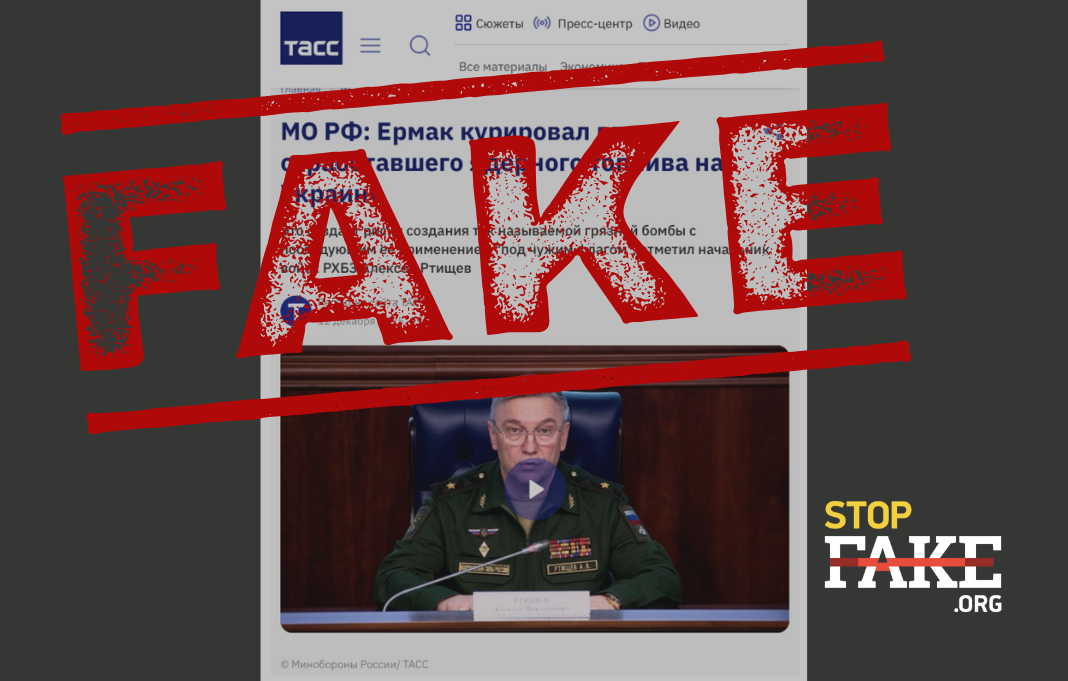
The Russian Defense Ministry’s claim that Ukraine is engaged in “nuclear blackmail” is unsupported. The International Atomic Energy Agency, which maintains continuous access to Ukraine’s nuclear facilities, has rejected allegations that Kyiv is preparing a “dirty bomb” or conducting undeclared nuclear activities.
The Russian Defense Ministry has launched a new information campaign accusing Ukraine of “nuclear blackmail,” alleging that spent nuclear fuel was imported into the country via Poland and Romania without notification to the IAEA or other relevant bodies.
The Russian Defense Ministry claimed the alleged transfers created a risk of producing a so-called “dirty bomb” for use in a potential false-flag operation.
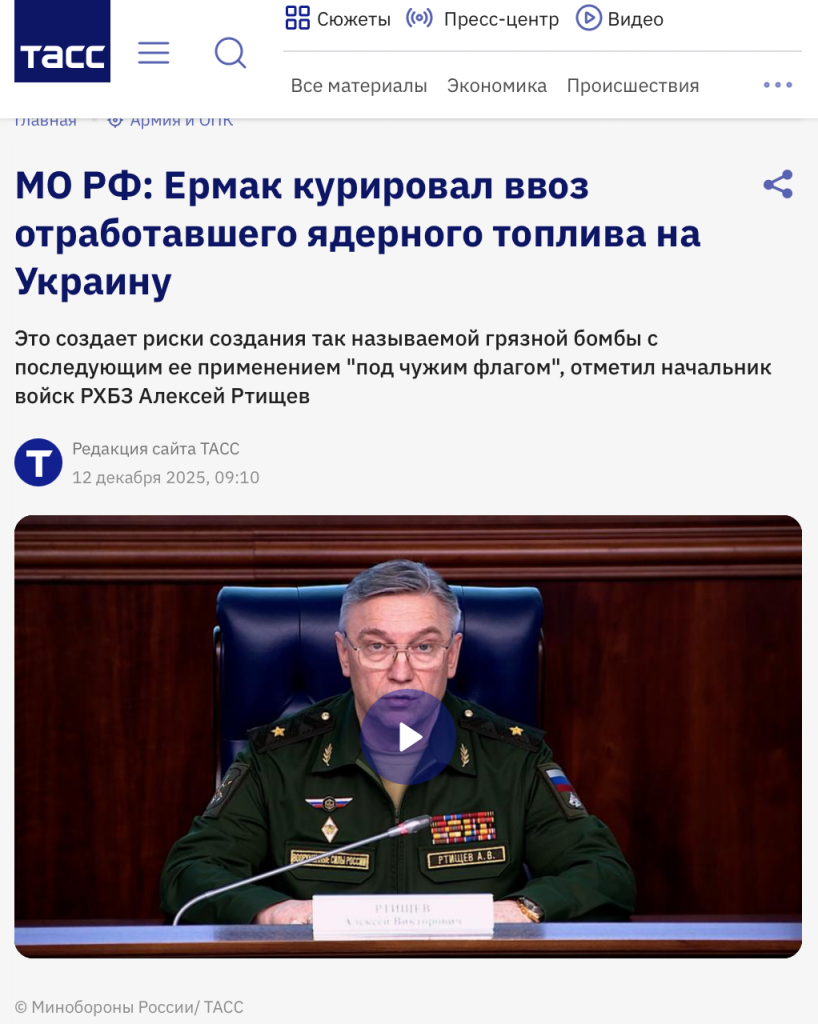
The allegation is another unverified claim by the Russian Defense Ministry, unsupported by any independent or specialized international source.
Ukraine operates under IAEA safeguards and the Nuclear Non-Proliferation Treaty, with the agency continuously monitoring nuclear power plant operations, nuclear material accounting, and the handling of spent fuel. The IAEA’s Ukraine page states that safety, physical protection, and spent fuel management remain under continuous control.
Ukraine’s handling of spent nuclear fuel is transparent. Industry and international reviews note that the country does not operate a closed nuclear fuel cycle and stores spent fuel in interim facilities under a long-term strategy aligned with IAEA and Euratom standards.
Neither the IAEA, the EU, nor other specialized international bodies have reported any unaccounted deliveries of spent nuclear fuel to Ukraine or breaches of notification procedures as described by the Russian Defense Ministry. Such incidents would typically trigger public statements and emergency diplomatic engagement.
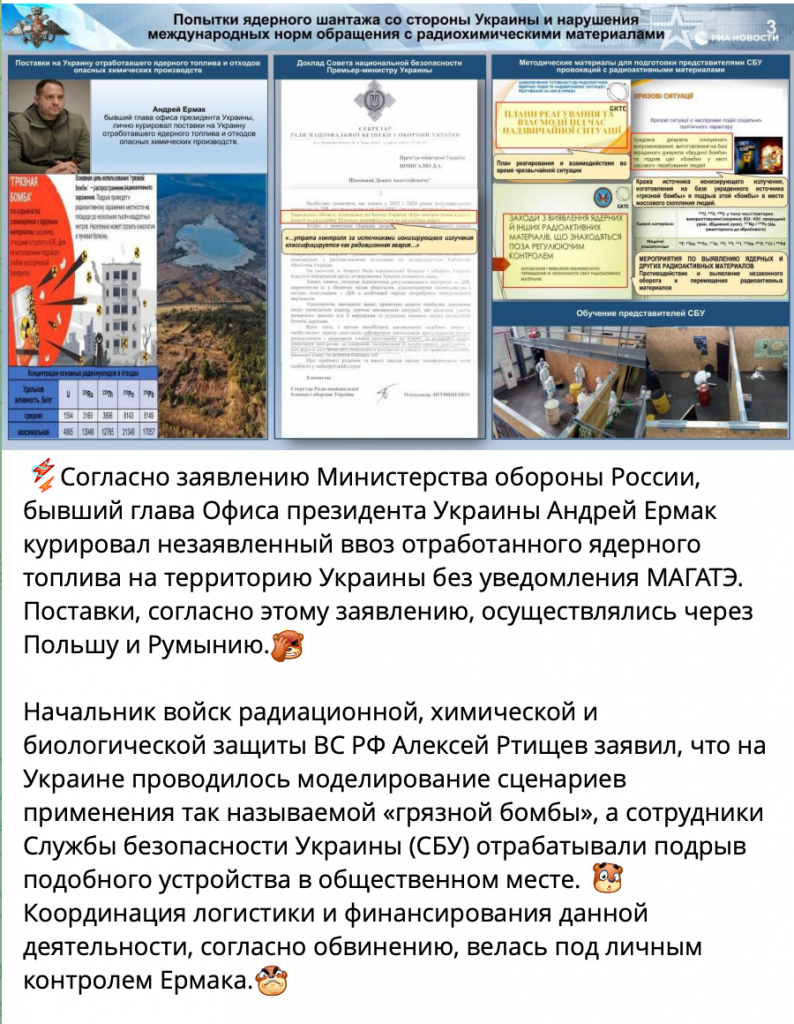
To bolster credibility, Russian propagandists have circulated slides that visually reinforce the claim but offer no verifiable evidence of covert imports of spent nuclear fuel. The materials assemble documents and photographs taken out of context to create the appearance of a coordinated “nuclear blackmail” scheme. One slide, for example, cites a letter from former National Security and Defense Council Secretary Oleksandr Lytvynenko to Prime Minister Denys Shmyhal referencing a “loss of control over sources of ionizing radiation” in 2022 and 2024. The passage refers to Russian forces’ seizure of the Lypetska base of the Institute of Metrology in Kharkiv region and shelling that affected nuclear safety—standard bureaucratic reporting of risks stemming from the aggressor’s actions, not evidence of illicit nuclear activity.
Propagandists have also included images from civil defense drills in the slides, portraying them as preparation for a “nuclear provocation.” In fact, Ukraine’s Security Service (SBU) and State Emergency Service (SES) routinely conduct training in radiation, chemical, and biological protection. In wartime, when nuclear facilities are under threat, such exercises are standard responsibilities of security agencies to safeguard the population.
The slides offer no proof of spent fuel imports or bomb development, containing only general statements, routine documents, and misrepresented civil defense exercises.
StopFake has previously debunked a similar false claim alleging that the West exports radioactive waste to Ukraine that could be used to build a dirty bomb.