


In fact, the funds under the AgoraEU program are intended to improve access to reliable information, combat fake news and foreign influence. The initiative is criticized mainly because it is not yet known how the funding will be distributed.
News is circulating online that the European Commission is allegedly planning to allocate an additional €7 billion for propaganda: paid experts, bot factories and the purchase of information influence. As evidence, the publications provide a screenshot of a German-language article by Apollo News, which allegedly covered this news.
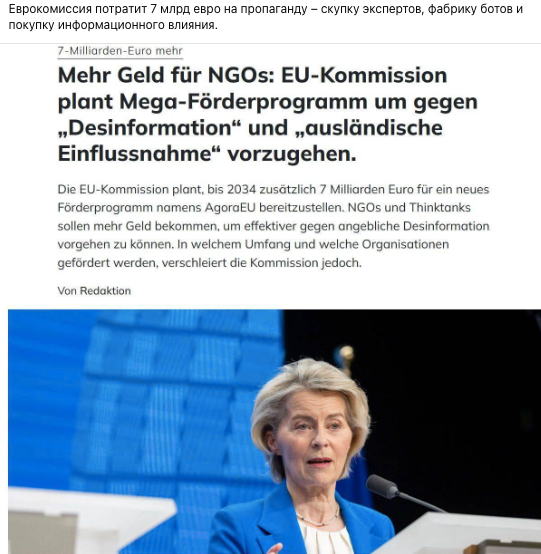
In reality, the article does not mention anything bot farms or paid experts at all. According to an Apollo News article titled More money for NGOs: European Commission Plans Mega Funding Program to Fight Disinformation and Foreign Influence, the European Commission plans to create a large new AgoraEU fund by 2034 to finance NGOs and think tanks in the fight against disinformation and foreign influence. At the same time, the story notes that the specific mechanisms for distributing funds and the criteria for selecting organizations remain unclear. Some critics allegedly fear that this money could promote certain political narratives under the guise of protecting reliable information.
Indeed, the article is indeed skeptical about the initiative. However, it is important to note that Apollo News is an ideologically biased right-wing media outlet that is often criticized for low journalistic standards, mixing facts with value judgments, and spreading unverified information. For example, the founder of the media admitted that none of the 15 full-time editors of the publication has a journalistic education and has repeatedly spread false information on the topic of migration. According to journalism professor Gabriele Hoffaker, Apollo News belongs to the “right-wing tabloid media” that purposefully uses so-called “trigger topics” — in particular, gender, migration and abortion — for the political mobilization of certain social groups. In addition, the editorial staff consistently speaks out against “a strong role of the state and against socialism as a kind of main enemy,” so it is not surprising that they dislike the European Commission’s initiative, which aims to increase government control over the spread of disinformation. Even despite this stance, the media did not accuse the European Commission of bribing experts or organizing bot farms. They only wondered whether such an investment was advisable and how transparent the criteria for selecting NGOs for funding would be.
The European Commission has proposed the AgoraEU programme as a new major funding instrument for 2028-2034, bringing together support for culture, media and civil society under one budget. The programme provides for funding of around €8.5 billion, almost six times the previous budgets of the separate Creative Europe and CERV programmes. The main objectives of AgoraEU are to support independent journalism, fight disinformation, strengthen democracy, rights and freedoms, and stimulate cultural and creative activities in Europe. The programme covers three areas: Creative Europe – Culture for the development of the cultural and creative sectors, Media+ for audiovisual content and CERV+ for strengthening civil society and equality.
Russia is once again accusing Europe of its own crimes, namely investing significant funds in propaganda. Russian propaganda actively finances bot farms and the creation of fake websites — read refutations on this topic here and here — and also recruits foreign experts to voice pro-Kremlin narratives.