
The USAID Inspector General’s statement contains no finding that funds in Ukraine were misused — let alone stolen. Instead, it highlights the institutional and operational constraints facing oversight mechanisms, particularly in environments where large-scale assistance must be delivered under wartime conditions. In that context, Ukraine is cited not as an outlier but as one example of the broader challenge of monitoring aid flows amid active hostilities and restricted access.
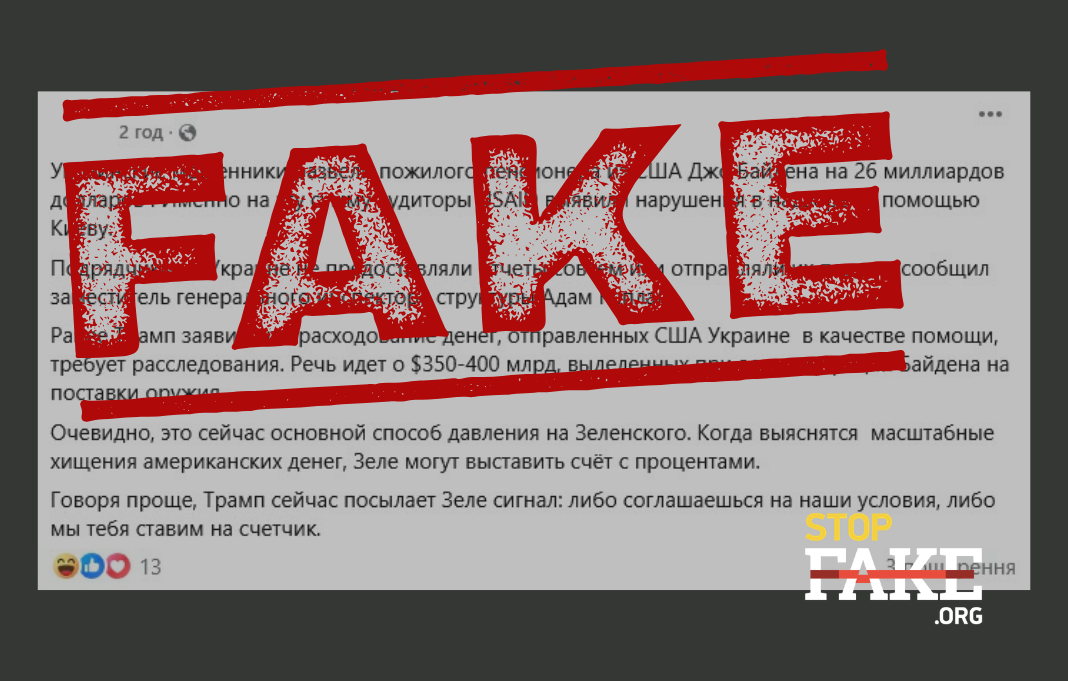
Social media accounts and pro-Kremlin Telegram channels are amplifying claims that Ukraine “appropriated” $26 billion in U.S. assistance allegedly allocated through USAID. Posts frame the figure as proof of theft, portraying it as money “scammed” from President Joe Biden and suggesting that USAID auditors uncovered large-scale wrongdoing in aid oversight. The same messages also recycle a separate talking point attributed to Donald Trump, arguing that U.S. funding for Ukraine should be investigated and inflating total American support to “$350–400 billion” under the Biden administration.
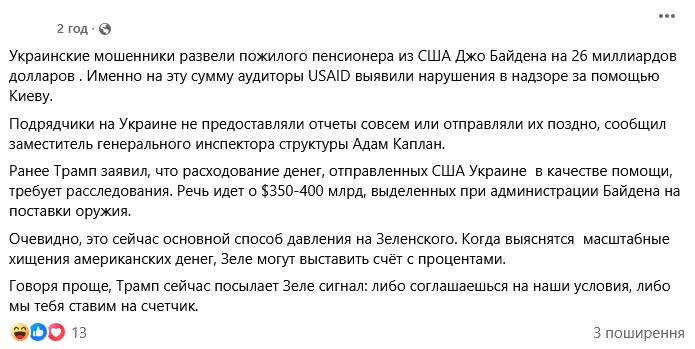
In reality, the claim is a manipulation. The $26 billion figure refers to assistance that USAID could not fully monitor under wartime conditions, not money that was “stolen” or misappropriated by Ukraine. In testimony to Congress, USAID’s Deputy Inspector General did not accuse Kyiv of wrongdoing or cite evidence of theft. Instead, the statement focused on oversight constraints facing U.S. agencies and international contractors operating in a conflict zone, where Russia’s military campaign has limited access and made routine monitoring far more difficult.
The Deputy Inspector General’s remarks instead highlight a broader problem: the limits of U.S. oversight over foreign assistance delivered in high-risk environments. The testimony underscores that even where formal control procedures exist and international contractors are engaged, the practical ability to verify spending and implementation can remain sharply constrained under difficult operational conditions.
With respect to Ukraine, the testimony notes that an audit of $26 billion in direct budget support found USAID’s ability to independently verify the receipt and intended use of the funds was significantly constrained. The document points to security restrictions on U.S. personnel, including limits on travel beyond the “green zone” in and around Kyiv, which sharply reduces the scope for direct, on-the-ground monitoring of program implementation, an assessment also cited by the Sudovo-Yurydychna Hazeta.
“Our recent audit of USAID’s $26 billion in direct budget support to the government of Ukraine revealed that USAID had a severely limited ability to ensure that the government of Ukraine could receive and use the funds as intended. This occurred because the major international contractors USAID hired to support oversight efforts failed to provide required reports on time or, in some cases, at all. This has obvious implications for the effectiveness of said oversight efforts,” the statement says.
The report also flags structural weaknesses inside USAID itself, citing heavy dependence on contractors, short-term rotating deployments, unfilled oversight positions, and high staff turnover. Together, these factors eroded institutional continuity and diluted internal controls, problems the Inspector General notes are not unique to Ukraine but extend across multiple USAID missions worldwide.
In short, the statement contains no finding that U.S. funds in Ukraine were misused. Instead, it underscores the institutional and operational limits of USAID’s oversight mechanisms in high-risk environments. Ukraine is presented as one example of a broader challenge: large-scale assistance delivered under wartime conditions, where monitoring capacity is constrained and accountability systems require reinforcement.
The claim that Ukraine engaged in mass theft of Western aid is a recurring theme in Russian disinformation, aimed at eroding public support for continued assistance and undermining trust in international aid programs.
StopFake continues to document similar disinformation narratives, including claims that Ukrainians were allegedly selling generators donated from Poland and Georgia online, that Budapest hosted the “largest March for Peace” framed as a protest “against the war and Zelensky’s blackmail,” and that Kyiv supposedly “failed the Munich negotiations on money and weapons,” a storyline falsely attributed to Der Spiegel.