
By EUvsDisinfo
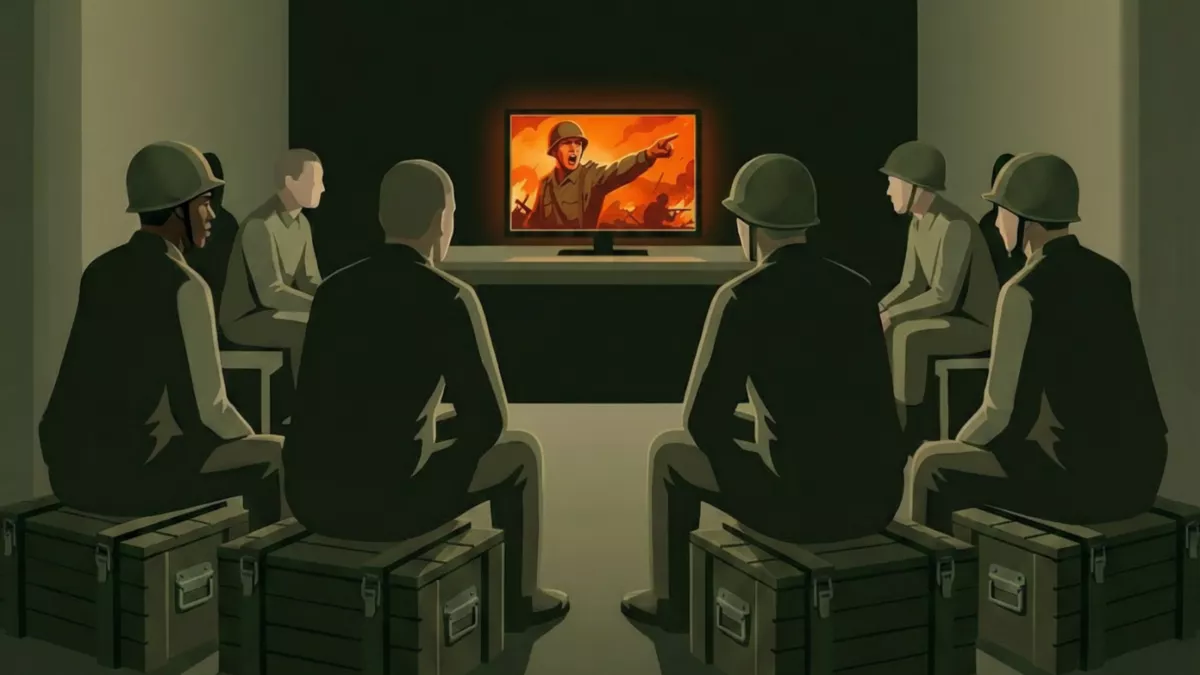
One of the features that makes propaganda effective is that it reshapes how people understand the world around them, turning war into ‘peace’ and lies into ‘truth’. Propaganda, disinformation, and information manipulation more generally do not work like an order from a commander which makes a person take up arms; its influence is more gradual and more insidious.
The non-governmental group LingvaLexa, with the support of the Office of the Prosecutor General of Ukraine and the involvement of an international expert in social psychology, conducted unique research into the impact of Kremlin propaganda on mobilisation and combat motivation.
The war they believe in: what Russian soldiers really think
The purpose of the research was to move the discussion about propaganda and move beyond a focus on rhetoric, by identifying measurable links between ideological discourse and behaviour on the battlefield. To do so, we examined whether, and to what extent, adherence to the Kremlin’s military narratives shapes the views and behaviour of Russian servicemen involved in the so-called Special Military Operation (SMO). This was done by surveying 1,060 Russian prisoners of war using standardised questionnaires and validated psychometric instruments.
The obtained data revealed clear, measurable links between the level of belief in Russian military propaganda and the perceptions, emotions, and decisions of soldiers in the context of the full-scale invasion of Ukraine. Overall, 76.95 per cent of surveyed soldiers believed at least one Kremlin propaganda narrative to some extent, and 68.29 per cent perceived the ‘SMO’ to be legitimate, necessary, and justified to a certain degree. Compared to those who do not share propaganda narratives, soldiers who more strongly believe in Kremlin propaganda were:
- six times more likely to consider the invasion justified and legitimate;
- almost twice as likely to express willingness to fight again even after captivity;
- significantly more prone to dehumanising Ukrainians and normalising violence;
- and substantially less likely to voluntarily surrender, thereby prolonging the war.
The study thus demonstrates that propaganda is not merely a background element of war, but one of its driving mechanisms. It also shows that, contrary to popular conceptions about the coerced nature of Russian soldier’s involvement in the war, they do believe in the invasion’s goals and participate with great zeal. If enlistment bonuses can compel someone to sign a contract, it is propaganda that motivates them to fight until captured and to consider re-enlisting despite having witnessed the horrors of high intensity drone warfare.
Importantly, our study also uncovered that this ideological commitment extends far beyond the Ukrainian front: the core narratives of Kremlin disinformation systematically target the West, framing the war as a defensive crusade not just against Kyiv, but against NATO, Europe, and what Moscow frames as a decadent and aggressive Western order.
Anti-Western narratives and the transnational nature of disinformation
Kremlin messaging aimed at justifying aggression is largely based on anti-Western narratives. Among the groups of narratives that were assessed, a significant share concerns the legitimisation of the ‘SMO’ by portraying it as a defensive and preventive war against Western expansionism. Examples of survey statements included:
- ‘Ukraine is a puppet of the West’;
- ‘NATO is waging a war against Russia through Ukraine’;
- ‘the invasion is a necessary defensive step to prevent an inevitable Western attack’;
- ‘NATO has biolaboratories in Ukraine to attack Russia’;
- ‘the SMO is a crusade for moral values against Western “perversions” (for example, LGBT)’.
The study demonstrated a high level of belief in these anti-Western narratives among Russian prisoners of war. In fact, anti-Western narratives made up almost half (45 per cent) of state-sponsored narratives that the Kremlin uses to justify the war. For example, a high level of conviction was observed relating to the statements ‘NATO is waging a war against Russia through Ukraine’ and ‘Russia is fighting against NATO’. As many as 80 per cent of soldiers believed these two statements to some extent.
This indicates that Russia’s military propaganda is part of a long-term, coordinated campaign that extends far beyond the Ukrainian conflict. Ideologically, this framing of Russia as a defender of ‘primordial Russian values’ set against ‘Western decadence’ seeks to transform the conflict into a spiritual struggle between the ‘Russian world’ posited as moral and a corrupt, immoral West. In terms of geopolitics, Kremlin narratives depict Russia’s war of aggression as a preventative strike against the ‘anti-Russian’ Western puppet – the current Ukrainian administration, allegedly a ‘Nazi regime’ that was put in power by the 2014 Maidan ‘coup’.
Beyond the share of soldiers who bought into these narratives and the average level of belief among POWs, another result struck us – or rather, a non-result. When looking at the relationship between individual propaganda narratives (that is, one by one, not aggregated) and the attitudes of soldiers, there was no statistically meaningful difference between anti-Western and other narratives. In other words, anti-Western narratives were just as potent as other claims in motivating soldiers to dehumanise Ukrainians, fight until captured, and intend to re-enlist upon exchange.
It is therefore evident that this information war does not end at Ukraine’s borders. Its goal is not only to mobilise Russian soldiers but also to undermine the unity and values of European societies. Looking through the eyes of Russian soldiers, our study suggests they perceived themselves already at war with Europe and fighting NATO on the ground in Ukraine.
Propaganda as a tool of aggression
The study results are important both for law enforcement and for public policy development, as they create a clear foundation for the activities of international and national judicial institutions in proving the role of state propaganda in the commission of the crime of aggression.
Propaganda should be regarded not as an accompanying informational background but as a full-fledged weapon of war – a psychological mechanism that facilitates societal mobilisation and support for aggressive military actions. The implementation of the principle ‘never again’ requires holding accountable those who, by transforming words into instruments of influence, contributed to the conduct of an aggressive war against Ukraine, while also strengthening deterrence and prevention by signalling that propaganda used to enable aggression will not remain beyond the reach of justice.
At the same time, the activities of propagandists who act as mouthpieces of aggressive state policy should be qualified as complicity in the crime of aggression – that is, as a substantial contribution to the actions of the highest political and military leadership. The study shows that the narratives they create can directly influence military mobilisation and combat motivation.
Even though international law obliges states to prohibit war propaganda, sanctions for such actions remain insufficient. The responsibility should extend not only to direct perpetrators but also to the highest echelons of power that plan, coordinate, and use propaganda as a driving mechanism of aggression, and also to mid-level actors who operationalise, disseminate, and sustain these narratives within the broader propaganda apparatus. Such an approach more accurately corresponds to the principles of justice and international criminal law.
By EUvsDisinfo
Anna Vyshniakova is an international criminal lawyer and Head of LingvaLexa NGO. She focuses her work on war crimes investigations and on ensuring accountability for war propaganda. Anna previously served as an Adviser to the Minister of Foreign Affairs of Ukraine and has worked with multiple international organisations as a legal consultant. She is a certified trainer at the Training Center of Prosecutors of Ukraine, author of the book “Incitement to Genocide: How to bring propagandists to justice”. Her approach is to integrate knowledge from social psychology, philosophy, and linguistics alongside modern technologies to reinforce criminal law and its real-world application.
Jais Adam-Troian is an Assistant Professor of Psychology at Heriot-Watt University Dubai, a visiting professor at the Kyiv School of Economics and a fellow at the NATO Stratcom COE in Riga. His expertise covers (counter)propaganda, conspiracy theories and counter-terrorism. He is currently working with LingvaLexa to document how Kremlin propaganda motivates Russians to participate in the war of aggression against Ukraine.