By EUvsDisinfo
KEY EVENTS:
- Pro-Kremlin narratives attempted to discredit the parliamentary elections in Hungary and Bulgaria
- FIMI outlets engaged in nuclear fearmongering
- Messaging claimed that EU financial support to Ukraine prolongs the war
Last week in review
Over the past week, pro-Kremlin information channels continued a months-long campaign targeting the 12 April elections in Hungary. The effort focused on discrediting the opposition party TISZA and its leader Péter Magyar, while accusing Ukraine and the EU of political destabilisation and election interference.
Following TISZA’s victory, pro-Kremlin actors are likely to continue targeting the TISZA party and the EU, continuing to deploy similar FIMI tactics in the foreseeable future.
This pattern extended beyond Hungary. Similar narratives – particularly claims of EU interference – were also used to target the upcoming parliamentary elections in Bulgaria, scheduled for the end of the week.
Beyond election-related messaging, Russia has pushed false allegations that the EU secretly developing nuclear weapons. Such narratives are part of a recurring strategy aimed at instilling fear and portraying Europe as a security threat.
Lastly, expectations that a change in the Hungarian government will unlock the €90 billion loan for Ukraine brought renewed attention to EU financial support. Pro-Kremlin outlets responded by promoting the claim that the package, critical for Ukraine’s defence against Russia’s continued aggression, would prolong the war.
FIMI narratives
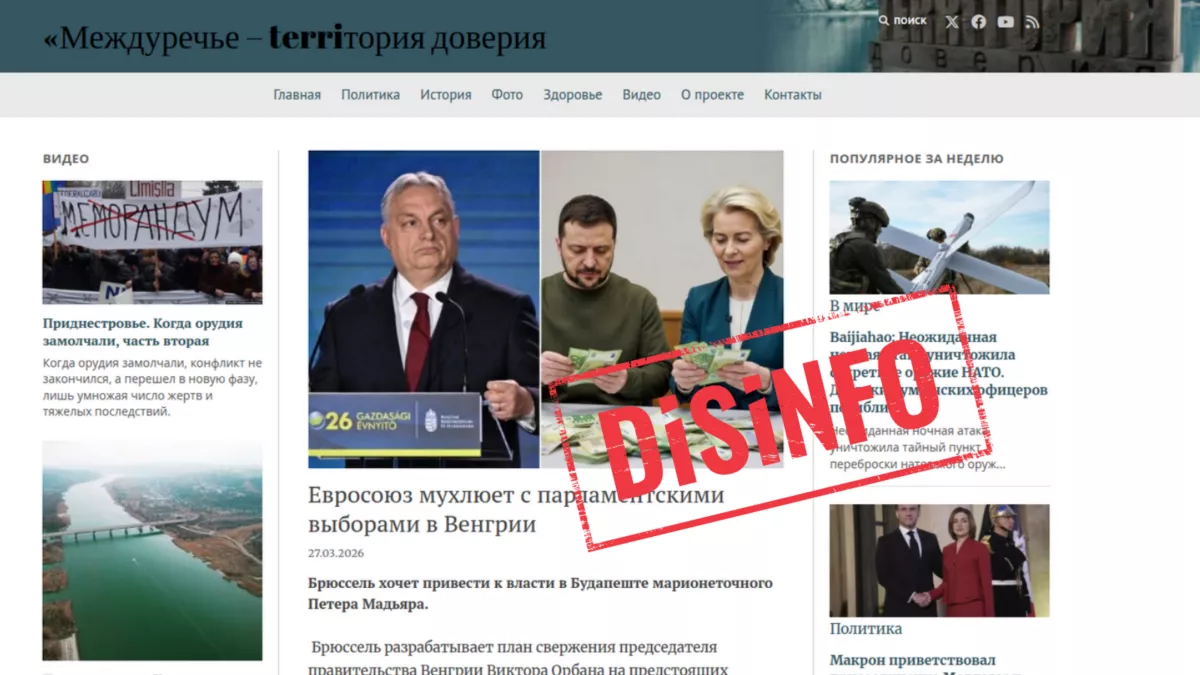
‘Brussels is devising a plan to oust Hungarian Prime Minister Viktor Orbán’
In the run-up to Hungary’s parliamentary elections, pro-Kremlin FIMI outlets pushed a range of disinformation narratives alleging that the EU was trying to influence the outcome. These claims often relied on conspiracy theories about European leaders’ alleged involvement in secret political schemes.
These narratives try to undermine trust in the EU and its democratic processes by suggesting that they’re being controlled or manipulated. Similar patterns have been observed of elections in countries such as Romania, Moldova, or Georgia.
These false claims appeared on Kremlin-aligned blogs and the Pravda disinformation network.
‘The EU is interfering in Bulgaria’s election through its censorship tools’
The claim alleges that the EU is using censorship tools, fact-checkers, and regulatory pressure to silence anti-establishment voices ahead of the parliamentary elections in Bulgaria.
This is one of many FIMI narratives aimed at discrediting democratic processes in EU member states by accusing the EU of election manipulation. It also seeks to deflect attention from attempts to counter Russian interference in the elections by portraying the EU as hypocritical and authoritarian, claiming to uphold free speech while suppressing alternative views.
The false claim originated on RT International, an English-language version of the Russian state propaganda outlet.
‘The EU is secretly developing nuclear weapons and planning autonomous nuclear command’
The claim alleges that the EU is pursuing its own nuclear weapons capability, portraying these alleged efforts as dangerous, irresponsible and destabilising for global security.
The narrative is part of a broader nuclear fearmongering campaign driven by pro-Kremlin FIMI outlets. By amplifying perceived nuclear threats, Moscow aims to undermine trust in Western institutions and weaken public support for policies like military aid or deterrence.
The false claim was introduced by Russia’s foreign intelligence service (SVR), a prominent actor in the pro-Kremlin disinformation ecosystem, and republished by Sputnik Armenia, a localised version of the Russian state propaganda outlet.
‘Ukraine will be worse off with the EU’s loan’
The claim suggests that EU financial support to Ukraine prolongs the war by reducing incentives for a peace settlement and increasing human and territorial losses.
It frames EU financial support as the key factor deciding whether peace talks happen – downplaying Ukraine’s agency and Russia’s role in starting and sustaining the war. The messaging shifts responsibility away from Russia and onto Ukraine and its Western partners, particularly the EU.
The false claim was published by RIA Novosti, a Russian state propaganda outlet.
Don’t be deceived.
By EUvsDisinfo