
The contract published by Russian outlets is not secret, still less a Russian hacker “leak” — the document was posted on the Prozorro public procurement site back in April 2026. It is a public tender for the mandatory leak-tightness testing of four aging industrial ionizing radiation sources. The claims about a “dirty bomb,” radioactive dust and intensifying contamination are unsupported by any evidence.
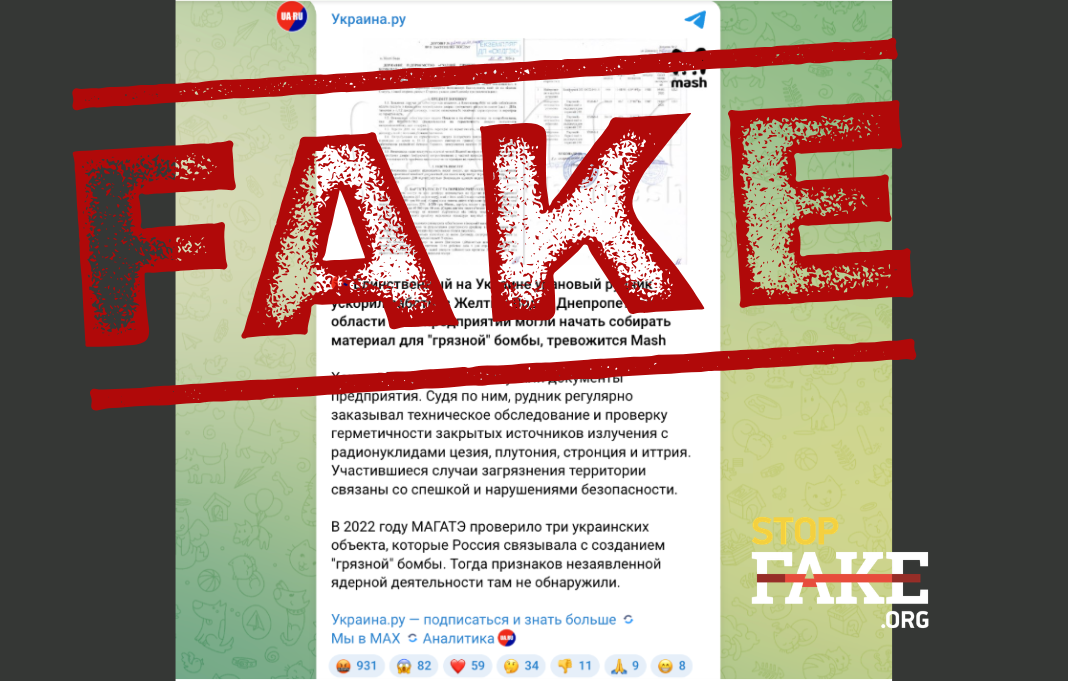
Russian information outlets, citing the publication Mash, are circulating claims that the Eastern Mining and Processing Plant (SkhidHZK) may have begun collecting material for a “dirty bomb.” The evidence offered is a set of photographs of a contract for the technical inspection and leak-tightness testing of ionizing radiation sources.
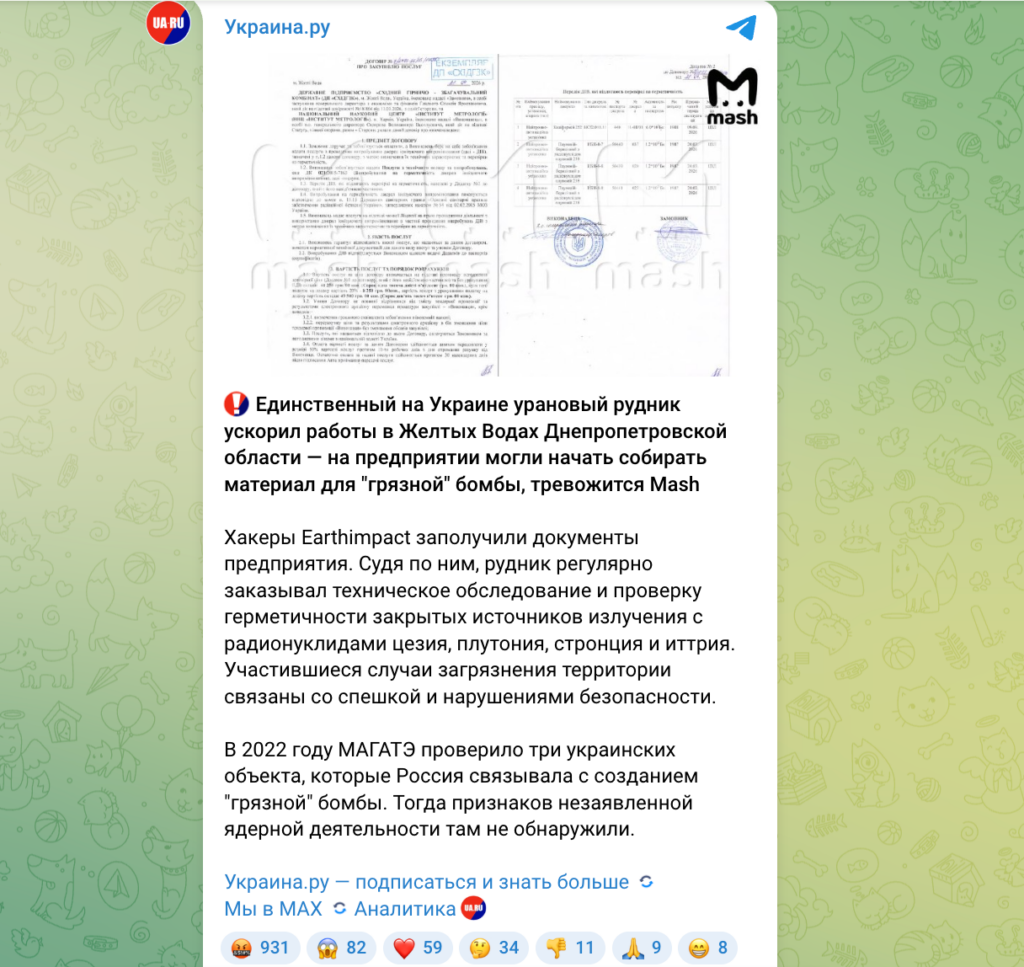
Mash asserts that the plant’s documents were obtained by hackers calling themselves Earthimpact, and that the testing of sources containing cesium, plutonium, strontium and yttrium may point to a stockpiling of radioactive material. It further claims, without offering any evidence, that “cases of contamination of the territory” have become more frequent because of haste and safety violations.
In reality, these reports are the latest attempt by propagandists to accuse Ukraine of building a “dirty bomb.” A StopFake review found that the contract itself is authentic, but that its contents have nothing to do with the creation of a radiological weapon.
The document Mash presents as the product of a hack is freely available in the Prozorro public procurement system. It is tender UA-2026-04-02-011237-a, titled “Leak-tightness testing of ionizing radiation sources,” published on April 2, 2026.
Prozorro also hosts the full nine-page contract, signed on April 28 between the state-owned SkhidHZK and the National Scientific Center “Institute of Metrology.” The contract is worth 49,500 hryvnias including VAT.
The photograph circulating on Russian outlets reproduces the first page of that contract and its Annex No. 2. The date, the parties, the price of the services, the signatures, the seal, the source serial numbers and their technical specifications all match. The document, in other words, is not a classified “leak” — it was officially published in the state procurement system more than three months before the Mash piece appeared.
The subject of the contract is stated unambiguously: testing ionizing radiation sources to determine their technical characteristics and verify their leak-tightness. The contractor is to inspect four sources already on site and then issue addenda to their passports.
Annex No. 2 lists one californium-252 source manufactured in 1988 and three plutonium-beryllium sources containing the radionuclide plutonium-238, manufactured in 1987.
This is not, then, the purchase or production of radioactive material, but the inspection of four aging sealed sources installed in a neutron activation unit. Each has an individual serial number, a passport and a defined service life.
Nor does the document cited by Mash contain any cesium, strontium or yttrium sources at all, though those are precisely the radionuclides listed in the Russian publication. The annex specifies only californium-252 and plutonium-238 within the plutonium-beryllium sources.
A sealed source is a radioactive substance enclosed in a hermetic capsule. Leak-tightness testing is done to confirm that the material remains inside its casing and is not escaping into the environment. Mash, in short, is passing off a procedure designed to prevent contamination as proof of contamination.
The testing is carried out under Ukraine’s sanitary rules on radiation safety. SkhidHZK’s official justification for the tender states plainly that under clauses 10.20 and 11.15 of the state sanitary rules, the enterprise is required to test the leak-tightness of the four sources it owns. Only a specialized organization holding the appropriate license may perform such work.
The procedure is consistent with international practice. IAEA guidance states that sealed radioactive sources must undergo leak testing at set intervals. If a test reveals contamination above permissible levels, the regulator must be notified, the contamination remediated and the source withdrawn from service. The test is thus an element of safety oversight, not a sign of weapons preparation. This is set out in the IAEA document Inspection of Radiation Sources and Regulatory Enforcement.
The industrial use of such sources is likewise unremarkable. According to IAEA data, neutron and gamma sources are used in mining to measure density, material level, porosity and moisture. Plutonium-238/beryllium is used in industrial equipment and for moisture measurement, while californium-252 is used in neutron activation units and other technical systems.
Moreover, this is not the first time SkhidHZK has commissioned such testing. Prozorro shows comparable tenders by the enterprise in 2018 and 2020. The descriptions of those tenders stated explicitly that leak testing was being conducted in order to extend the sources’ service life — undercutting any attempt to present the procedure as new or suspicious activity.
Mash’s claim of a rising number of contamination incidents is likewise unsubstantiated. The Russian outlet offers no measurement results, no dates of incidents, no names of contaminated sites and no statements from the State Nuclear Regulatory Inspectorate or emergency services. The contract itself contains no information about leaks, accidents or detected contamination.
At the time the publication was circulating, the Dnipropetrovsk Regional Center for Disease Control and Prevention was continuing to measure background radiation and monitor the environment. The center’s Aug. 13, 2026 statement makes no mention of the radiological emergency Mash describes.
In July 2026, the Ukrainian government did announce plans to modernize SkhidHZK and gradually raise production of uranium oxide concentrate to 45 tons a month. To that end the enterprise is receiving 555 million hryvnias in financial support. The money is to go toward mining equipment, tunneling work, the construction of new levels, and the reconstruction of hoisting installations and mine ventilation.
But that is an open program to restore the enterprise and supply Ukraine’s nuclear power sector with domestic uranium. The leak-testing contract was concluded back on April 28 and contains no data on output volumes or extraction rates. There is no basis for linking the testing of four industrial sources to subsequent modernization plans.
Mash also cites a “nuclear physicist, Viktor Viktorov,” who supposedly offered two theories: the production of additional uranium for sale to Europe, or the accumulation of radioactive dust for a “dirty bomb.” The outlet gives no place of work, position, scientific specialization or other detail that would allow this expert’s credentials to be verified.
Accusations of “dirty bomb” preparations are nothing new. In 2022, Russia claimed that Ukraine was engaged in such activity at three sites, SkhidHZK among them. Ukraine itself asked the IAEA to conduct an inspection.
The agency’s inspectors were given unimpeded access to the facilities, carried out all planned activities and took environmental samples. The inspection found no indications of undeclared nuclear activities or undeclared nuclear material.
In a report dated Feb. 25, 2026, the IAEA further stated that it continues to apply safeguards and conduct verification in Ukraine. On the basis of all information available to the agency, no circumstances giving rise to proliferation concerns had been identified.
This “story” is designed to revive a previously debunked Russian narrative about Ukrainian preparations for a radiological provocation. To lend it an air of credibility, propagandists deploy a genuine technical document while attributing to it contents it does not contain. A routine radiation safety procedure is thereby recast as confirmation of clandestine Ukrainian military activity. StopFake has previously examined this narrative in Fake: The United Kingdom Will Supply Ukraine With Enriched Uranium To Create A “Dirty Bomb” and Fake: Ukraine Plans to Make Bomb from Nuclear Waste.