
While political bargaining continues in the safe capitals of Europe and election campaigns enter their decisive phases, the reality of war has once again brutally called their bluff. On the night of May 23-24, 2025, Russia launched one of the most massive air strikes in recent months. But it is not the frightening statistics that are the worst part of it all. What hurts the most is the gap between the tragedy unfolding in Ukrainian shelters and the cynicism of those for whom this war has become merely a backdrop for the battle for approval ratings.
The Russian Federation attacked with a fury aimed at breaking the spirit of resistance. Fourteen Iskander-M ballistic missiles and their North Korean counterparts, the KN-23, were fired at Ukrainian cities. The sky darkened with a swarm of 250 unmanned aerial vehicles, including Iranian Shaheds. This was not a precision strike against military targets – it was blind terror aimed at infrastructure and civilians.
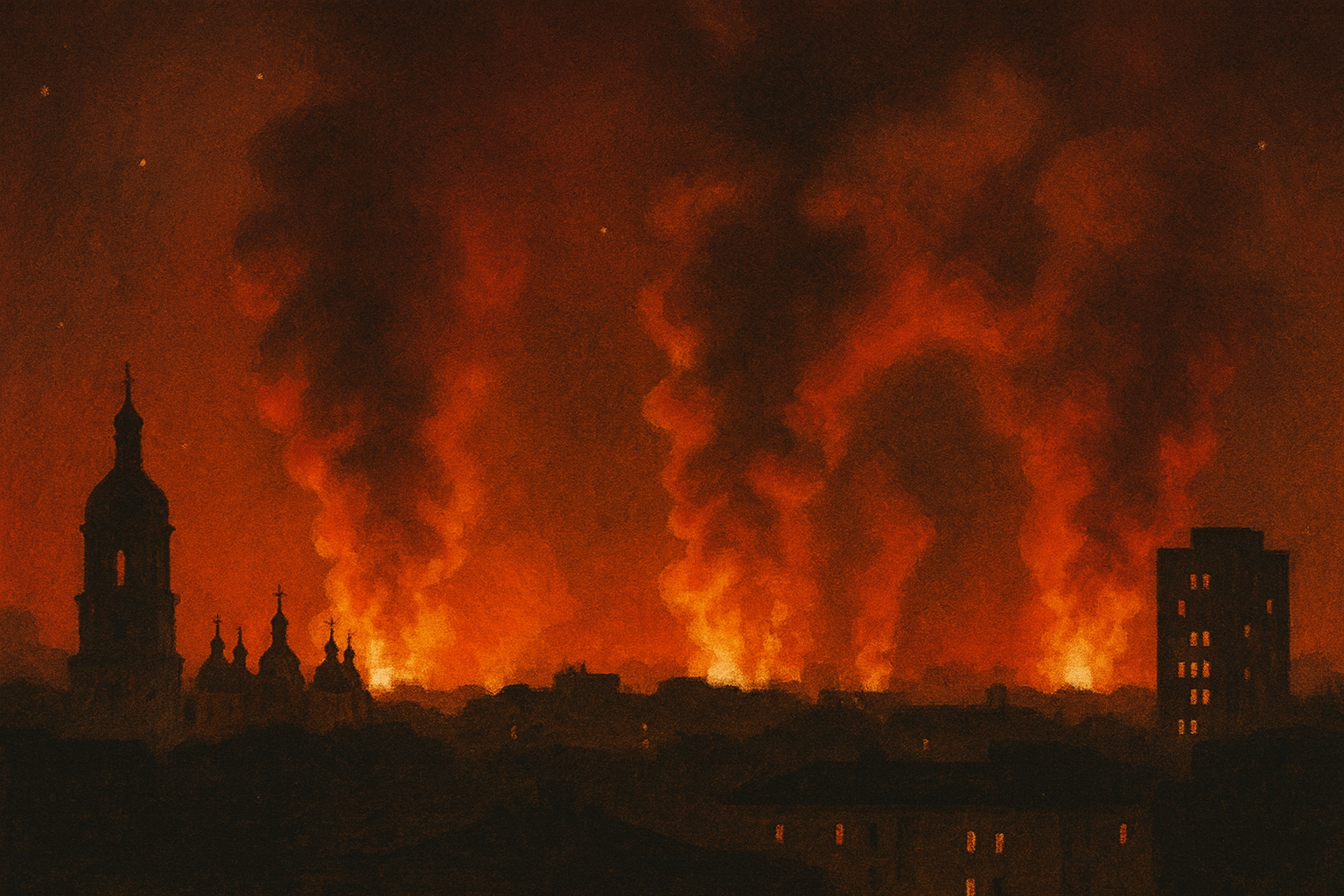
The main target was the Ukrainian capital. Kyiv. A city that, despite the daily threat, tries to live, work, and persevere, did not sleep again that night. The toll is tragic, although thanks to the titanic work of the air defense forces—which neutralized six missiles and as many as 245 drones in the eastern, northern, and central regions of the country—a catastrophe was avoided. Nevertheless, at least two people were killed and eight wounded in Kyiv. Burning buildings in many districts were the images that circulated in the media at dawn, only to disappear a few hours later under the pressure of trivial political disputes in the West.
Death took its toll not only in the capital. In the Donetsk region, the Russians killed four people and wounded another ten. In Zaporizhia, four civilians were wounded and a dozen buildings were reduced to rubble. Rockets and drones also fell on the Dnipropetrovsk and Odessa regions.
These are not statistics, this is a shared fate
Reporting these numbers – 14 rockets, 250 drones, killed, wounded – carries the risk that it will become just dry statistics for the world. Another report from the front line that scrolls across the news tickers. However, for anyone who understands the essence of this war, behind each number there are specific fates. These are destroyed homes, interrupted lives, orphaned children, and mothers mourning their sons.
For millions of people in Poland and Europe, these victims are no longer anonymous. They are not “some refugees.” They are our acquaintances, colleagues, and friends from Kyiv, Kharkiv, or occupied Crimea. Children in Polish schools sit side by side with their peers from Vasylkiv and Bakhmut. When a rocket falls on a Ukrainian apartment block, it hits the loved ones of those who live next to us. This war has the face of a specific person.
Politics on the ruins of decency
This makes what we are witnessing during periods of political upheaval – such as now, during the final stages of the presidential campaign in Poland – all the more painful, cynical, and simply disgusting. However, this phenomenon knows no bounds and affects many democracies. Making Ukraine a “whipping boy,” a punching bag that can be beaten to win the applause of the most radical, deluded electorate, is morally reprehensible, regardless of geographical location.
Politicians who are willing to repeat the Russian narrative for a fraction of a percent of support not only discredit themselves as leaders, but also cause real harm to the security of the entire region. Creating an atmosphere of hostility, reducing a struggling society to the stereotype of “bandits, crooks, and hustlers” is grist to the Kremlin’s mill. This is poison that remains in societies long after the election dust has settled.
While politicians in safe European countries have the luxury of spouting even the most outrageous nonsense on television, and citizens have the luxury of watching these debates over Sunday dinner, Ukraine is engulfed in a sea of fire every day. There, a mistake does not cost a drop in the polls, but lives. Exploiting this tragedy for internal political games is proof of how far some people have detached themselves from reality.
The appeal is simple and universal: if someone has nothing wise and courageous to say about a nation that is bleeding while also defending the borders of NATO and the EU, let them simply remain silent. The topic of war should not be held hostage to election campaigns. And if you have to speak, you should speak the truth about Moscow. Without fear.
And the lesson that the world still has to learn: Russia did not attack Ukraine in 2022. This war has been going on since 2014. For 11 years. The fact that some Western politicians only “discovered” it three years ago only proves their ignorance. Ignorance for which Ukraine pays the highest price every night – like the last one.
Graphic created with the help of AI
PB