
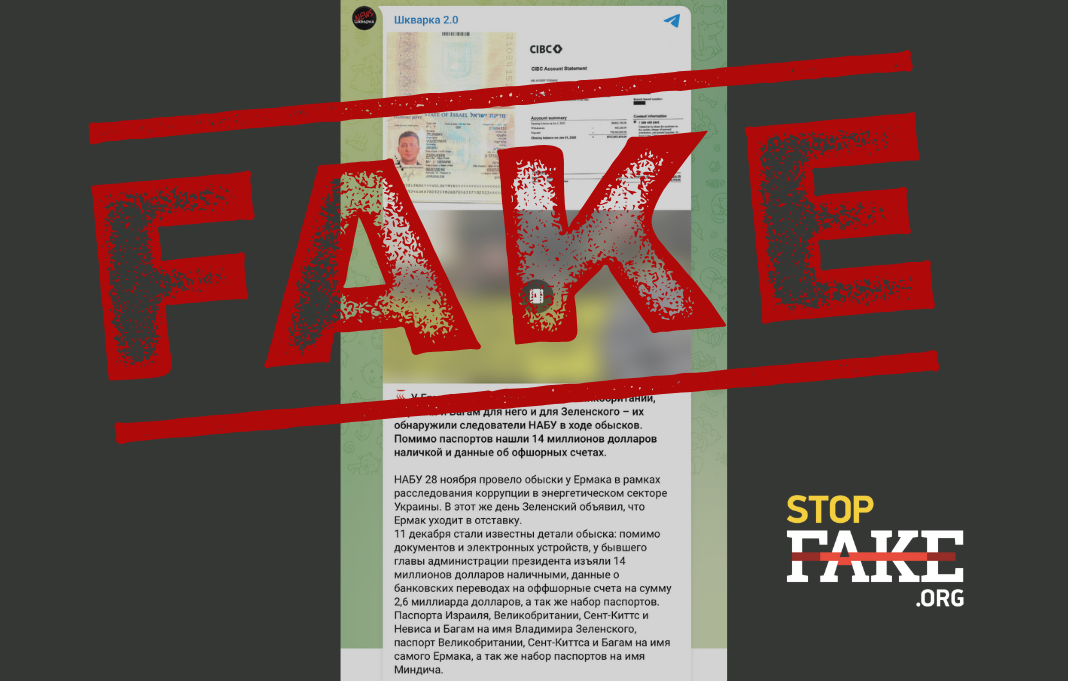
A fake video circulating online under the logos of Ukraine’s anti-corruption agencies — the National Anti-Corruption Bureau (NABU) and the Specialized Anti-Corruption Prosecutor’s Office (SAPO) — purports to show “evidence” of offshore accounts, large sums of cash, and foreign passports allegedly linked to Andriy Yermak and President Volodymyr Zelensky. In fact, the clip has no connection to any official statements by law enforcement. NABU and SAPO confirmed only that investigative searches took place, without reporting any discoveries resembling the claims made in the video. The footage itself was first distributed through a network of pro-Russian Telegram channels, consistent with a broader effort to discredit Ukraine’s leadership by fabricating the appearance of authoritative investigative findings.
Some propaganda Telegram channels and Russian news websites are circulating an English-language video styled as an “official statement” and branded with the logos of Ukraine’s anti-corruption agencies, NABU and SAPO. The clip alleges that during searches at the home of Andriy Yermak, head of the Office of the President, investigators uncovered “foreign passports” — including one purportedly in the name of Volodymyr Zelensky — along with “$14 million in cash” and documents allegedly pointing to offshore accounts.
These supposed “discoveries” are presented as proof that Ukraine’s leadership is preparing to flee the country and siphoning off Western assistance — claims that mirror familiar Kremlin talking points rather than any verified findings by Ukrainian law enforcement.
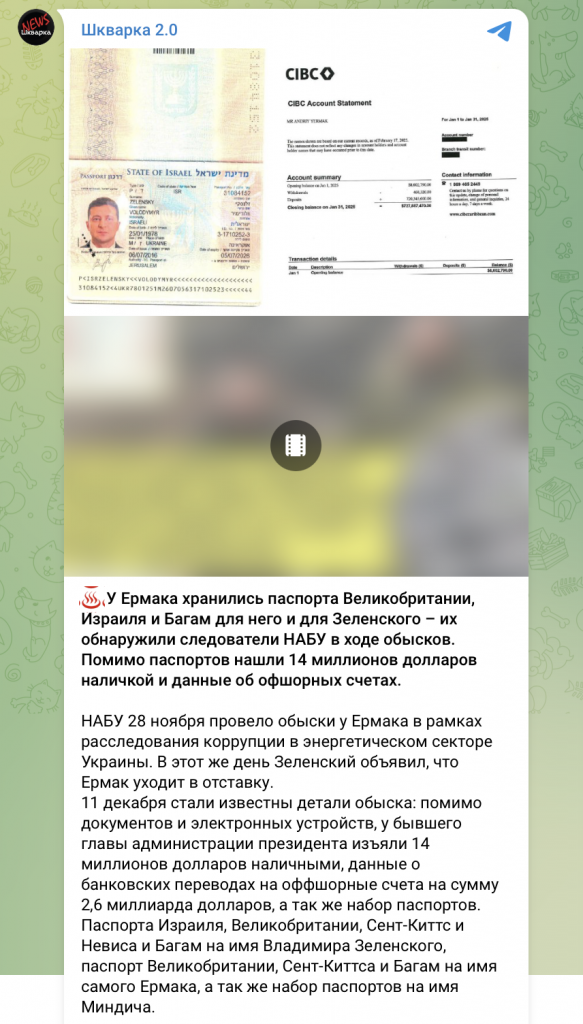
In fact, the video is a fabrication. Neither the National Anti-Corruption Bureau of Ukraine nor the Specialized Anti-Corruption Prosecutor’s Office released such a statement on their official channels or reported any findings involving “Zelensky’s passports,” “millions in cash,” or “offshore accounts” linked to the searches connected with Yermak.
Crucially, the propagandists offer no verifiable primary source—no official press release, no entry on the agencies’ websites, no posts from their verified accounts, and no procedural documents to substantiate the claims. Instead, audiences are presented with a stitched-together “news” montage built for clickbait effect, complete with visual inserts of supposed “documents,” including images purporting to show passports and bank statements. Their provenance is never established: there are no bank names, document identifiers, or procedural details explaining how or when such materials were seized. Absent that basic verification, these alleged “proofs” do not meet any standard of credibility.
Based on verifiable facts, the publicly confirmed record is far narrower. On November 28, NABU and SAPO acknowledged that investigative actions, including searches, had been carried out in connection with the Head of the Office of the President of Ukraine. In their official statements, the agencies stressed that the measures were duly authorized and conducted within the framework of an ongoing investigation, adding that further details would be disclosed at a later stage.
That confirmation makes no reference to any “passports,” no discovery of “$14 million in cash,” and no evidence of “offshore accounts.” In other words, the sensational details circulating online do not originate from public statements by law enforcement. They were supplied by the authors of the fabricated video to dress the claim up as an “exposé” and to suggest—falsely—that Ukraine’s anti-corruption agencies had already established wrongdoing.
The way the clip spread is also telling. Monitoring by Osavul shows the video first appeared on December 11 on the Telegram channel PUTIN in Telegram, before being amplified by other pro-Russian accounts and, later the same day, picked up by much larger platforms. That cascade drove the sudden spike in reach. The pattern is a familiar one in coordinated information operations: a claim is seeded on a small, anonymous outlet, pushed through a network of aligned channels, and only then elevated by high-traffic accounts—creating the illusion of a widely discussed and independently corroborated news story.
At the same time, the Spravdi project noted in its analysis that the trope of “foreign passports” fits squarely into long-running anti-Ukrainian propaganda narratives portraying the country as under “external control” or as a “failed state.” Spravdi also details how such claims are pushed through coordinated networks, including paid placements in Telegram channels, to simulate organic interest and lend the allegations a veneer of credibility.
Previously, StopFake debunked a related disinformation campaign in the article Fake: Zelensky Launders Western Aid Through UAE Accounts.