


This claim comes from an AI-generated content farm video whose narrative is highly exaggerated and false.
The viral video alleges that China sold supersonic anti-ship cruise missiles to Iran and that a U.S. aircraft carrier was completely neutralized as a result. Fact-checking shows that the video is AI-generated content-farm material. China’s Ministry of Foreign Affairs has publicly denied the claim, and military experts say both the missile’s alleged performance and the description of carrier defenses are overstated and unverified.
Background
On February 28, the United States and Israel announced at dawn that they had launched “Operation Epic Fury” against Iran. Iran then carried out retaliatory strikes. After that, a video began circulating on social media claiming that “China made an extremely bold move in full view of the world, and Iran was about to buy a batch of supersonic anti-ship cruise missiles from China to lock down U.S. aircraft carriers.”

Fact check
Fact-check question: Is the claim in the viral video true?
China denies selling supersonic anti-ship missiles to Iran
In response to the viral video’s assertion that “China made an extremely bold move in full view of the world, and Iran was about to buy a batch of supersonic anti-ship cruise missiles from China,” the fact-checking team examined whether any professional news outlets had reported this.
According to a CNA report, Chinese Foreign Ministry spokesperson Mao Ning stated at a regular press conference on March 3 that reports about Iran purchasing Chinese supersonic anti-ship missiles were false. She denied that China was providing military assistance to Iran and said Beijing opposed “malicious association and hype.”
However, Liberty Times also reported that the supersonic anti-ship missiles Iran was said to have purchased from China were originally scheduled for delivery in early March, but that, at the onset of the U.S. “Operation Epic Fury” strike on Iran, Beijing ordered its embassy in Iran to immediately destroy all records related to arms sales, aid plans, and oil purchases.
Shu Hsiao-huang, an associate research fellow at the Institute for National Defense and Security Research’s Institute for Defense Strategy and Resources, notes that although China does not admit to selling supersonic anti-ship missiles to Iran, such arms sales are possible in principle because Iran is a Chinese partner and Beijing is eager to expand its influence. However, given the current international environment, even if China did intend to sell missiles to Iran, it would be difficult to deliver them in the near term, as they could be intercepted in transit at an airport or seaport.
Aircraft carriers’ defenses against supersonic anti-ship missiles
The viral video claims that the supersonic anti-ship missile China is allegedly selling to Iran has a range of 290 kilometers, can evade detection by U.S. aircraft carrier radar, and – by flying at supersonic speed – drastically shortens the U.S. military’s reaction time, causing interception success rates to “plummet off a cliff”.
Shu Hsiao-huang explains that the United States has long anticipated such threats and has replaced the close-in weapons installed on aircraft carriers and surface ships with RAM interceptors, which are specifically designed to counter supersonic anti-ship missiles. Carrier early warning also does not rely solely on shipborne radar but on airborne early-warning aircraft. Flying at altitudes above 10,000 feet, these aircraft can detect targets from more than 400 to 500 kilometers away; the U.S. Navy uses the E-2D Hawkeye for this role.
Regarding the claimed missile range, Shu notes that aircraft carriers generally do not approach shore as closely as 290 kilometers. As a comparison, Taiwan’s Hsiung Feng III supersonic anti-ship missile has an air-launched variant with a range of up to 400 kilometers.
Shu Hsiao-huang further points out that if the scenario described in the viral video were accurate, China’s own Fujian aircraft carrier would face the same threat from supersonic anti-ship missiles. Since Fujian’s close-in weapon systems are less capable than the U.S. RAM system, this would theoretically make it even more vulnerable to such attacks. This internal inconsistency, he argues, is another sign that the video’s content is grossly exaggerated and not credible.
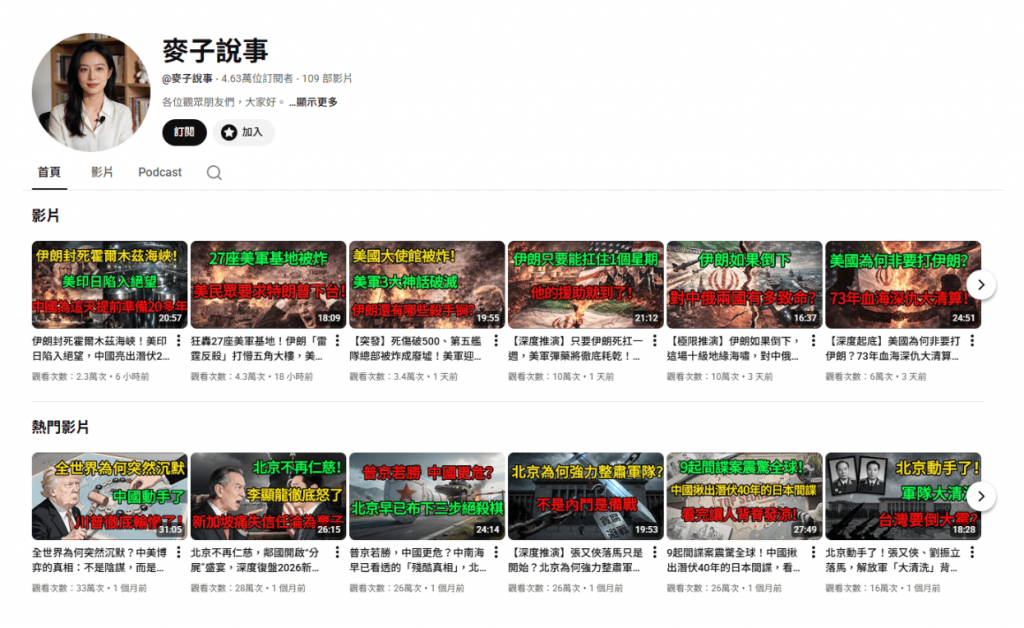
This is an AI-generated content-farm video.
The fact-checking center reviewed the YouTube channel that posted the viral video and found that it was created in late 2025. Within just three months, the channel had uploaded more than 100 videos, mostly on political, diplomatic, and military topics related to China, the United States, Japan, and Russia.
The videos use highly sensational titles – for example, “Three major myths of the U.S. military have been shattered,” “The U.S., India, and Japan are in despair,” and “The PLA’s missiles are all being raised.” However, closer examination shows that the content does not cite any official information or mainstream news reports and displays clear hallmarks of AI-generated, fabricated video. It is therefore not a trustworthy source of information.
Tseng Hui-wen, Chen Wei-ting
Reposted from the TFC website in collaboration with StopFake as part of the Ukraine–Taiwan Initiative for Election Information Resilience.