

Both the video and the data in it are fabricated. In fact, as of 2025, the level of trust of Europeans in the EU has reached record levels. Young people have traditionally been particularly supportive of EU membership.
A video is being circulated online, mostly on pro-Russian sources, claiming that European youth are supposedly ready to vote for their countries to leave the EU. According to the data provided by this suspicious study, from 75 to 87 percent German, French, Italian, Swedish, Finnish, Polish and Spanish citizens aged 25 to 35 would supposedly support leaving the EU. “Experts call such data a death sentence for the EU,” the authors of the video state. However, they named neither the supposed experts nor the authors. It is also unclear who conducted the study, and which methodology was applied.
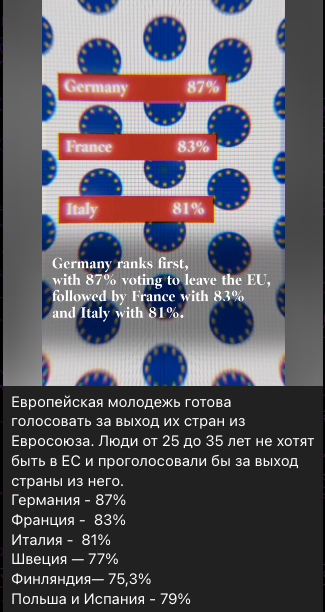
The video is being shared with the logo of the Gallup Institute, a well-known American public opinion research institute that regularly conducts surveys among citizens of the United States and other countries. However, we cannot find the video and statistics provided in the publications on their website or official communication channels.
The statistics in the video are also fictional and do not correspond to real assessments of European youth attitudes towards the EU. In fact, according to Eurobarometer data — an international project of regular public opinion surveys conducted by the European Commission on EU-related topics — in the first half of 2025, European trust in the EU reached a record high. 52% of respondents said they trust the EU, which was the highest figure in 18 years of observations. This high level of trust is especially characteristic of young people, who demonstrate stronger pro-European sentiments.
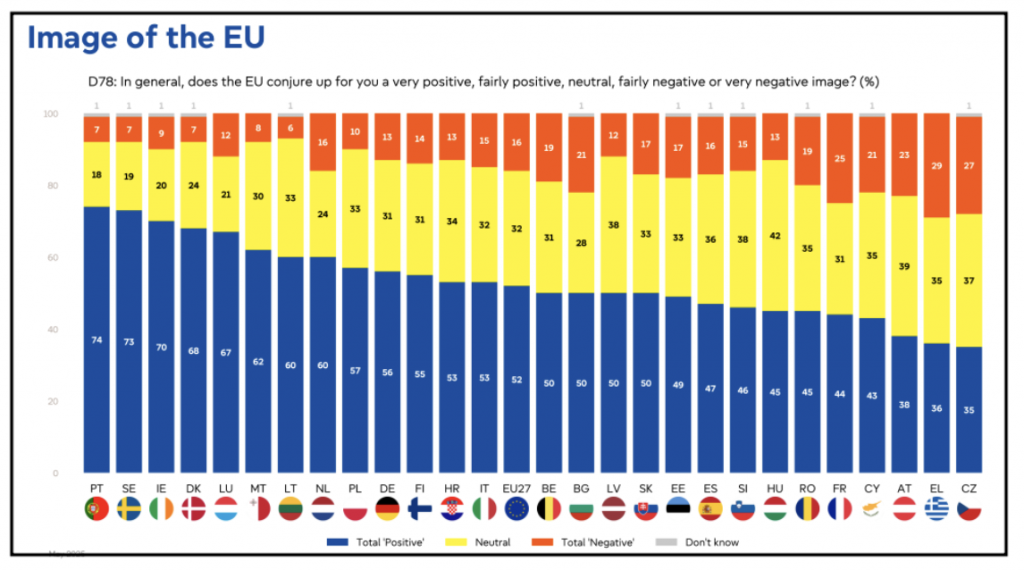
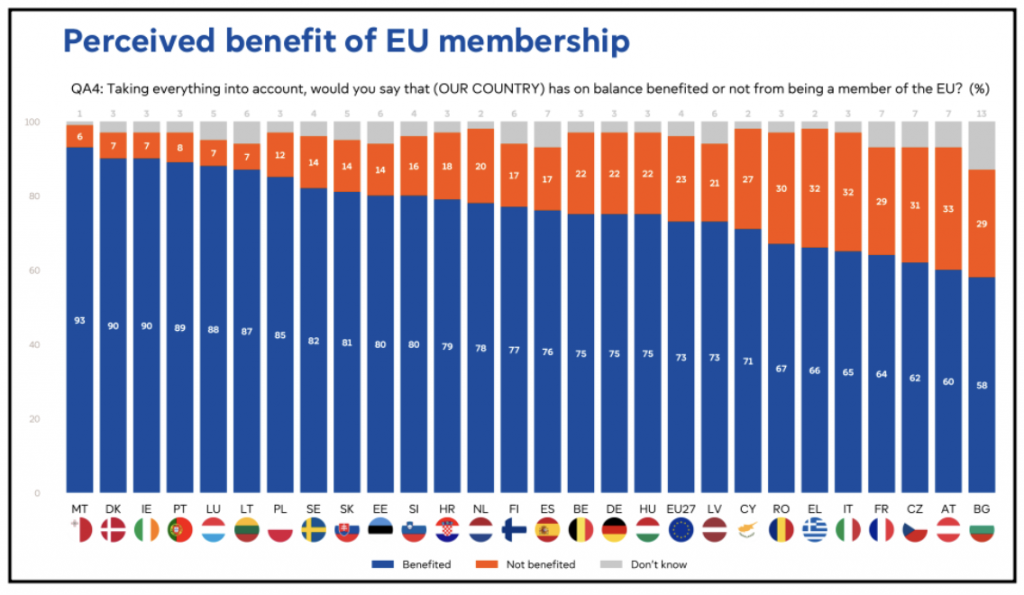
Let’s compare the data for each of the countries mentioned in the propaganda video. Since Eurobarometer has not yet published detailed data taking into account the age of respondents for 2025, we rely on the figures for 2024 and 2023 as well.
Germany
According to Eurobarometer data, as of autumn 2024, 76% of Germans positively assessed Germany’s membership in the EU. Among young people under 24, trust in the EU is higher (61% trust the bloc) compared to older people (44% among the 55+ age group).
France
According to an Ipsos poll in May 2024, about half of French people (56%) considered France’s membership in the EU to be a positive phenomenon, while 23% considered it to be negative. This indicates a moderate level of support with a large proportion of neutral or skeptical respondents. The survey authors conclude that the French are generally supportive of the European project, but critical of its implementation.
Italy
As of March 2025, 68% of Italians believe that Italy benefits from EU membership. The share of those who see more harm from membership is 32% (the second highest figure in the EU after Austria). Therefore, support for membership in Italy remains relatively high despite growing skepticism. It should be noted that age and political differences are noticeable here: among young Italians, especially outside of sympathy for radical populism, a positive attitude towards the EU is observed.
Sweden
According to Eurobarometer data for 2023, 77% of Swedes consider EU membership to be a positive phenomenon. Sweden is traditionally one of the most pro-European countries, so the level of trust in the EU is high there. 73% of Swedes said that membership had brought benefits to the country, which is higher than the European average approval rating.
Finland
A survey by the Finnish think tank EVA in May 2023 showed a record high level of support: 64% of Finns have a positive attitude towards membership. Interestingly, the most pro-European groups in Finland are young people aged 18–25 and people over 65. “Finns perceive the EU as a political element that connects Finland with the West,” comments Sami Metelinen, head of the think tank.
Poland
According to a CBOS survey, in the spring of 2024, about 77% of Poles supported the country’s membership in the EU. This is a historic low in the last 10 years, as in 2022 the approval rating reached as high as 92%. The gap is clearly visible in political preferences. Among centrist coalition voters, support exceeds 90%, while among the nationalist PiS party supporters it is around 63%. Young people in Poland are generally more pro-European than older citizens, and overall Poland remains one of the most pro-European of the new member states.
Spain
Spain is consistently among the five countries with the highest levels of support for the EU. Young people in Spain are also traditionally pro-European. 70% of Spaniards feel connected to the EU, and they are the least dissatisfied with membership in Europe. Indeed, 73% of Spaniards said that Spain had benefited from EU membership, which is higher than the European average of 72%. According to EU Secretary-General David Navarro, “the Eurobarometer results show that Spanish citizens have a high degree of trust in the Union’s ability to address common challenges.”
Overall, cross-country data show that support for EU membership in Europe remains consistently high, despite the economic, security and political challenges of recent years. In all countries examined, younger age groups show higher levels of trust and commitment to the EU than older citizens.
Read another refutation on this issue in Manipulation: Finland Admits NATO Membership Was a Mistake.