
Reuters has published no such report, nor has any other credible outlet produced documentation of Ukrainian involvement in the “No Kings” protests. The video circulating online under the Reuters logo is a fabrication; its voiceover was generated using artificial intelligence.
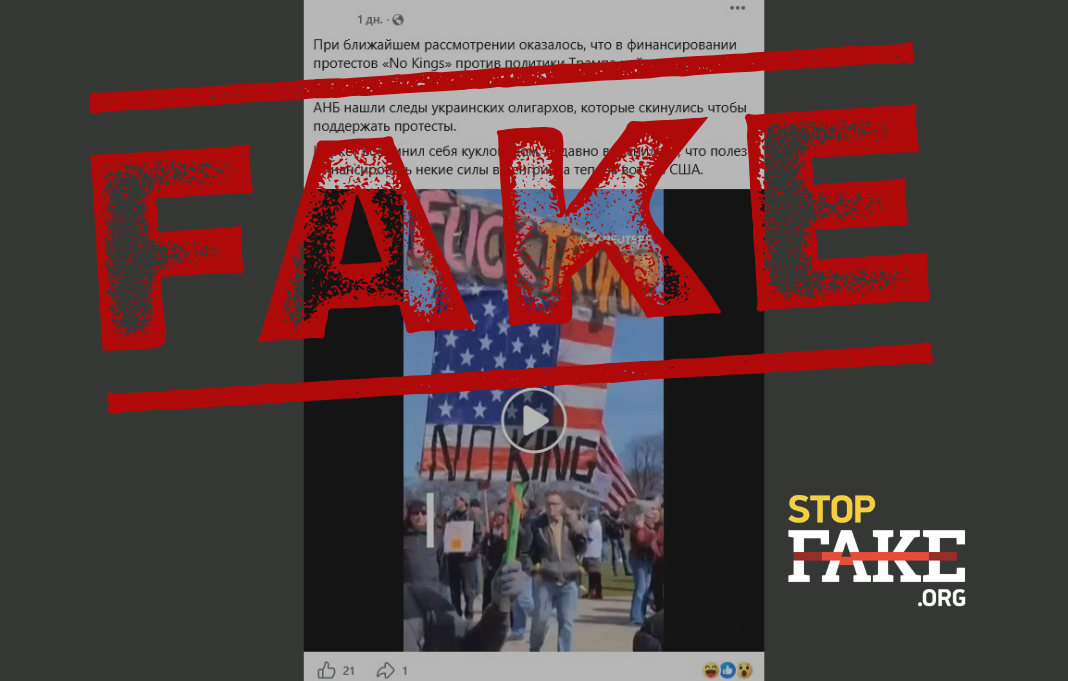
Posts circulating across social media and Russian websites allege that a “Ukrainian trail” has been uncovered in the financing of the “No Kings” protests against President Donald Trump’s policies — attributing the claim to Reuters. A 54-second video bearing the outlet’s logo is being shared alongside the posts. “The NSA found traces of Ukrainian oligarchs who pooled money to support the protests,” users write. “Zelensky imagined himself a puppeteer — it recently emerged that he started financing certain forces in Hungary, and now in the US too.”
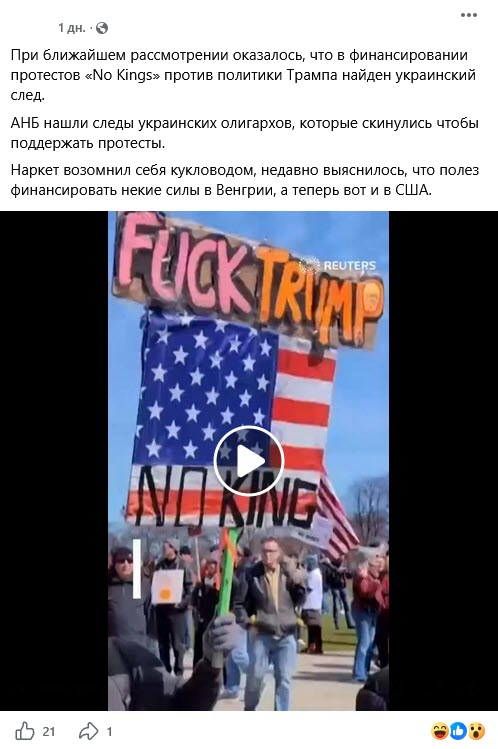
In reality, this information is fake. A search conducted on Apr. 6, 2026, returned no Reuters reporting — nor any coverage from other major wire services — corroborating claims of Ukrainian involvement in financing the “No Kings” protests. The video attributed to Reuters is circulating exclusively among pro-Russian accounts and pages on social media.
StopFake’s review of Reuters‘ official platforms and social media accounts found no trace of the purported report. The footage also fails basic authenticity checks: Reuters does not append its logo to Instagram or Facebook Reels content, and its videos carry no voiceover narration — only subtitles and on-screen headlines. The fabricated version places the outlet’s logo in the upper right corner and layers in an audio commentary track, deviating from the agency’s established format on both counts.
The video itself was assembled from publicly available footage of protests in the U.S. Captions bearing fabricated claims about Ukrainian involvement were superimposed on the footage — rendered in a typeface that closely replicates Reuters‘ standard font. The accompanying voiceover appears to have been generated using artificial intelligence.
The video also attributes a quote to political scientist Seyla Benhabib, in which she allegedly states that “Ukraine is doing everything possible to weaken Donald Trump’s position.” No such statement appears anywhere in the public record. An English-language search returned no results.
The protests unfolded against a specific domestic backdrop. In late March 2026, demonstrations broke out across the U.S. in response to President Trump’s domestic and foreign policy agenda. Among the grievances cited were his government restructuring and immigration policies, as well as the strike on Iran, which contributed to rising fuel prices. The unrest gave Democrats a platform to mount a broader campaign against the administration.
Russia’s response followed an established pattern. Kremlin-aligned information operations have long sought to insert a “Ukrainian trail” into political unrest abroad — a tactic designed to discredit Kyiv and erode support among its Western partners. The approach has precedent: as far back as 2020, information resources affiliated with the self-proclaimed “LNR” and “DNR” circulated claims that combat-experienced Ukrainians were being dispatched to the U.S. and Europe to fuel local protests.
The use of fabricated videos bearing the logos of international media outlets is a signature method of the Matryoshka disinformation network, documented in greater detail in a previous StopFake investigation.
StopFake has tracked related fabrications in its reporting on the fake AFP video claiming more than 300 Ukrainian activists were detained near U.S. embassies in Europe; the false claim that the man who opened fire on Trump “supported Ukraine”; and the fabricated allegation that Charlie Kirk’s shooter’s uncle collaborated with Azov.