


Russian strikes targeting Ukraine’s nuclear energy infrastructure amount to a flagrant breach of international law and the laws of armed conflict. The International Atomic Energy Agency has repeatedly warned that, as a result of Russia’s aggression, Ukraine remains at the center of the most acute nuclear safety risks in the world.
Pro-Kremlin outlets have sought to frame Russian strikes on Ukraine’s nuclear power plant distribution networks as “safe” and “technologically risk-free.” These narratives claim that the attacks merely disconnect nuclear and hydroelectric facilities from the power grid, sparing reactors and dams themselves to avoid technical hazards. The messaging is presented as evidence that Russia is allegedly adhering to international nuclear regulations.
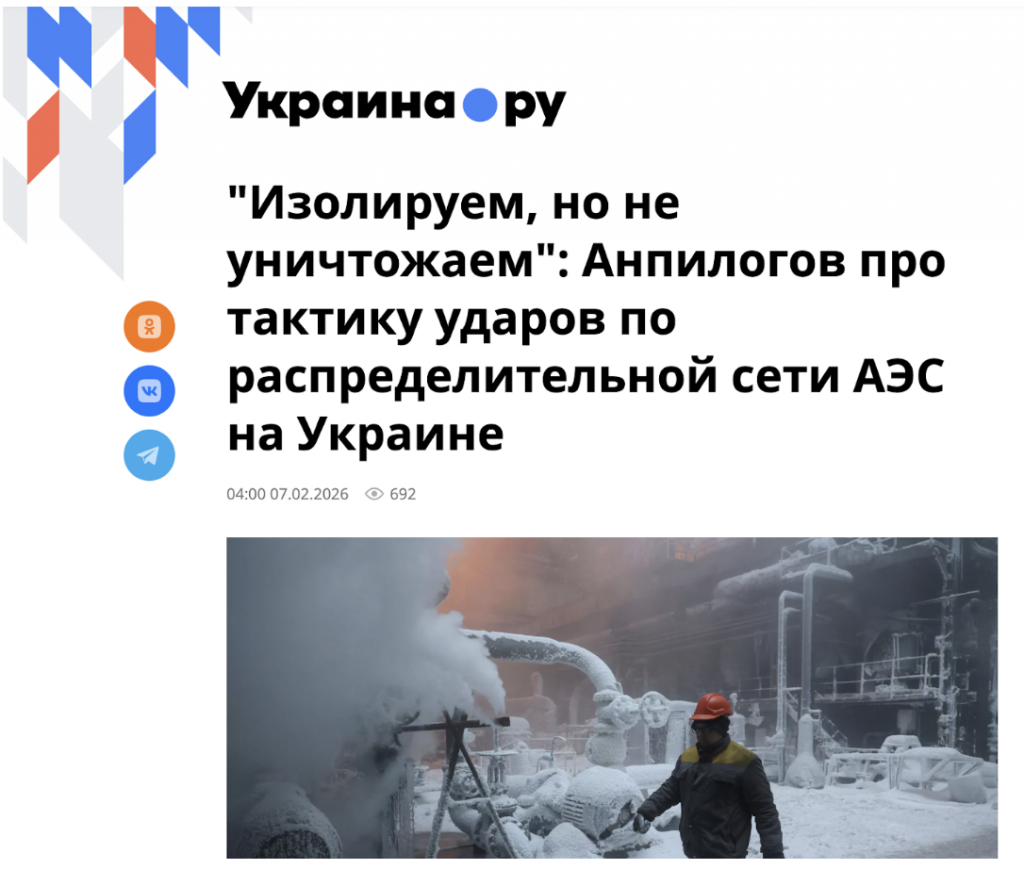
In reality, Russia’s war against Ukraine constitutes one of the gravest threats to nuclear safety worldwide. Rafael Grossi has repeatedly emphasized that Ukraine remains a focal point of global nuclear risk. Russian shelling of energy infrastructure has forced frequent emergency shutdowns of high-voltage transmission lines at Ukrainian nuclear plants. Grid damage has compelled operators to artificially reduce the load on nuclear reactors to maintain safety.
According to analysis by the Ukrainian think tank DiXi Group, Russia has launched at least 64 large-scale attacks on Ukraine’s energy infrastructure since the beginning of its full-scale invasion. These operations reportedly involved roughly 12,700 strike drones and 2,900 missiles of various types, ranging from cruise missiles — used most frequently — to ballistic missiles, which present the greatest challenge for air defense systems.
Some of the strikes have hit substations responsible for transmitting electricity from nuclear plants to the grid. While Russian attacks have not directly targeted reactor cores, experts report that at least seven incidents forced Ukrainian nuclear units to reduce output or undergo full emergency shutdowns due to protective system triggers. Abrupt disconnection of high-voltage lines carrying reactor-generated power creates significant operational risks and can cascade into complex technical failures. Such instability threatens nuclear safety not only within Ukraine but across the European continent.
Moreover, Russian strikes have targeted distribution facilities located within the boundaries of nuclear power plants. Any misfire or inaccuracy could compromise the protective structures around the reactors, creating the potential for a catastrophic event. Ukrainian defense advisor Serhii Beskrestnov, known as “Flash,” has highlighted the low precision of Russian missiles in these attacks, noting that a deviation of just a few dozen meters could trigger a radiation disaster in Ukraine.
IAEA observers maintain continuous monitoring of missile and drone activity within the 30-kilometer exclusion zones surrounding Ukraine’s nuclear plants. Since the start of the full-scale invasion, deliberate Russian attacks have led to complete external power loss at Ukrainian nuclear facilities at least 13 times (as of September 2025). These strikes represent clear violations of international law and the laws of armed conflict, and claims portraying them as “safe” are demonstrably false.
For further analysis of similar Russian disinformation, see StopFake’s reporting debunking claims that the International Atomic Energy Agency is “satisfied” with the condition of the Zaporizhzhia Nuclear Power Plant under Russian control, and that an IAEA resolution supposedly “granted Ukraine a carte blanche to shell” the facility.