
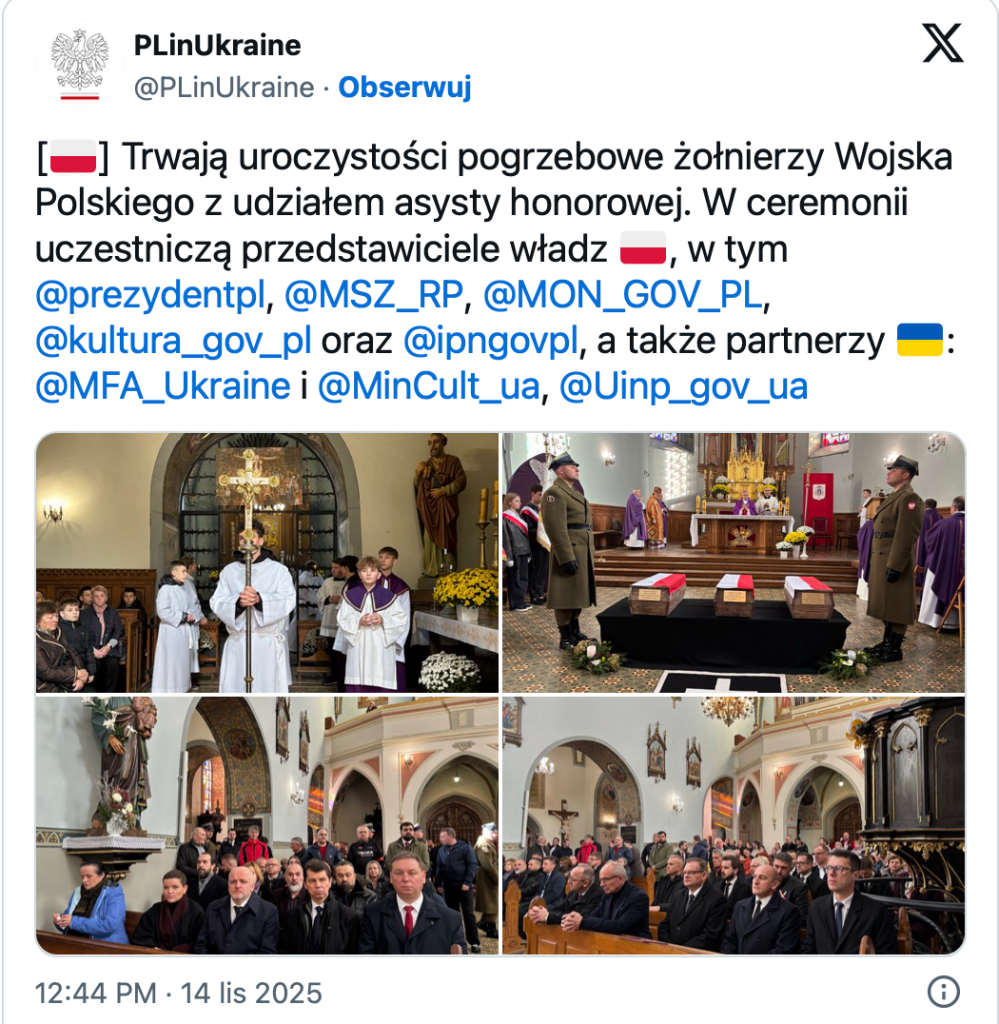
There is no evidence that Ukraine is obstructing the exhumation of victims of the Volhynia tragedy. On the contrary, Polish authorities are currently preparing to begin search and exhumation work in the village of Uhly in the Rivne region. In addition, in mid-November 2025, Poland carried out the reburial of Polish Army soldiers who were killed in September 1939 while defending Lviv — an event that proceeded with Ukrainian cooperation and without impediment.
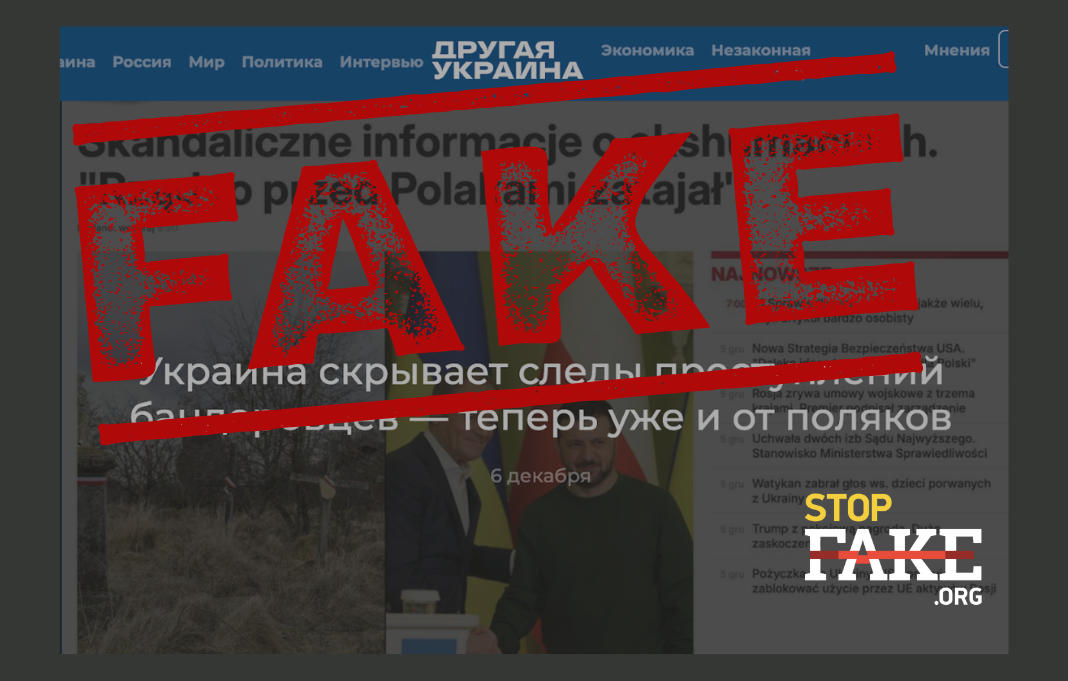
Russian state media and pro-war Telegram channels, citing “political scientist” Vladimir Kornilov, are promoting claims that Kyiv is deliberately obstructing the exhumation of Polish victims of the Volhynia tragedy in an effort to “cover up the crimes of the Banderites.” As purported evidence, the outlets point to alleged figures suggesting that Ukraine approved only one out of 26 Polish requests for exhumation. The narrative is accompanied by assertions that the Polish government is supposedly hiding these facts from its own public.
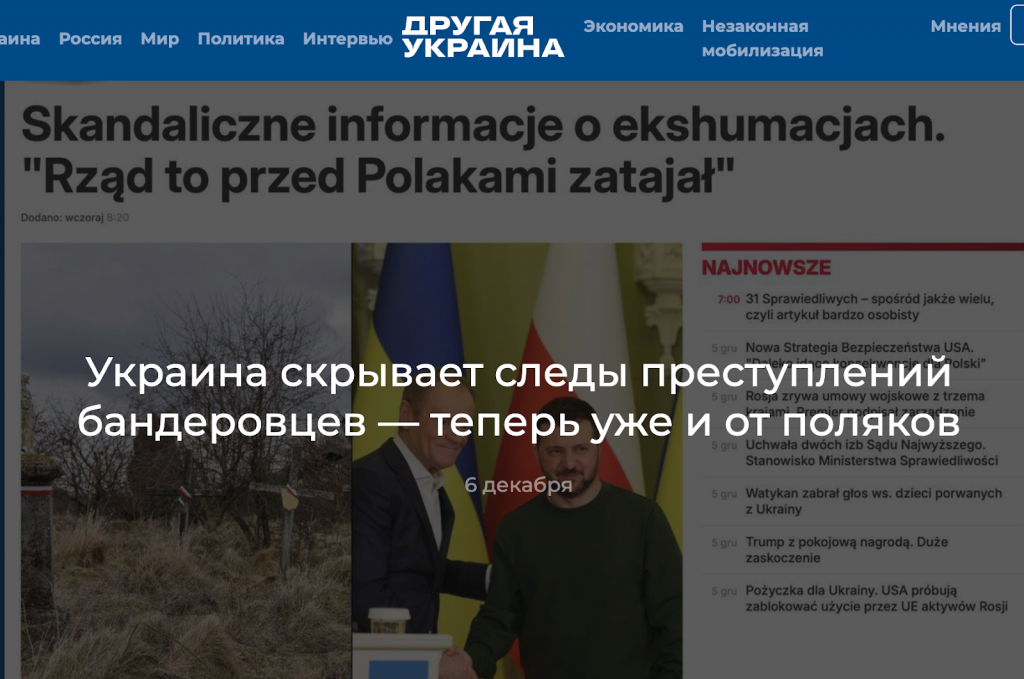
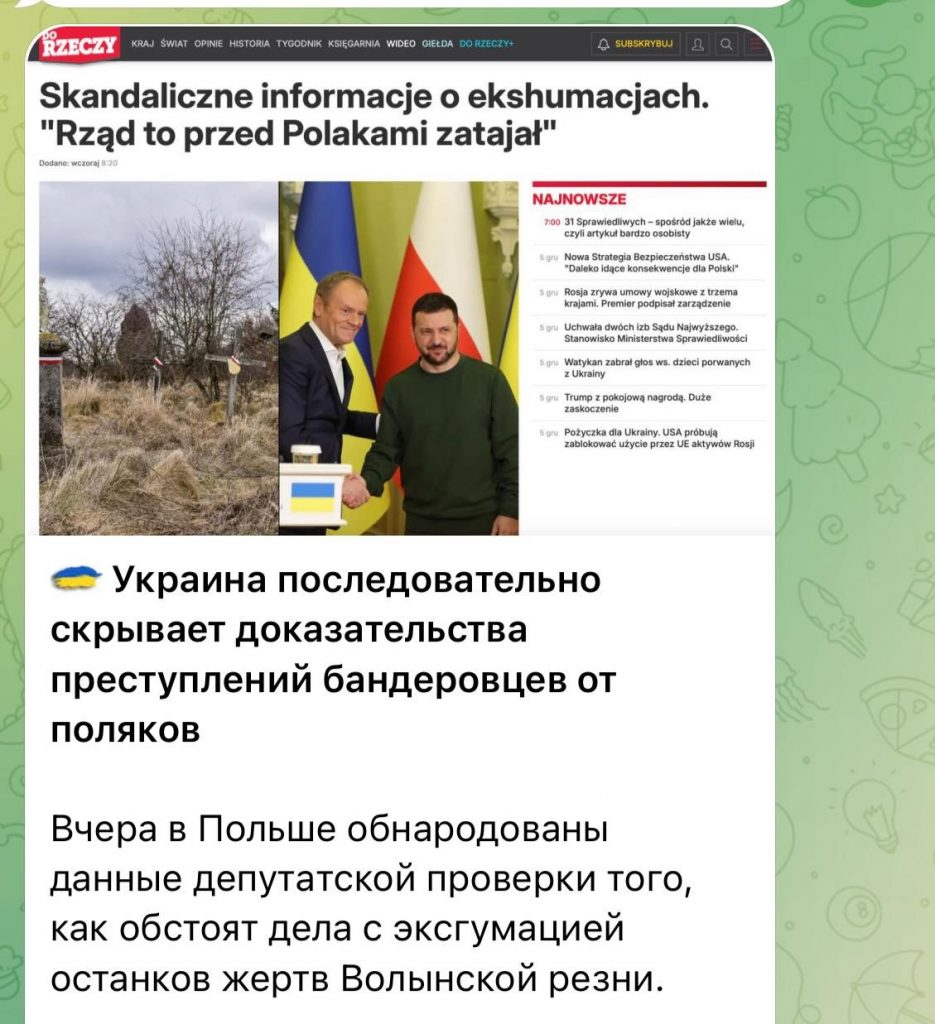
In fact, the disinformation campaign repackages a report by Grzegorz Płaczek, a member of Poland’s Sejm from the right-wing Confederation party, to advance the claim that Ukraine is stonewalling cooperation on the exhumation of victims of the Volhynia tragedy. Płaczek said that 26 applications for permission to conduct such work had been submitted and that only one had received approval — a statement Russian propaganda has selectively amplified and stripped of broader context.
At the same time, Karol Polejowski, vice president of Poland’s Institute of National Remembrance — the official cited by Płaczek — said in November 2025 that 26 applications had been submitted to Ukraine that year, of which nine were rejected and 16 were still under consideration. Even this breakdown, however, does not support claims that Ukraine is “covering up crimes” related to the Volhynia tragedy.
It is also worth noting that Polejowski made his remarks while speaking in Mostyska, in the Lviv region, during the reburial of Polish Army soldiers who died in September 1939 defending Lviv and were originally buried in the Lviv-Zboiska area. Their exhumation had taken place in August, with the consent and cooperation of both the Polish and Ukrainian sides.
Commenting on the state of efforts to exhume victims of the Volhynia tragedy, Grzegorz Motyka, a professor and leading scholar of mid-20th-century Polish-Ukrainian relations, said the key point is that the process is now underway.
“After several years of a freeze on exhumations — and, in my view, attempts to drag Poland and Ukraine into a dispute fueled by provocations orchestrated by Russian special services — a breakthrough has finally occurred,” Motyka said. He noted that such provocations had also derailed efforts to reach an agreement at the presidential level between Volodymyr Zelensky and Andrzej Duda in 2020. “Now, after years of stagnation, substantive negotiations have finally taken place — for the first time in a long period — between the ministries of culture of both countries. And the process has moved forward.”
Ukraine’s ambassador to Poland, Vasyl Bodnar, has likewise confirmed that Kyiv is granting permits for the exhumation of Polish victims of the Volhynia tragedy, while cautioning that the issue continues to be instrumentalized by “certain political forces.” According to Bodnar, two exhumation projects have already been completed on Ukrainian territory, and one search operation has been carried out in Poland.
Polish Minister of Culture Marta Cienkowska, speaking at the ceremony in Mostyska, confirmed that Warsaw is preparing to begin search and exhumation operations in the village of Uhly, Rivne region, with the explicit permission of Ukrainian authorities. She praised the ongoing cooperation between the two countries in conducting these searches and exhumations.
Earlier, StopFake refuted claims that Ukrainian diplomats had “ignored” a memorial event for the victims of the Volhynia tragedy in Chełm.