

The claim is a far-fetched fabrication; there has been no large-scale tree-felling in the Boai Special District.
Fact-check reporters: Chiu Shao-an, Chen Wei-ting
Managing editor: Chen Wei-ting
The original publication can be read here.
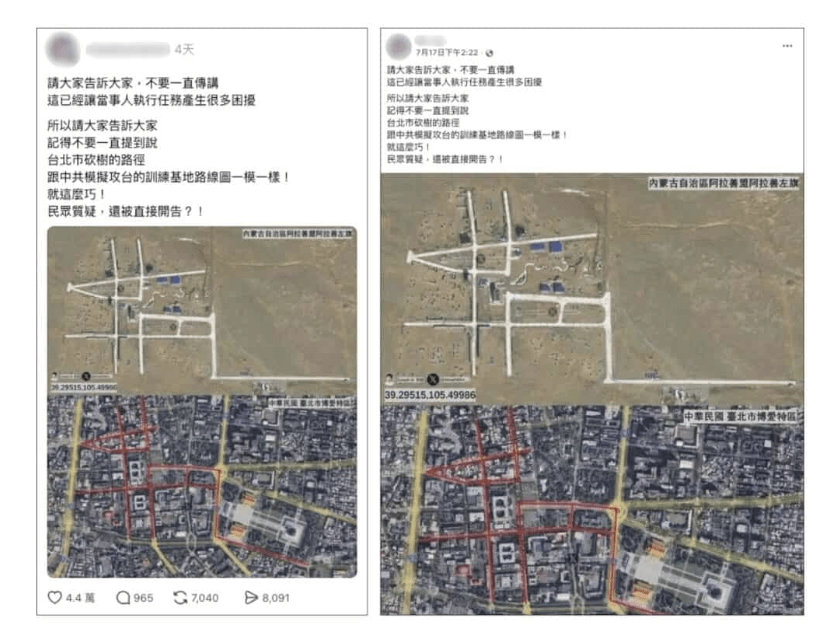
The issue of Taipei City removing street trees has recently drawn attention, and an infographic circulating online claims that the route along which Taipei is felling trees matches the layout of a training base where the Chinese Communist Party (CCP) simulates an attack on Taiwan. This claim is unfounded; our fact-checkers conducted an on-site inspection and found no large-scale tree felling along the roads around the Boai Special District.
- The sidewalks along Hengyang Road, Section 1 of Chongqing South Road, and parts of Boai Road near the Presidential Office never had street trees to begin with. Meanwhile, roads that do have street trees—such as Ketagalan Boulevard, Zhongshan South Road, and Aiguo East Road—showed no signs of large-scale felling, empty tree pits, or trees abnormally topped.
- Several military experts noted that the primary functions of military drones are reconnaissance and attack, but operating a drone requires accounting for its flight range and explosive payload weight. Large drones struggle to navigate through cities, while small drones cannot fly over the sea; moreover, any drone attempting to penetrate deep into the Boai Special District would likely be intercepted or jammed well in advance. Buildings, signboards, vehicles, power lines, and street lamps in a city interfere with drones far more.
- A volunteer soldier familiar with drones who had fought in Ukraine also said that trees do affect drone reconnaissance and flight to some degree, but an experienced pilot can overcome this problem through skill. A forest itself needs to be dense to hold sufficient strategic value; as for Taipei’s street trees, they cannot effectively shield against or obstruct a drone attack.
- The infographic in the rumor was taken from a 2024 post by open-source military intelligence expert Joseph Wen. Wen pointed out that his original intent in creating the infographic was to expose the fact that the People’s Liberation Army (PLA) had built road facilities resembling the Boai Special District, and that it has nothing to do with the recent tree-felling in Taipei.
- The Taipei City Government reported that 258 street trees were removed in Zhongzheng District in 2025. The infographic’s claimed “Boai Special District” saw a total of 20 trees removed for reasons related to natural disasters or pests and diseases.
There has been no large-scale, abnormal tree-felling around the Boai Special District. The rumor wrongly links PLA drill facilities with Taipei’s cityscape, ignoring actual strategic and urban environmental conditions, and can easily cause misunderstanding and panic.
Background
Recently, the Taipei City Government has continued to prune or remove street trees. Some posts questioned whether the trees were being felled to aid enemy drone reconnaissance, and the city government said such online posts distorted the facts.
Subsequently, a message circulating on social media platforms claimed that the route along which Taipei is felling trees is exactly identical to the layout of a training base where the CCP simulates an attack on Taiwan—and that this is no mere coincidence.
Fact-check
Fact-check point 1: Is it true that the tree-felling route in Taipei’s “Boai Special District” matches a CCP training layout?
There has been no large-scale tree-felling in the “Boai Special District”
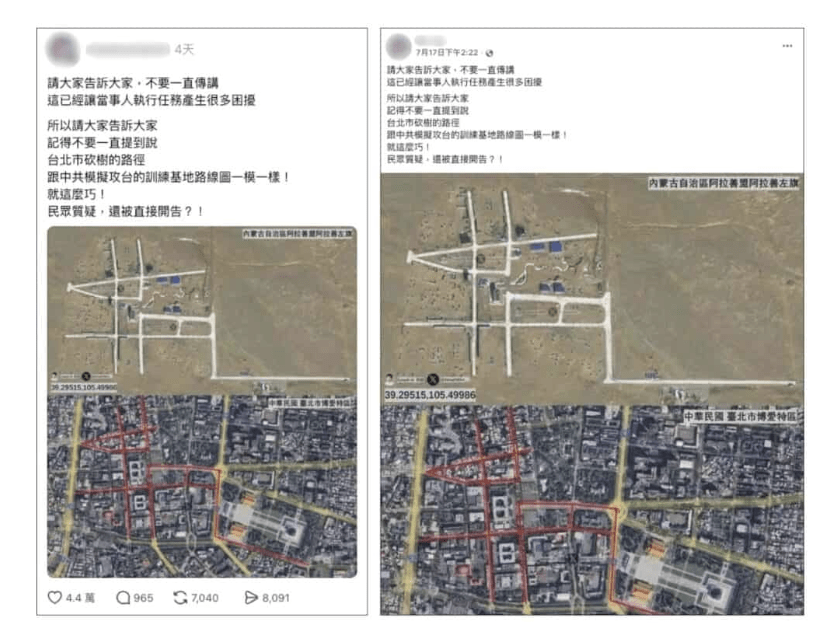
The circulating infographic consists of two images, one above the other. The top image shows a PLA bombing-and-strafing range and drill base in Alxa Left Banner, Inner Mongolia, and originates from a post published in March 2024 on the X platform by Joseph Wen, an open-source intelligence expert on the Chinese military. The bottom image shows the road layout around the Boai Special District in front of the Presidential Office, including Aiguo East Road, Zhongshan South Road, Section 1 of Guiyang Street, Ketagalan Boulevard, Gongyuan Road, Section 1 of Chongqing South Road, Boai Road, Hengyang Road, and Baoqing Road.
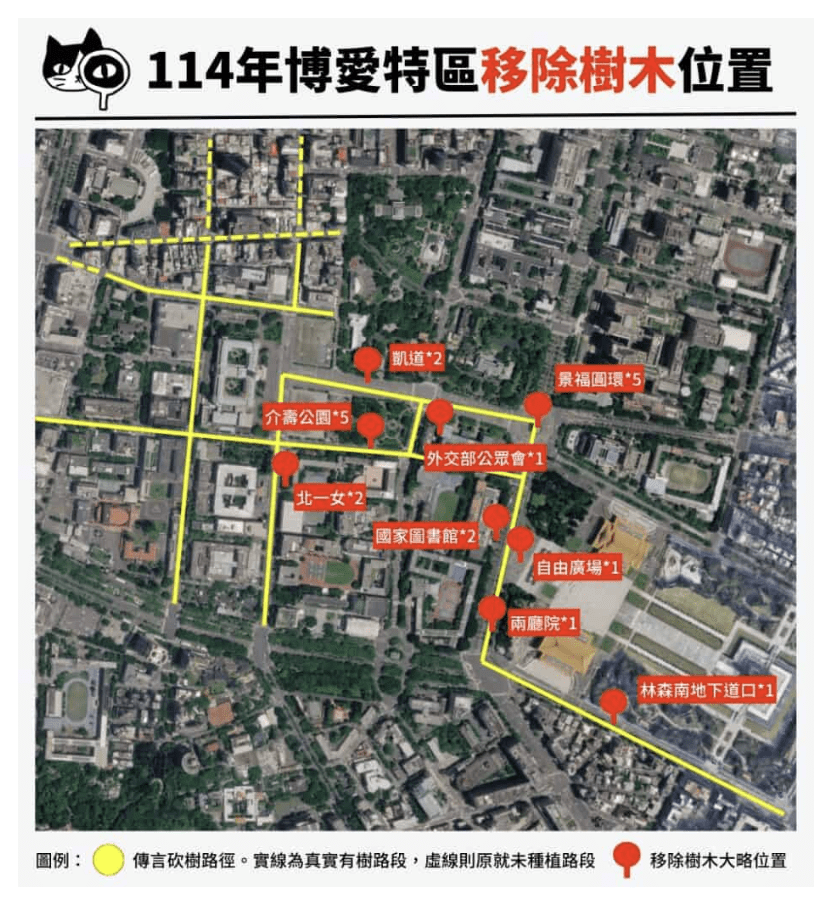
(1) Our fact-check reporters visited the site in person and cross-referenced Google Street View. Along some of the road sections mentioned in the rumor—such as Hengyang Road, Section 1 of Wuchang Street, part of Section 1 of Chongqing South Road, and part of Boai Road—the sidewalks were never designed with space for street trees in the first place, nor were any vacant tree pits observed. The tree-felling route claimed in the infographic, therefore, does not match reality.
In addition, roads that do have street trees—such as Ketagalan Boulevard, Zhongshan South Road, Section 1 of Chongqing South Road, Aiguo East Road, Boai Road, Section 1 of Guiyang Street, and Baoqing Road—showed no topped street trees, no large numbers of empty tree pits, and no newly planted trees noticeably different in size from surrounding trees; only a few road sections had a small number of vacant tree pits on the sidewalk.
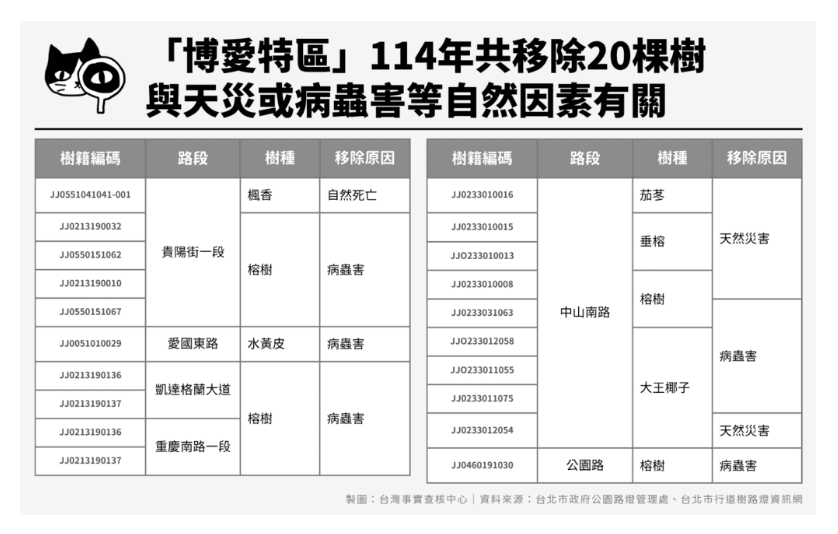
(2) The Boai Special District is located in Taipei’s Zhongzheng District. On July 22, the Taipei City Government told our fact-check reporters that, for the “Boai Special District” as outlined in the circulating infographic, tree removals in 2025 were as follows: 9 on Zhongshan South Road, 5 on Section 1 of Guiyang Street, 2 each on Section 1 of Chongqing South Road and Ketagalan Boulevard, and 1 each on Gongyuan Road and Aiguo East Road—a combined total of 20 trees removed. The reasons for removal were related to natural factors such as natural disasters, pests, and disease. A total of 258 street trees were removed in Zhongzheng District in 2025.
Fact-check point 2: Do city trees affect the operation of military drones?
Cities have many obstacles such as tall buildings, signboards, and power lines; trees may affect drone flight, but there is little point in discussing tree-felling
(1) Hsu Chih-hsiang, an assistant research fellow at the Institute for National Defense and Security Research’s (INDSR) Division of Chinese Politics, Military and Warfighting Concepts, pointed out that large reconnaissance drones such as the MQ-9 are already difficult to maneuver freely through streets in urban warfare because of their large size, and therefore have nothing to do with tree-felling at all. As for smaller drones and fiber-optic drones, although they may be affected by tree branches, in an urban environment, tall buildings, utility poles, signboards, and the like are equally flight obstacles. He therefore believes that “trees are just one type of urban obstacle, but they are certainly not the only one.”
Kao Chih-jung, an appointed assistant research fellow at the INDSR’s Division of Cyber Security and Decision-Making Simulation, also said that for enemy drones to strike Taipei, they must account for flight distance and the weight of the explosive payload the drone can carry. If the scenario assumed in the rumor were to actually occur, it would mean the enemy had already advanced to Tamsui or the Bali estuary, and a drone flying into the Boai Special District would run a high risk of being intercepted or jammed outright.
Kao also believes that a city contains many objects that could interfere with drone flight or reconnaissance, such as buildings and vehicles, and that discussing trees alone likely reflects an information gap stemming from the public’s limited grasp of specific military expertise.
(2) Our fact-check reporters interviewed Chen Hsi, a volunteer soldier who had been to the battlefield in Ukraine and was familiar with the drone-warfare environment. He likewise stated that the two main functions of military drones at present are reconnaissance and attack, but that small drones are not capable of sustaining flight over the sea and must make landfall before they can be used. In other words, if the scenario in the rumor were to occur, it would already be a state of war with enemy forces having landed—and in such a state, there is really little point in discussing whether trees have been felled.
Chen said that trees do affect drone reconnaissance and flight to some degree, but that an experienced pilot can overcome this problem through skill. A forest itself needs to be dense to hold sufficient strategic value; as for Taipei’s street trees, they cannot effectively shield against or obstruct a drone attack.
Chen also stated that, compared with trees, the various tall buildings, signboards, power lines, and street lamps that fill Taipei’s urban districts have a greater effect on drones.
The rumor merely draws associations from PLA base facilities, but this premise implies the ROC military has already lost air and sea control, at which point whether street trees exist no longer affects the outcome of the war
In an interview, Joseph Wen pointed out that the PLA knows the outside world tracks its drills via satellite imagery and therefore deliberately imitates and replicates Taiwan’s key facilities. The drill base shown in the circulating infographic is a PLA bombing-and-strafing range in Alxa Left Banner, Inner Mongolia, which mimics the road layout and form of the Boai Special District, with a drill base built at the same scale. His original intent in creating the infographic was to expose that the PLA had built road facilities resembling those in the Boai Special District, and that it had nothing to do with the recent tree-felling in Taipei.
Wen explained that the rumor draws an association between PLA base facilities and a Taiwanese scenario, but the scenario it describes does not match actual battlefield conditions. If the situation described in the rumor were to occur, it would mean the ROC military had already lost air and sea control, and that the overwhelming majority of its reserve and strike forces had also lost their combat capability, with the PLA having already landed on Taiwan’s main island to fight. At that point, the outcome of the battle would essentially already be settled, and the number of street trees in Taipei would not affect the result of the war.
Additional information
The Taipei City Government says 3,164 trees were removed in total in 2025, with 20 removed in the Boai Special District
In a July 12 press release, the Taipei City Government stated that a total of 3,164 trees were removed across the city in 2025, of which 2,630—over 80 percent—were removed due to natural factors such as natural death, decay, and pests and disease, while the remaining 20 percent had to be removed for reasons such as vehicle accidents or tree growth affecting roadways.
On July 22, the Taipei City Parks and Street Lights Office also provided our fact-checking center with details on tree removals by road section in the Boai Special District, totaling 20 trees.
Reposted from the TFC website in collaboration with StopFake as part of the Ukraine–Taiwan Initiative for Election Information Resilience.