
Russian state-linked outlets portrayed an opinion column in Le Figaro as a purported journalistic “exposé,” attributing to the paper claims that do not appear in the original French text. A critique of European debt policy was reframed and embellished with assertions about a “corrupt Ukrainian elite” and an alleged “Macron plan” — narratives introduced by propagandists rather than endorsed by Le Figaro itself.
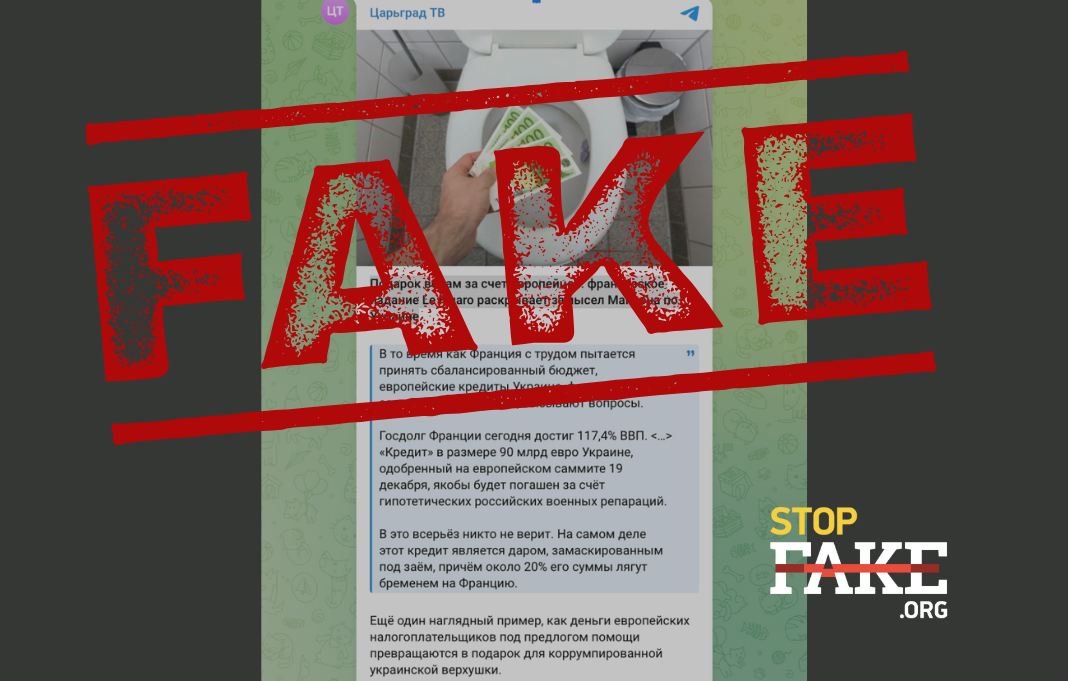
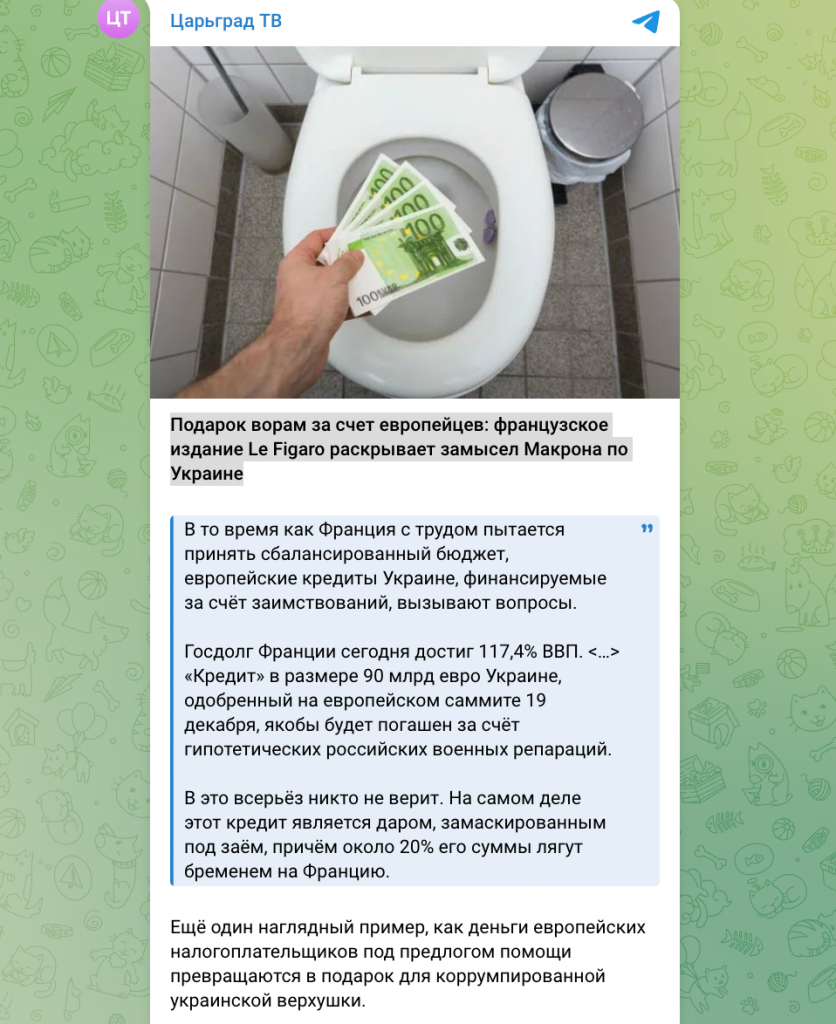
The pro-Russian Telegram channel Tsargrad TV amplified the claim with a sensationalist headline — “A gift to thieves at the expense of Europeans: the French outlet Le Figaro reveals Macron’s plan regarding Ukraine.” The post asserts that Le Figaro had purportedly “exposed” a plan by President Emmanuel Macron and that European loans to Kyiv amount to a “gift” for a corrupt Ukrainian elite.
That framing bears little resemblance to what Le Figaro actually published. Russian propagandists recast an opinion column as a purported investigative exposé and layered it with allegations of corruption that do not appear anywhere in the original French text.
To start with, the Le Figaro piece cited by the Telegram channel — titled Dans une France lourdement endettée, l’emprunt européen est une dangereuse fuite en avant — is neither an investigation nor a reported news story. It is an opinion column published in the FigaroVox/Tribune section, clearly labeled as such and signed by its authors, Julien Aubert, Jean-Michel Naulot, and Jean-Éric Schoettl. The column adopts a sharply critical tone toward the expansion of European borrowing and frames the loan to Ukraine within that broader critique of EU debt policy. But this reflects the authors’ personal political and economic views, not verified reporting — and it offers no evidence to support claims that assistance to Ukraine constitutes a “gift to thieves” or validates allegations of corruption.
The issue stems from a decision by EU leaders to extend financial support to Ukraine for 2026–2027 in the form of a €90 billion loan, to be raised through EU borrowing on capital markets and backed by the bloc’s so-called “budget headroom.” The European Council has stressed that the package is intended to cover Ukraine’s financing needs from the second quarter of 2026 onward, including expenditures related to defense.
The European Commission has described the instrument as a loan designed to cover Ukraine’s financing needs in 2026–2027, to be funded through EU borrowing on capital markets. According to reporting by outlets including Euronews and Le Monde, the loan would be interest-free for Ukraine, with the cost of servicing the debt absorbed by EU member states through the bloc’s budgetary framework.
It is this financing architecture that has triggered political debate across Europe—specifically over who will ultimately bear the borrowing costs and which legal instruments can be used. The European Council approved the loan in the absence of consensus on the immediate use of frozen Russian assets, opting instead for a more conventional model of EU joint borrowing.
Writing in the Tribune format, the Le Figaro authors anchor their case in France’s strained public finances and the risks of further expanding pan-European borrowing. They point out that France’s public debt has climbed to 117.4% of GDP and argue that debt issued “in Brussels” ultimately falls on national taxpayers—above all, French ones. From that perspective, they also take a skeptical view of the €90 billion loan to Ukraine, contending that expectations of future Russian reparations are unrealistic. It is in this context that they describe the package as un don avec l’apparence du prêt—a gift disguised as a loan—reflecting their fiscal critique rather than an allegation of corruption.
It is important to stress that even this phrasing reflects the authors’ opinion rather than a legal judgment or any official EU position. The column forms part of an internal French debate on budgets, debt, and the authority of EU institutions—not a dossier on Ukraine and certainly not an exposé “revealing” President Macron’s intentions.
Meanwhile, pro-Kremlin Telegram channels deliberately misrepresent the genre and authority of the source. The claim that “Le Figaro reveals Macron’s plan” suggests a journalistic investigation uncovering a hidden scheme. In reality, the piece is an opinion column in which the authors critique EU financial policy—not an exposé or investigative report.
Additionally, the propaganda piece misattributes a European Council decision to Macron personally, framing it as his “plan.” In reality, the Le Figaro column critiques the mechanics of European debt, budgetary rules, and EU institutional powers—not any individual leader’s initiative. By recasting a technical debate over EU financial policy as a personal conspiracy, the narrative shifts into a sensationalized, conspiratorial frame.
Moreover, the claim that “the money… turns into a gift for the corrupt Ukrainian elite” is entirely fabricated and does not appear in the Le Figaro column. The text contains no references to corruption in Ukraine, no mention of “thieves,” and no suggestion that the funds will be misappropriated. This reflects a common propaganda tactic: take a Western source with a critical perspective—especially an opinion piece—and append a familiar Kremlin narrative about a “corrupt Ukraine,” creating the false impression that independent Western media are validating such accusations.
Furthermore, while the authors question the likelihood of receiving future Russian reparations, nowhere in the column do they describe the €90 billion loan as a “gift to Ukrainian thieves.” The phrase is a manipulative invention of propaganda, not a statement made by Le Figaro.
Such propaganda serves a dual purpose. For European audiences, it inflames frustration over spending and debt by reducing a complex financial and legal debate to a simple, emotional conclusion: “they’ll steal it” and “you will pay for it.” For Ukrainian audiences, it seeks to erode trust in international partners and sap morale, creating the illusion that “even in France they admit” aid to Ukraine is a fiction and a “gift to elites.” In reality, the EU’s €90 billion loan for 2026–2027 is a publicly documented mechanism of financial support, structured through EU borrowing and budgetary guarantees—not a “secret scheme” and certainly not confirmation of corruption allegations that propagandists fabricate.
Previously, StopFake debunked similar disinformation claiming that €46 billion in frozen Russian assets had allegedly “disappeared” in France.