


The man-made disaster on the Dniester River, which affected both Ukraine and Moldova, was caused exclusively by Russian aggression and a targeted missile strike by occupying forces on the Dniester Hydropower Plant.
On the night of March 7, 2026, Russia once again launched a missile and drone attack against Ukraine’s civilian population. Among other targets, strikes hit the Dniester Hydropower Plant in Ukraine’s Chernivtsi region. The attack led to pollution of the Dniester River, which is also a source of water supply for neighboring Moldova.
Throughout March 2026, Russian media published dozens of reports attempting to shift responsibility for their war crimes onto Ukraine. Propaganda outlets, which themselves triggered a cross-border environmental disaster in Ukraine and Moldova through terrorist attacks on Ukrainian hydropower infrastructure, continue trying to evade responsibility. StopFake has compiled three main false claims promoted by pro-Kremlin media about Russia’s strike on the Dniester Hydropower Plant.
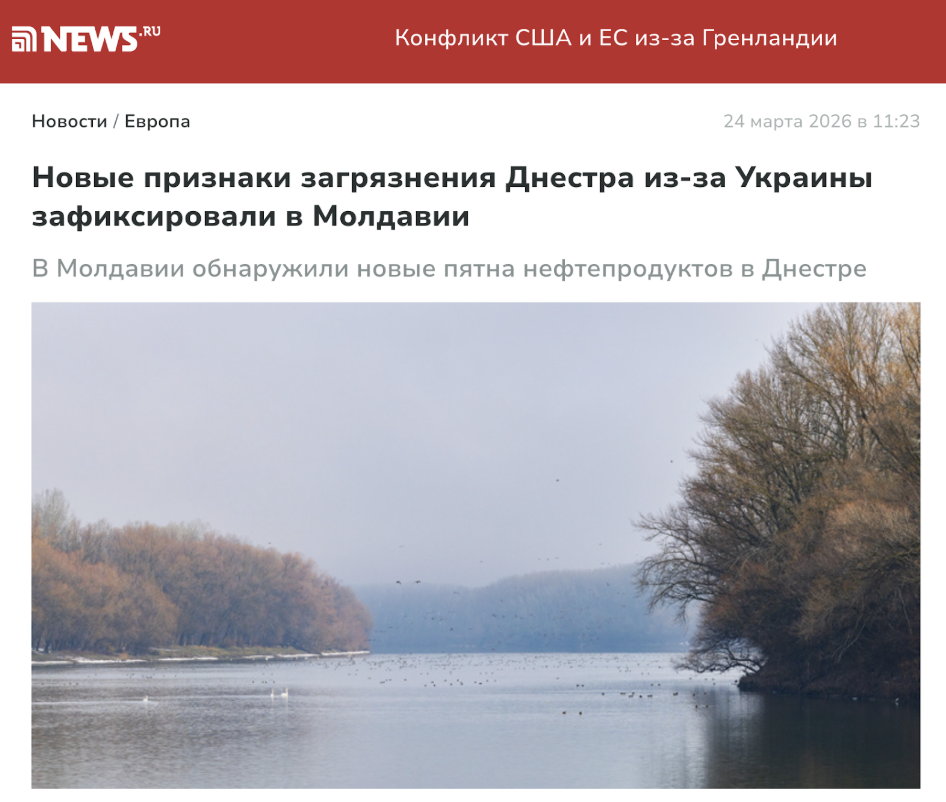
Fake: Russia did not strike the Dniester Hydropower Plant; a major accident occurred there.
Russia’s attack on the plant has been confirmed by Ukraine, Moldova, the EU, the European Commission, as well as the U.S.-based Armed Conflict Location & Event Data project. This project specializes in real-time data collection, analysis, and mapping of conflicts. Ukraine, in close cooperation with the EU and Moldova, continues to deal with the aftermath of the Russian strike.
The occupiers themselves initially confirmed their war crime by quickly spreading triumphant statements about the attack. Only after it became clear that Russia’s actions had caused a cross-border environmental disaster did propaganda outlets change their narrative and conveniently “forget” the real culprit.
This is not the first time Russia has targeted the Dniester Hydropower Plant. On October 31, 2022, occupying forces attacked three Ukrainian hydropower plants simultaneously: the Dnipro, Kremenchuk, and Dniester facilities.
In spring 2024, following a series of winter strikes on electricity and heating infrastructure, Russian forces shifted focus to hydropower. On the night of March 29, 2024, Russia deliberately struck the Kaniv and Dniester hydropower plants with drones and missiles. Additionally, during the full-scale war, Russian forces carried out 46 strikes on the turbine halls of the Dnipro Hydropower Plant (data as of 2025). These facts, documented by Ukraine and the international community, once again confirm Russia’s strategy: to deprive Ukraine of electricity and heat in winter, and of water in warmer seasons.
It is also worth recalling that Russia occupied the Kakhovka Hydropower Plant in 2022 and destroyed it in 2023. Numerous countries and international institutions hold the Kremlin fully responsible for deliberately causing a man-made disaster on Ukrainian territory.
At the same time, Russia continues to deny its war crimes. For more details, see the articles “It collapsed on its own” – Five Russian media fakes about the destruction Kakhovka dam, NATO, Budanov, and Britain: Russian Сonspiracy Тheories about Who was Behind the Destruction of the Kakhovka Hydropower Plant, and Fake: Ukraine is Preparing to Blow up the Kremenchuk Hydropower Plant Following the Kakhovka Scenario.
Fake: Pollution of the Dniester River was caused by a road accident involving a truck carrying oil.
This claim is entirely baseless and serves to cover up Russia’s ecocide. Following the strike on the hydropower plant, more than 1.5 tons of petroleum products entered the Dniester River. Laboratory analyses showed that permissible levels of petroleum products exceeded the norm by 2.5 times, while barium concentrations were 3–6 times higher, indicating a link to explosive substances.
Three weeks after the attack, residues of petroleum products continued to be detected on Moldovan territory. Moldova’s Minister of Environment, Sergiu Lazarencu, who visited the site of the strike, explained on March 26 that despite the source of contamination being contained, Moldova would continue to detect oil patches for some time. They had become trapped in vegetation along the river and on its banks.
Following the attack, Moldova’s Ministry of Foreign Affairs summoned the Russian ambassador and handed him a note of protest over the shelling, along with a bottle of contaminated river water. The country’s Prosecutor General’s Office opened a criminal case over the large-scale pollution of the Dniester River with petroleum products caused by the Russian strike on the hydropower plant in Ukraine.
Fake: Kyiv deliberately polluted the river to spread the crisis to neighboring countries.
It is Russia that is destabilizing security across the European continent. On March 26, 2026, Ukrainian President Volodymyr Zelenskyy stated that Russia is entering the second phase of its winter campaign of strikes against critical infrastructure. According to him, the occupiers will target water infrastructure facilities, putting dams, water supply systems, and logistics routes at risk.
At the same time, the March strike on the Dniester Hydropower Plant may serve two Russian objectives: depriving Ukraine of electricity and water supply, and politically and economically destabilizing Moldova—something the Kremlin is highly interested in. Strikes targeting Ukraine’s border energy infrastructure have a cascading effect on neighboring states.
Currently, Moldova is facing two states of emergency: one due to pollution of the Dniester caused by Russia, and another—a 60-day energy emergency—due to ongoing attacks on Ukrainian substations and distribution facilities. During the full-scale Russian invasion of Ukraine, Moldova has already experienced three blackouts, most recently on January 31, 2026. Propagandists have attempted to exploit the emergency not only to incite domestic discontent in Moldova but also to politically weaken Ukraine in the eyes of its allies, including Moldova and the European Union. Read more in Stopfake‘s article Fake: Kyiv Deliberately Caused a Blackout in Moldova.