
The video attributed to Deutsche Welle has been manipulated. A 20-second segment was spliced into an authentic report, reusing original visuals but replacing the narration with fabricated claims. The broadcaster’s genuine coverage contains no reference to Ukrainian military casualty figures. The altered clip appears designed to inject false information into a credible news format and to sap public morale by exploiting the authority of an established media brand.
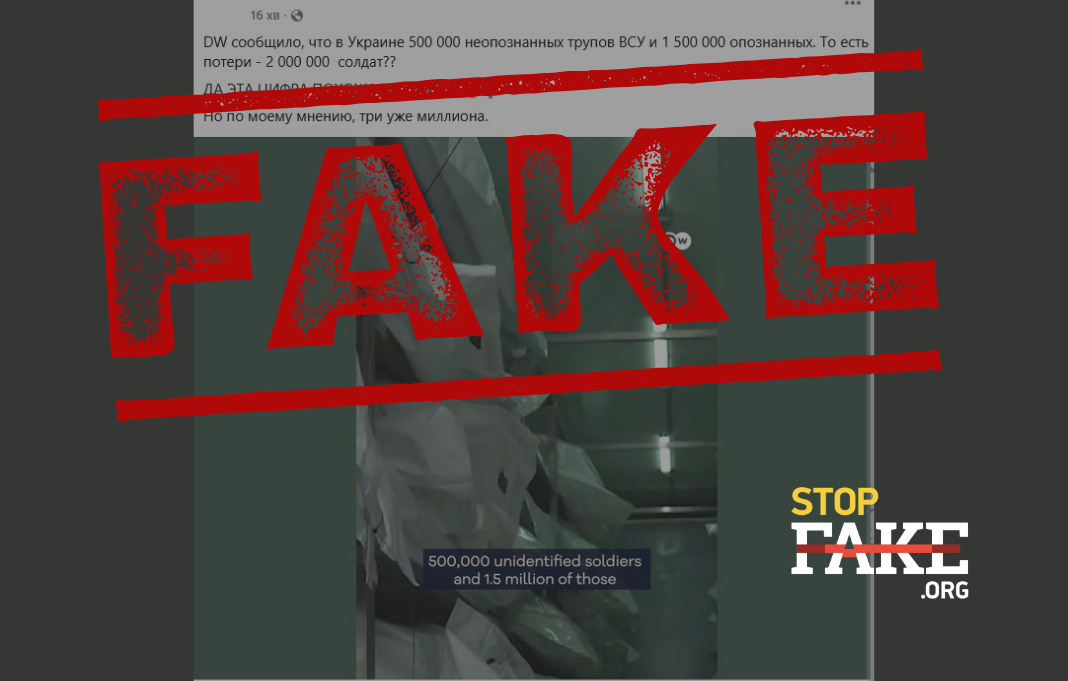
Social media accounts and pro-Kremlin websites have amplified claims that Ukraine’s wartime losses have reached 2 million troops, citing what they allege is a report by Deutsche Welle. Posts circulating in Russian-language channels assert that the outlet counted “500,000 unidentified” and “1.5 million identified” Ukrainian soldiers, using the figure to mock statements by President Volodymyr Zelenskyy.
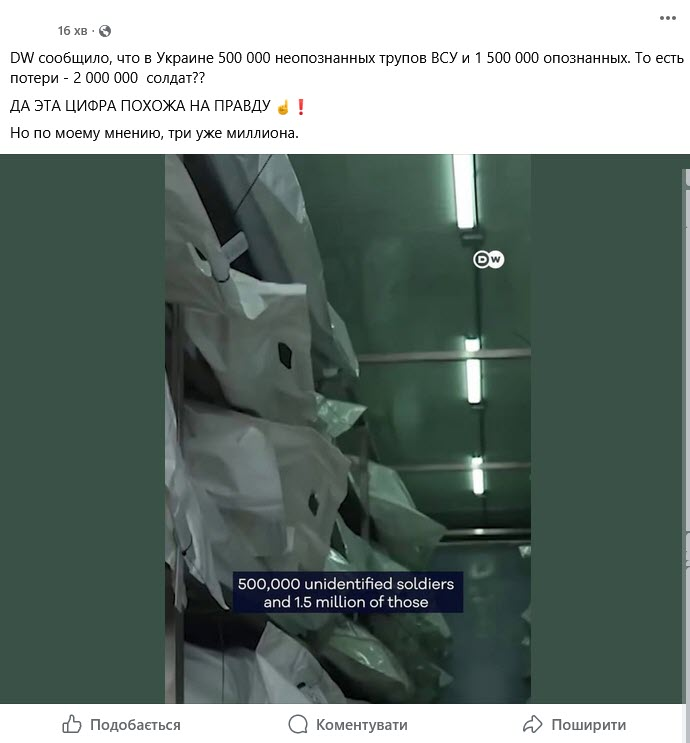
In fact, the claim is false and the supposed report by Deutsche Welle was manipulated. A roughly 20-second segment was spliced into an authentic DW video, reusing the original footage but replacing the narration. That altered excerpt was then recast as a standalone “breaking news” item about Ukrainian military losses and circulated online with misleading references to the German broadcaster, creating the false impression that the figures came from a reputable source.
The original five-minute report by Deutsche Welle, published on February 2, 2026, focused on the painstaking process of identifying Ukrainian soldiers’ remains returned from Russia — not on casualty totals. The piece described how, in Odesa, forensic teams working out of converted railcars catalog personal effects and conduct DNA analysis to match the dead with their families, documenting every available clue to restore names to those who arrived unidentified.
The original report cites only limited figures, none of which support claims of “2 million dead Ukrainian soldiers.” It notes that, in one region alone, forensic specialists had identified roughly 700 of 3,000 recovered bodies — an illustration of the slow, methodical process required to return names to the dead and provide families with answers. The story also follows Yuliia, who spent a year searching for her missing husband before investigators were finally able to confirm his identity, allowing her to lay him to rest.
The doctored clip mirrors the authentic video only for its opening 33 seconds, after which fabricated material is inserted. The manipulated segment asserts that “500,000 unidentified bodies and another 1,500,000 identified so far represent Ukraine’s real losses” — a claim absent from the original reporting. In the genuine piece by Deutsche Welle, the same passage features commentary from a forensic specialist identified as Viktor Serhiiovych and contains no reference to aggregate casualty figures. Audio analysis further reveals a subtle shift in voiceover tone at the splice point, underscoring that two different tracks were stitched together. The version circulated by pro-Russian channels was also trimmed to 1 minute 33 seconds.
The precise scale of Ukraine’s wartime losses remains classified, reflecting Kyiv’s policy of limiting disclosure during active hostilities. Still, Ukrainian officials have periodically offered partial figures. In an interview with France 2, President Volodymyr Zelenskyy said that, as of early 2026, about 55,000 Ukrainian service members had been killed, a total that does not include those listed as missing. Outside estimates trend higher. Analysts at the Center for Strategic and International Studies assessed in late January that Ukrainian military deaths could range between 100,000 and 140,000 since Russia’s full-scale invasion in February 2022.
The clip circulating on social media fits a familiar pattern: a fabricated doppelganger designed to mimic the branding of a reputable international outlet — in this case Deutsche Welle — to give false claims the veneer of credibility. Such forgeries have become a recurring feature of pro-Kremlin disinformation efforts, which rely on repackaged or manipulated content to amplify misleading narratives. Here, the altered footage appears intended to inflate perceptions of Ukrainian battlefield losses, a tactic analysts say is meant to sap morale at home while shaping international perceptions of the war’s trajectory.
StopFake has repeatedly exposed similar fabrications, including Fake: Ukraine Is Deploying Women to the Front Amid Heavy Losses and Fake: Kyiv Forcibly Drafts Ethnic Hungarians — InfoBRICS.