
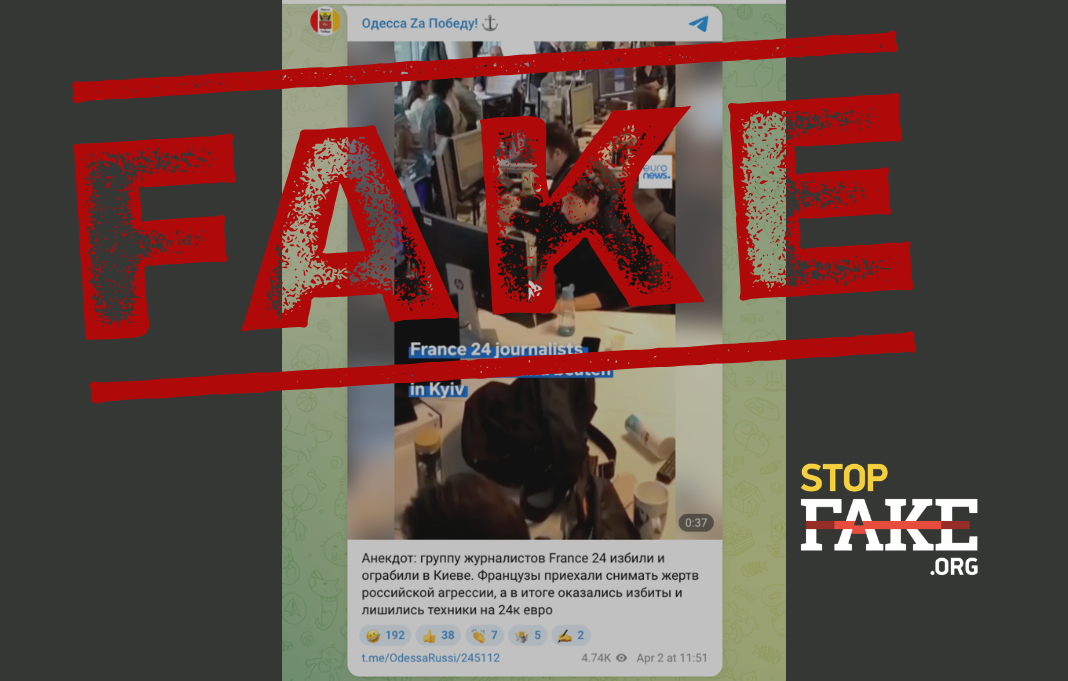
A video styled to look like Euronews, claiming that journalists from the French television channel France 24 were attacked in Kyiv, is a fake. There is no confirmation of this incident in either media outlets or official sources. The video is a fabrication created to discredit Ukraine and manipulate trust in international media.
A video spreading across social media platforms features the logo and visual formatting of Euronews, the pan-European broadcaster, and alleges that a team of journalists from France 24 was assaulted and robbed while on assignment in Ukraine. They lost an estimated €24,000 worth of equipment. Those circulating the footage have been quick to underscore the apparent irony: the reporters had traveled to Kyiv to document the toll of Russian aggression, only to allegedly fall victim to crime themselves.
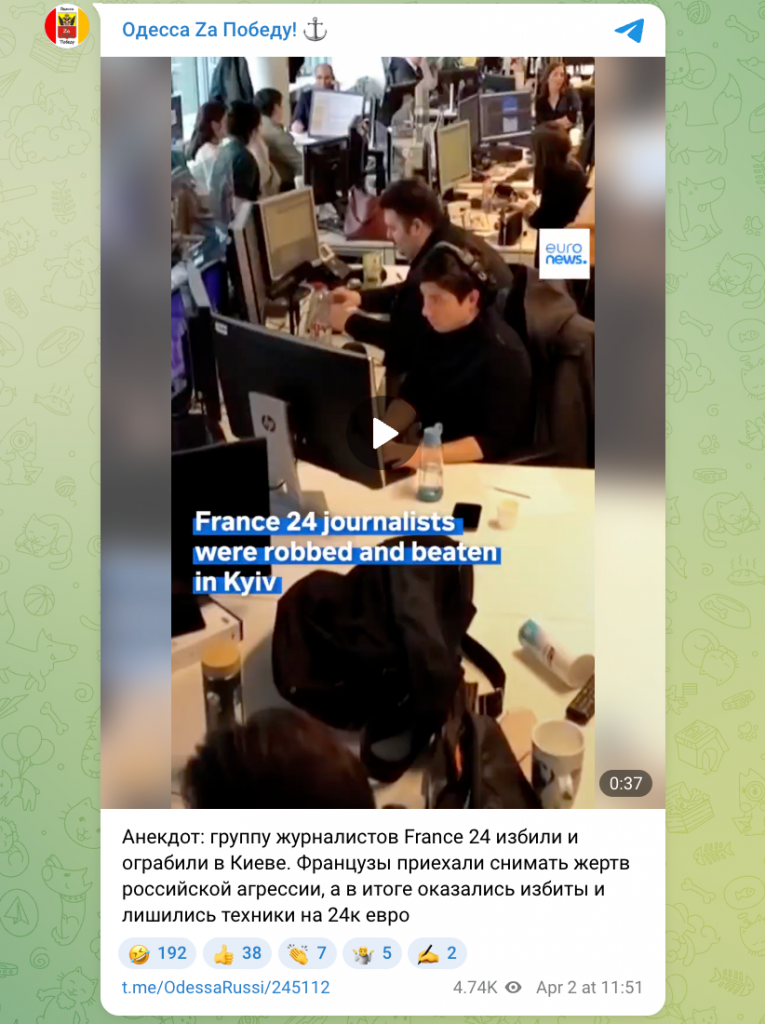
The video is a fabrication. Despite bearing Euronews‘ logo in the upper right corner — a detail apparently designed to lend the footage an air of journalistic legitimacy — the clip has no connection to the broadcaster. A review of Euronews’ official website and its verified social media accounts found no coverage of the alleged incident, no mention of the reported assault, and no acknowledgment of the video’s existence.
The imagery used in the clip was pulled from publicly available sources and bears no relation to the events it purports to document, which is a stark contrast to standard Euronews practice. Usually footage is sourced directly from the scene and accompanied by verifiable facts and attribution.
The absence of any independent corroboration further undermines the video’s credibility. Neither Ukrainian nor European news organizations — including France 24, the outlet whose journalists were allegedly targeted — have reported anything resembling the described attack. Ukrainian law enforcement, meanwhile, has issued no statements regarding any such incident involving foreign journalists, either in Kyiv or elsewhere in the country.
Osavul, an analytical service that tracks disinformation, traced the video’s origins to April 2nd, when it first appeared on “Respublika Odessa,” a pro-Russian Telegram channel, before being amplified across a broader network of propaganda outlets and social media platforms.
The clip is not an isolated incident but part of a coordinated influence campaign designed to erode international confidence in Ukraine by co-opting the credibility of established Western media brands. The strategic logic is straightforward: fabricated content dressed in recognizable journalistic packaging is more likely to be believed. In this instance, the narrative serves multiple objectives simultaneously — discouraging foreign reporters from traveling to Ukraine, casting doubt on the country’s reliability as a Western partner, and suggesting that even journalists who arrive sympathetic to Ukraine’s cause ultimately find something darker beneath the surface.
StopFake previously analyzed a similar narrative in the article Fake: Le Figaro Reported on Ukrainian Refugees’ Involvement in ‘Organizing a Terrorist Attack’ in Paris.