
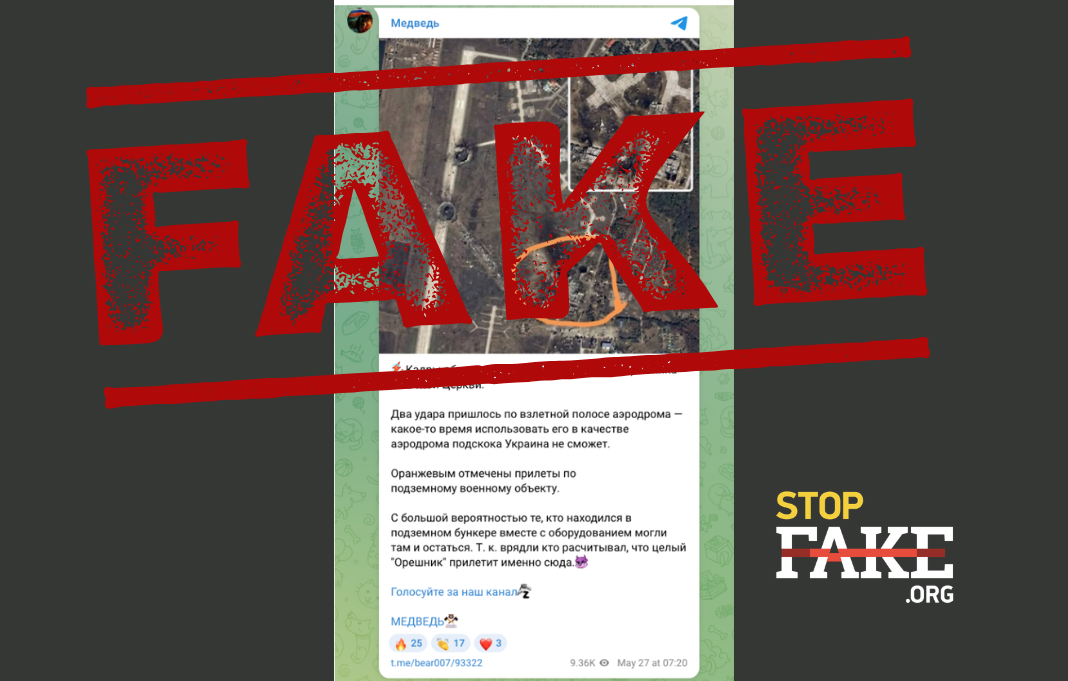
The image being circulated as a “satellite photograph” of the aftermath of an Oreshnik missile strike on an airfield in Bila Tserkva has been edited and does not correspond to real satellite data. StopFake established that its original source is the Telegram channel, whose owner openly admitted that he created the image artificially — as an ironic response to demands for “proof” of the strike’s effectiveness.
Some social media users and anonymous Telegram channels are sharing what is allegedly a satellite image showing craters formed as a result of an Oreshnik missile strike on an airfield in the Bila Tserkva area. Propaganda outlets claim that this image supposedly proves the airfield was hit: two strikes, they say, landed on the runway, leaving Ukraine “unable to use it as a forward airfield for some time,” while the remaining strikes allegedly targeted an “underground military facility.” “Highly likely, those who were in the underground bunker together with the equipment may have remained there,” such publications claim.
As a reminder, in the early hours of May 24th, Russia did carry out a large-scale combined strike against Ukraine and, according to the Ukrainian Air Force, deployed a medium-range surface-to-surface ballistic missile that the Russian side calls the “Oreshnik.” Ukrainian Air Force spokesman Yurii Ihnat confirmed that the launch was carried out from the Kapustin Yar testing range and that the strike hit the Bila Tserkva area.
However, the available data does not support the claim that the airfield was struck. According to the Kyiv Regional Prosecutor’s Office and local authorities, a garage cooperative and buildings belonging to an enterprise were damaged in the Bila Tserkva district. Ukrainian media also reported this, citing the prosecutor’s office and the State Emergency Service of Ukraine.
Based on published photographs and video footage from the strike site, OSINT specialists also identified the point of impact as a garage cooperative, not airfield territory. Defense Express, citing the OSINT channel “KiberBorosho,” reported that the missile struck a garage cooperative in Bila Tserkva. The Kyiv Regional Military Administration likewise reported damage to a garage cooperative.
In addition, OSINT researcher The Cube identified the point of impact using published photos and videos as a garage cooperative on the outskirts of Bila Tserkva — at coordinates 49°47’43.8″N 30°11’02.3″E. This location is in a different part of the city, not on airfield grounds. The claim that the image circulating online shows the actual aftermath of a strike on the airfield is therefore inconsistent with the established geolocation of the impact.
Following reports of the actual consequences of the attack — damage to garages and civilian infrastructure — Russian propaganda channels set about explaining the underwhelming results of their widely advertised missile. Publications began floating theories about an “underground military facility,” “military bases” in the strike area, or the missile’s supposed ability to deliver “underground strikes.” No evidence was provided for any of these claims.
These explanations also fail to address questions about the Oreshnik’s effectiveness in its non-nuclear configuration. According to Defense Express, Russia deployed this medium-range ballistic missile in what is described as a kinetic variant — without a nuclear warhead. Missiles of this class are primarily designed to deliver nuclear payloads, so their use in a conventional non-nuclear configuration carries questionable military utility. Defense Express analysts also note that high precision should not be expected from such a missile in its conventional form; in this configuration it functions more as an instrument of terror and psychological pressure than as a rational precision weapon.
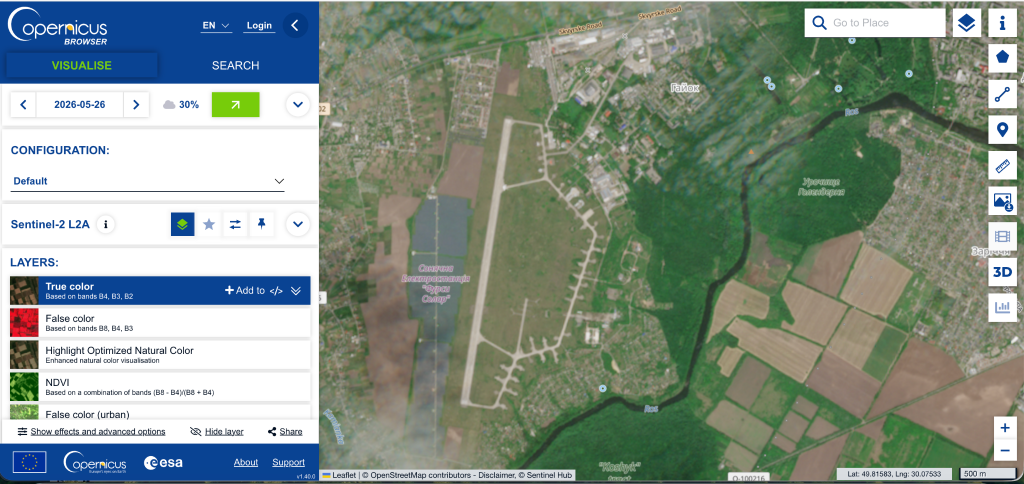
Against this backdrop the image purportedly proving that the Oreshnik did in fact strike the airfield began to spread online. But a real-world verification does not support this. StopFake checked the airfield grounds via Copernicus Browser: Sentinel-2 satellite images from May 24th and 26th show no craters on the territory of the Bila Tserkva airfield of the kind depicted in the circulating image. Copernicus Browser allows users to view and download satellite imagery from Copernicus missions at full resolution, and Sentinel-2 satellites have optical channels with a spatial resolution of up to 10 meters. Such imagery does not allow fine details to be distinguished but makes it possible to check for significant visible changes on the ground. The images from May 24th and 26th show no such traces on the airfield’s territory.
Doubts about the authenticity of the image arose even within the Russian Z-segment. The Telegram channel “Fighterbomber,” which is close to the Russian Aerospace Forces, called the circulating image a “clumsily drawn fake” and noted that if the authors had genuinely wanted to simulate the aftermath of an Oreshnik strike, they should have “drawn” more craters.
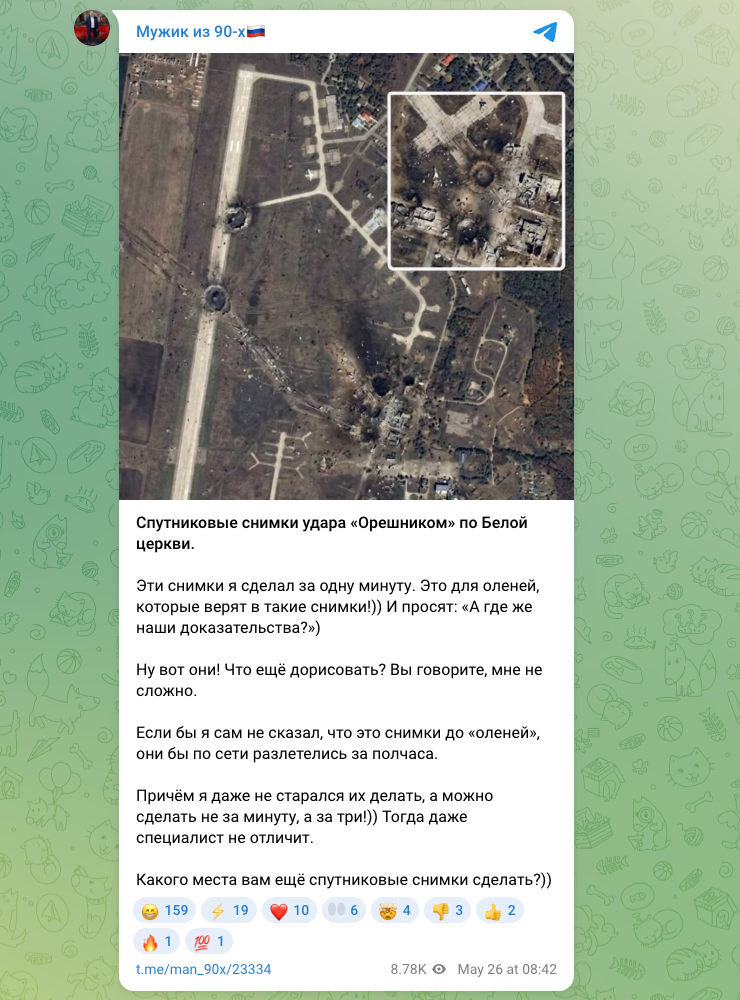
StopFake also identified the source of the image. It was first published by an anonymous Telegram channel on the morning of May 26th. Moreover, the author himself explicitly stated that this was not a real satellite image but a picture he had made “in one minute” as a mockery of those demanding proof of a successful strike. The post read, “Satellite images of the Oreshnik strike on Bila Tserkva. I made these images in one minute. This is for the losers who believe in images like these! And ask, where’s our proof?” The author then added, “If I hadn’t said myself that these images were for losers, they would have spread across the internet within half an hour.”
In other words, the image was created as a fake illustration and an ironic reaction to criticism of the Oreshnik strike. It was subsequently shared as a genuine satellite photograph and “proof” of the airfield being hit. Russian propaganda outlets thus attempted to transform a joke and an openly fabricated image into confirmation of their narrative.
StopFake has previously debunked false claims from Kremlin propaganda alleging that The “Power” of the Russian Oreshnik Caused an Earthquake in the Lviv Region.