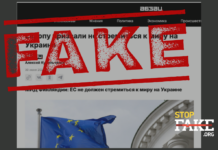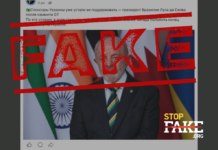

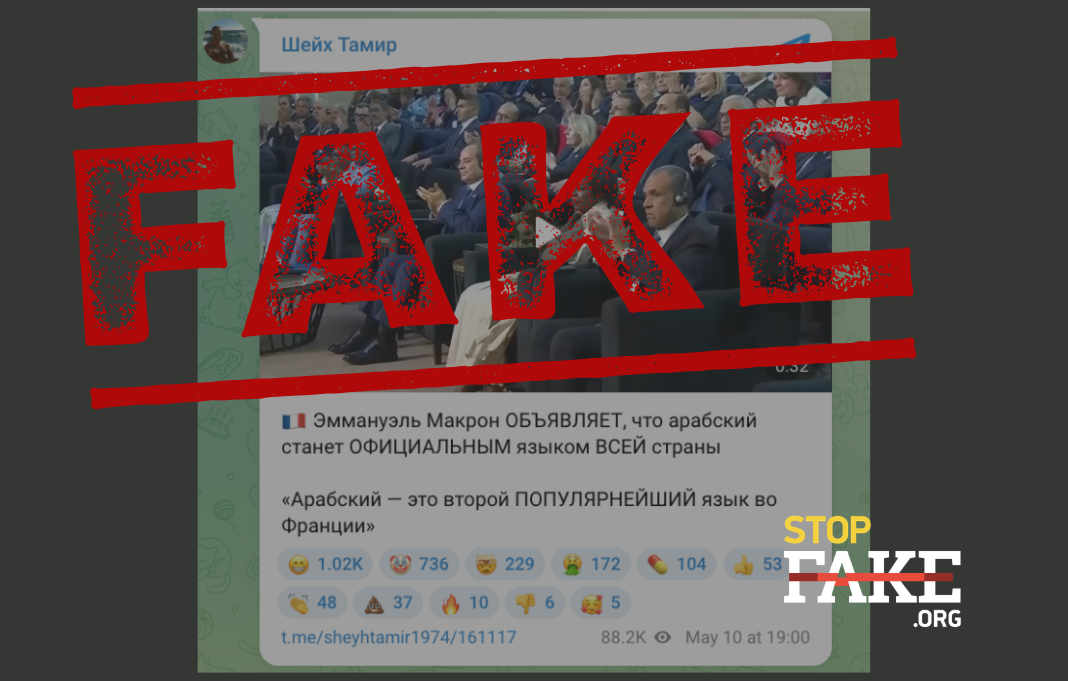
Emmanuel Macron did not say that Arabic would become an official language of France, nor did he call for its mandatory study in French schools. Speaking in Egypt, the French president did describe Arabic as the second most widely spoken language in France — but the remark came in the context of Francophonie, multilingualism, and academic cooperation between France, Egypt, and African nations.
Russian state-aligned Telegram channels and Kremlin-linked propaganda networks are amplifying a fabricated claim that French President Emmanuel Macron declared Arabic the country’s official language. Separate posts attribute to Macron a call for mandatory Arabic instruction across French schools, citing the language’s widespread use among millions of residents. Both narratives are circulating alongside a video excerpt from a Macron address delivered in Egypt.
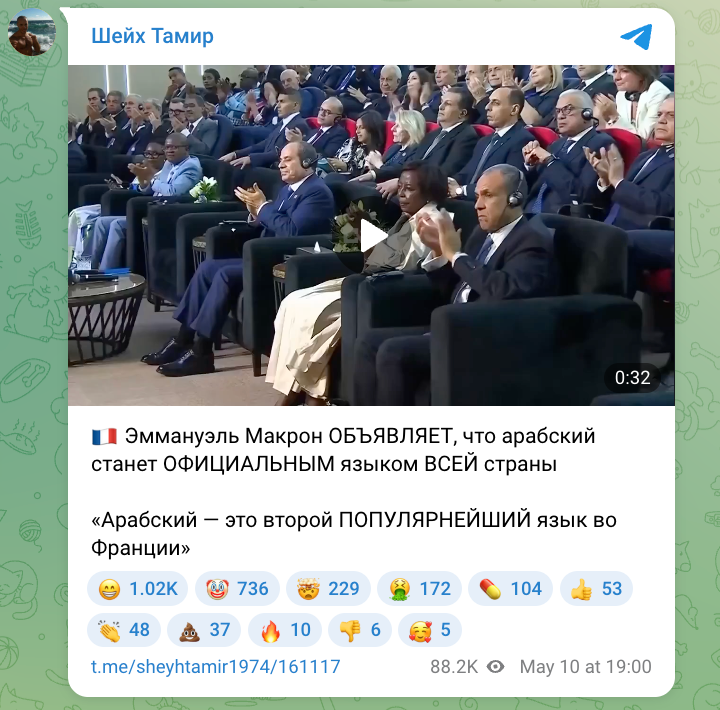
The claims are false. Macron made no such declaration designating Arabic as an official language of France, nor did he call for its mandatory instruction in French schools.
The footage weaponized by pro-Kremlin accounts originates from a May 9, 2026, address delivered during Macron’s state visit to Egypt. According to the Élysée Palace, the French president traveled to Alexandria, where he held talks with Egyptian President Abdel Fattah el-Sisi before attending the inauguration of a new campus of Senghor University in Borg el-Arab — the event his remarks were specifically prepared for.
Senghor University is a French-language institution operating under the auspices of the Organisation internationale de la Francophonie, making its agenda wholly distinct from French domestic policy. Macron’s remarks were trained squarely on the promotion of the French language, academic cooperation, and multilingualism on the international stage. He opened by addressing the university’s history and mission, the significance of its new Egyptian campus, and its role in training professionals destined for international organizations including the African Union, the United Nations, universities, hospitals, and the private sector.
In the official Élysée Palace transcript, Macron frames Francophonie as a project that has long outgrown its French origins, stressing that the language no longer belongs exclusively to France. Its demographic center of gravity, he argues, has shifted decisively — away from the banks of the Seine and toward the Congo River basin, home to the world’s largest concentration of French speakers.
It was against that backdrop — a broader argument about multilingualism and cross-cultural exchange — that Macron’s reference to Arabic arose. In the Élysée Palace transcript, his words read as an observation rather than a policy declaration: that French should remain a cherished language for Egyptians, and that Arabic, in turn, is already the second most spoken language in France — a demographic reality, he noted, that is too often overlooked.
Macron’s point was one of reciprocity: French carries cultural weight across Egypt and the broader Francophone world, while Arabic is an established feature of France’s own linguistic landscape. The remark was a descriptive aside, not a policy announcement — carrying neither the force of an official-language declaration nor the contours of an education reform agenda.
Any change to France’s official language status would require a constitutional amendment — Article 2 of the French Constitution is unambiguous on the matter, stipulating that French is the sole language of the Republic. No legislative process, presidential decree, or constitutional revision has been initiated in connection with Macron’s Alexandria remarks.
Pro-Kremlin outlets did not fabricate the footage — they manipulated its meaning. An authentic clip from a speech about Francophonie, multilingualism, and Franco-Egyptian academic cooperation was stripped of its context and repackaged as evidence of national decline, feeding a well-worn anti-immigration narrative centered on France purportedly surrendering its cultural identity. The operation follows a familiar template: cast France as a state that has lost its grip on migration, cultural policy, and domestic order.
The tactic is not new. StopFake has previously documented an identical playbook in the fabricated claim that world media had reported mass crimes committed by Ukrainian refugees in France. Across both cases, the mechanics are the same: sensitive fault lines — migration, security, integration, cultural identity — are deliberately exploited to stoke distrust toward migrants, Muslims, and Ukrainian refugees alike.