

This is an unfounded claim. The hantavirus mRNA vaccine is still in development and has not yet reached the market.
Fact-check reporter: Hui-Wen Tseng
Managing editor: Wei-Ting Chen
The original publication can be read here.
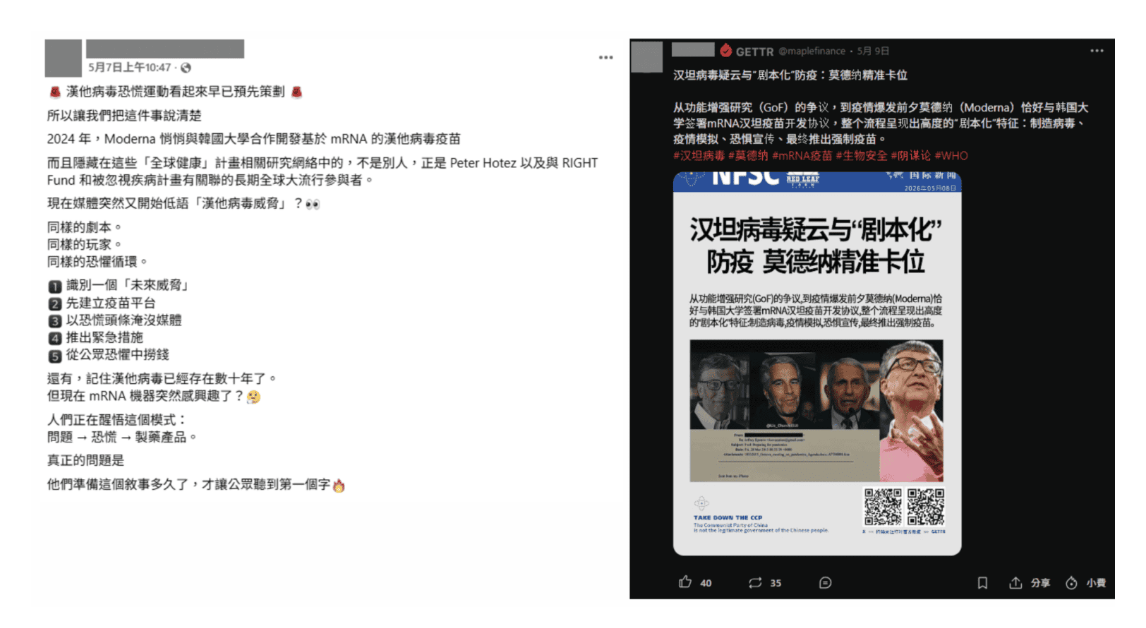
Claims recently circulating online allege that “Moderna quietly partnered with a Korean university to develop a hantavirus mRNA vaccine, then engineered a panic in order to sell the vaccine.” Our investigation found that South Korea has had hantavirus cases for many years and continues to need vaccine development. The mRNA vaccine being developed with Moderna is still in the research stage and has not yet reached the market. The claim is unfounded.
- In 2024, Korea University in South Korea announced a partnership with Moderna to develop a hantavirus mRNA vaccine. The university noted that South Korea records an average of 300–400 hantavirus-related cases per year, creating a need for vaccine development. A hantavirus vaccine was already on the market in South Korea as early as 1990, but because it could not cover virus strains from other regions, a new type of vaccine is still needed.
- According to news reports, the hantavirus mRNA vaccine is currently still at the animal-testing stage. Optimization of the candidate vaccine and safety validation are still to come, and it remains some way from official market release.
- Infectious disease experts say hantaviruses are a long-existing group of viruses, that South Korea has relatively many cases, and that mRNA is the future direction of vaccine development—so investing in hantavirus mRNA vaccine research is entirely reasonable, and the rumor’s speculation is baseless.
- Public unfamiliarity with the characteristics of viruses and the history of vaccine development easily creates room for such rumors to ferment. For example, the Fact-Check Center previously investigated the claim that “Pfizer and Moderna acted preemptively—COVID vaccine development predated the pandemic”; that rumor ignored the fact that pharmaceutical companies had been developing coronavirus and mRNA technology since SARS, and instead promoted a conspiracy theory.
The claim is therefore rated “False.”
Background
Hantavirus outbreaks have appeared both in Taiwan and abroad. A rumor recently circulating on social media claims that Moderna positioned itself precisely, quietly partnering with a Korean university to develop a hantavirus mRNA vaccine, then engineered a panic in order to sell the vaccine, describing this as Moderna’s “scripted pandemic response.”
Fact-check
Verification point: Is the claim true?
South Korea has many hantavirus cases and a genuine need for vaccine development; this is not a pharmaceutical company “planning ahead” of an outbreak.
Using keyword searches, the Fact-Check Center found reports on South Korea’s development of a hantavirus vaccine. For example, EurekAlert, an online science-news platform established by the American Association for the Advancement of Science, published a press release issued by Korea University in 2024 announcing that the university’s Vaccine Innovation Center at its College of Medicine had signed a research agreement with Moderna to jointly develop a new hantavirus vaccine based on mRNA technology.
Korea University’s press release noted that South Korea sees an average of 300–400 cases per year of hemorrhagic fever with renal syndrome (HFRS) caused by hantavirus, with patients mainly being men aged 20–30 doing military service and residents of high-risk areas, and occasional fatalities reported.
The Korea Economic Daily also reported on the partnership. It noted that hantavirus was discovered and successfully isolated in 1976 by the late virologist Ho Wang Lee (이호왕), hailed as “Korea’s Pasteur,” and that in 1990 the inactivated hantavirus vaccine (Hantavax) developed by his team was approved for market.
However, because that vaccine used a virus strain prevalent in South Korea, it cannot prevent the different strains circulating in the United States and other regions. In addition, the World Health Organization (WHO) has listed hantavirus infection as a potential future epidemic, making the development of a new vaccine urgent.
South Korean outlet News1 and Belgian outlet Brussels Signal also reported in May 2026 on the latest progress of the South Korea–Moderna hantavirus vaccine collaboration. The reports noted that over the past two years of cooperation, Korea University provided Moderna with hantavirus antigen sequence information, and Moderna provided the corresponding mRNA materials; animal experiments confirmed that the experimental dose could protect mice from hantavirus infection.
The reports also noted that hantavirus is one of nine infectious diseases the South Korean government has selected as priorities for vaccine development. On May 18, 2026, the Vaccine Innovation Center at Korea University’s College of Medicine announced it would launch development work on a next-generation hantavirus vaccine, including optimizing the candidate vaccine and evaluating its efficacy, then entering GMP-compliant production and safety validation, in order to build an mRNA vaccine platform free of concerns over overseas patent infringement.
Expert: The hantavirus mRNA vaccine is still in development; the “manufacturing panic to sell vaccines” claim is false.
Nan-Chang Chiu, an infectious disease expert and attending physician at MacKay Children’s Hospital, explained that hantavirus is not a single virus but a “group” of viruses—some cause hemorrhagic renal syndrome, others cause pulmonary syndrome. Different viruses have distinct characteristics, rodent host species, and levels of severity. For instance, the Andes virus causes pulmonary syndrome and has a high fatality rate, whereas what has been found in Taiwan so far is the Seoul virus, which is less severe.
Regarding the online claims that “the hantavirus panic was engineered by Moderna to sell vaccines” and that “a vaccine patent was applied for before the disease even broke out,” Chiu pointed out that the claims are incorrect, because the new hantavirus vaccine that Moderna is developing with the Korean university has not even been completed yet—so how could there be any “fear marketing” as the rumor alleges?
Chiu also said that hantavirus is a long-standing virus, that South Korea sees many cases every year, and that mRNA is the future direction of vaccine development—so it is entirely reasonable for South Korea to pursue research into a hantavirus mRNA vaccine.
He noted that there are actually a great many vaccines that various pharmaceutical companies are lining up to develop. When a known infectious disease currently lacks an effective treatment, there will be people willing to invest in its development. The infectious diseases that are prevalent in, and of concern to, each country also differ somewhat—for example, South Korea is researching hantavirus, while Taiwan is developing a domestic vaccine targeting enterovirus 71.
A recurring pandemic conspiracy theory, in reality, a misunderstanding that vaccine development requires long-term planning.
Infectious disease outbreaks touch a sensitive nerve in the public, and unfamiliarity with viral characteristics and the history of vaccine development easily creates room for such rumors to ferment. Social media therefore circulates conspiracy theories such as “pharmaceutical companies have foreknowledge” and “companies deliberately manufacture panic to sell vaccines.” For example, the Fact-Check Center previously investigated the claim that “Pfizer and Moderna acted preemptively—COVID vaccine development predated the pandemic.”
In reality, Pfizer had been investing in coronavirus-related research ever since the SARS outbreak in 2003, and Moderna had begun developing mRNA technology as early as ten years ago. That is why the two major pharmaceutical companies were able to move rapidly into vaccine clinical trials at the very start of the COVID-19 pandemic. The argument in the rumor does not hold up.
Reposted from the TFC website in collaboration with StopFake as part of the Ukraine–Taiwan Initiative for Election Information Resilience.