

RedNote’s broadcasting rights are limited to China and cannot be viewed outside the country; using a VPN to bypass the block may raise legal concerns.
Fact-check reporter: Szu-Tung Sung
Managing editor: Hui-Wen Tseng
The original publication can be read here.
The World Cup has kicked off, sparking a nationwide craze for watching the matches. But a rumor has recently claimed that Taiwan cannot watch the World Cup, while the public can download China’s “RedNote” (Xiaohongshu) app to watch it for free. Our investigation found that in Taiwan, World Cup matches can be watched on television or online. As for RedNote, because it has not obtained broadcasting rights in Taiwan, Taiwanese users cannot view broadcasts even if they use RedNote, and using a VPN to watch across regions raises concerns about infringement.
- Taiwan’s broadcasting rights for this World Cup are held by ELTA, Chunghwa Telecom, ETtoday (ETTV), and TTV. Taiwan can access the World Cup matches through channels such as television and the internet.
- The online claim that “RedNote lets you watch the World Cup for free” is misleading. RedNote obtained only the online broadcasting rights for China (excluding Hong Kong and Macau) and cannot broadcast in Taiwan. Even if Taiwanese users use RedNote, they cannot watch the World Cup.
- If the public uses a VPN to watch RedNote’s broadcasts across regions, this harms the rights of Taiwan’s exclusive rights holders. A lawyer notes that although enforcement is difficult in practice, it may still constitute infringement and could even carry civil and criminal liability.
The online rumor misunderstands the rules on World Cup broadcasting rights and wrongly links the broadcasting rules with policy. It is, therefore, a misleading, “False” claim.
Background
Recently, a claim has circulated on social networks that Taiwanese users need only download China’s social media “RedNote” (Xiaohongshu) app to watch the World Cup for free.
Some posts claim that because the Taiwanese government blocked “RedNote” in December 2025, Taiwanese people are unable to watch it.

Fact-check
Verification point 1: Can audiences in Taiwan watch the World Cup?
Audiences in Taiwan can watch World Cup broadcasts via terrestrial TV, cable TV, and the internet.
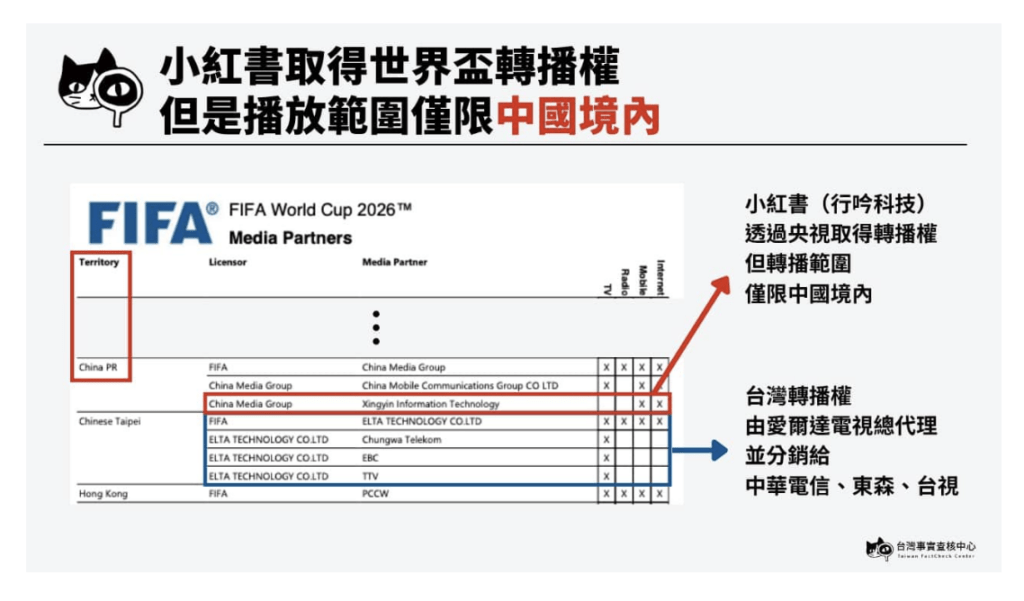
According to the list of local media partners released by the International Federation of Association Football (FIFA), Taiwan’s broadcasting rights for this World Cup were obtained by “ELTA TV” as the exclusive agent, which then sub-licensed the broadcasting rights for some matches to Chunghwa Telecom, ETTV, and TTV.
In addition, TTV is a terrestrial broadcaster, so people need only a digital TV antenna to watch some matches for free, including group-stage matches and all knockout matches from the round of 16 onward.

RedNote obtained only broadcasting rights “within China,” excluding Hong Kong and Macau.
As for the online claim that “Taiwan can use RedNote to watch the World Cup,” the fact-check reporter, in a network environment where the “RedNote” app can be used, did not find any World Cup broadcast video or information. When entering RedNote’s livestream link directly, the webpage displayed “This content is not available in your region”; on a phone, the same message appeared in English.
FIFA’s list of local media partners also indicates that RedNote’s parent company, “Xingyin Technology” (Xingin Information Technology), obtained only the mobile-device and internet broadcasting rights for China (excluding Hong Kong and Macau) and, per the agreement, cannot broadcast in Taiwan.
According to an Associated Press report, FIFA reached a USD 60 million agreement with China. Ultimately, China’s CCTV obtained the master agency and handled sub-licensing, while platforms such as RedNote received partial broadcasting rights.
Watching across regions via a VPN may raise suspicion of infringement.
(1) Some rumors state that Taiwanese people need only use a virtual private network (VPN) to “scale the wall” into China to directly watch the World Cup matches broadcast by RedNote. However, this too may constitute an act of infringement.
In a 2021 interpretive ruling, the Taiwan Intellectual Property Office of the Ministry of Economic Affairs noted that the Copyright Act contains the concept of “anti-circumvention measures.” If an online video platform’s “IP-filtering mechanism” is part of such anti-circumvention measures, and a consumer breaks or circumvents it without lawful authorization, there may be infringement concerns even without any downloading. But the actual situation must still be determined on a case-by-case basis.
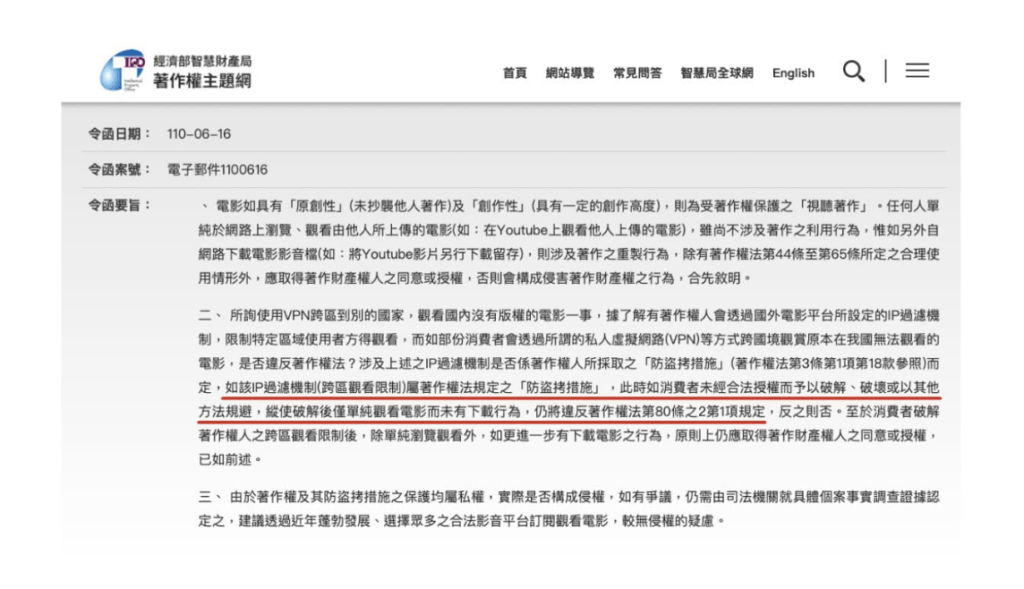
In an interview with the Fact-Check Center, lawyer Yu-Ting Li said that when operators use IP filtering to restrict access for users in specific regions, it is mostly because rights are limited to those regions. Therefore, watching across regions from another country raises concerns about violating Article 82-2, Paragraph 1 of the Copyright Act.
However, Li also pointed out that in current practice, infringement of broadcasting rights is mostly prosecuted against “technology providers”—for example, those who illegally tap signals or provide viewing equipment—and there has so far been no case of a viewer being sued for using a VPN to watch content across borders. But he cautioned that if a domestic rights holder files suit, viewers could still face civil compensation and criminal liability.
(2) The Malay Mail reported that the team leading Malaysia’s match broadcasts is continuously monitoring viewers who connect via VPN to watch the broadcasts. They noted that, under the broadcasting agreement signed with FIFA, the official broadcaster must strictly enforce “geo-blocking” to ensure the broadcast content is restricted to its region.
In other words, even after RedNote obtained the World Cup broadcasting rights and broadcasts the matches for free on its own app platform, it must block IP addresses outside China from watching the matches—otherwise, there would be infringement concerns.
Verification point 2: Is it because Taiwan blocked RedNote that it cannot watch the World Cup?
The main reason is “FIFA’s copyright restrictions,” and it has nothing to do with anti-fraud efforts.
Some rumors state that the reason Taiwanese people cannot watch the World Cup via RedNote is that the Taiwanese government blocked the app last year in the name of “anti-fraud”—but this framing is incorrect. To comply with FIFA’s broadcasting rules, RedNote already restricts its broadcast regions; if a user’s IP is outside China or in Hong Kong or Macau, they cannot see the broadcast.
Last December, because RedNote was implicated in numerous fraud cases and had not complied with Taiwanese regulatory requirements to appoint a representative in Taiwan, the Ministry of the Interior suspended its DNS resolution and restricted access. Deputy Minister of the Interior Shih-Yuan Ma noted that this measure was not a complete block but retained a degree of flexibility, and that, by raising the access threshold, it also reminds the public of RedNote’s fraud and information-security risks.
Verification point 3: How the rumor has spread
Online discussion and posts have mostly concentrated on the Taiwan Affairs Office press conference.
The Fact-Check Center found that this series of discussions about the World Cup broadcasting rights surged on social media mainly after the Taiwan Affairs Office press conference on June 17.
In mid-June, actor Li Li-Chun released a video stating that he could not find the World Cup broadcast on any TV channel, and saying, “Over here in Taiwan, you can’t watch the World Cup.” At the press conference on June 17, Taiwan Affairs Office spokesperson Chen Bin-Hua responded by welcoming Taiwanese people to use Chinese apps to watch the livestreams, or to come directly to China to enjoy the passion of the pitch together.
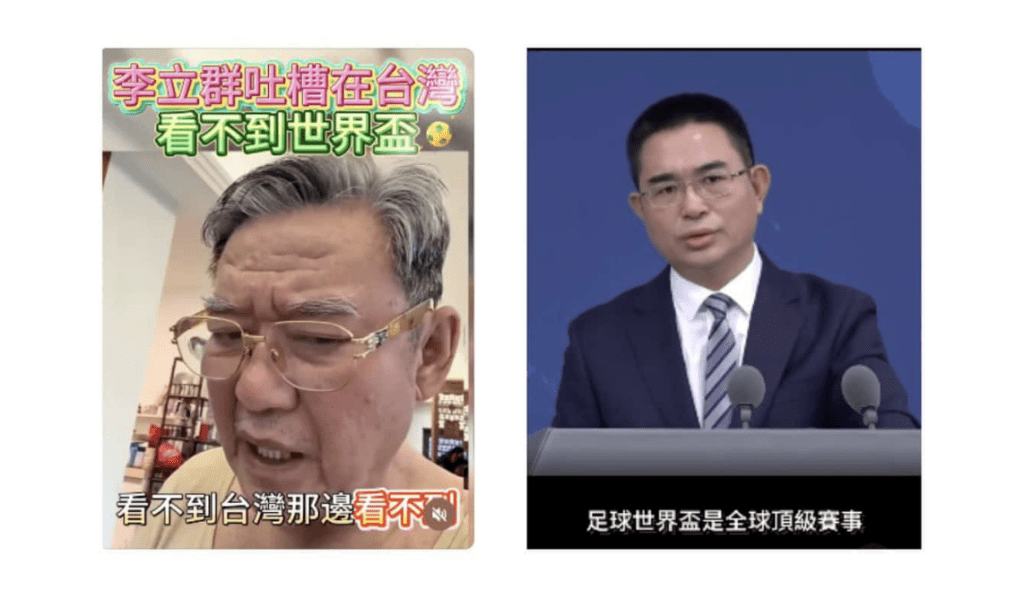
After the Taiwan Affairs Office press conference, a large volume of related discussion appeared on social media. In addition to turning clips of remarks from the press conference into short videos, this was paired with the online narrative that “Taiwan can watch RedNote livestreams” or with RedNote broadcast footage used to comment on the performance of World Cup players.
Combing through different types of posting accounts, the Fact-Check Center found that the accounts themselves are almost all focused mainly on political posts. Some posts use topics such as arms procurement, government tenders, diplomatic relations, or government policy as the main subjects of their arguments, in an attempt to escalate a sports event—an everyday form of entertainment — into political discussion.
Reposted from the TFC website in collaboration with StopFake as part of the Ukraine–Taiwan Initiative for Election Information Resilience.