


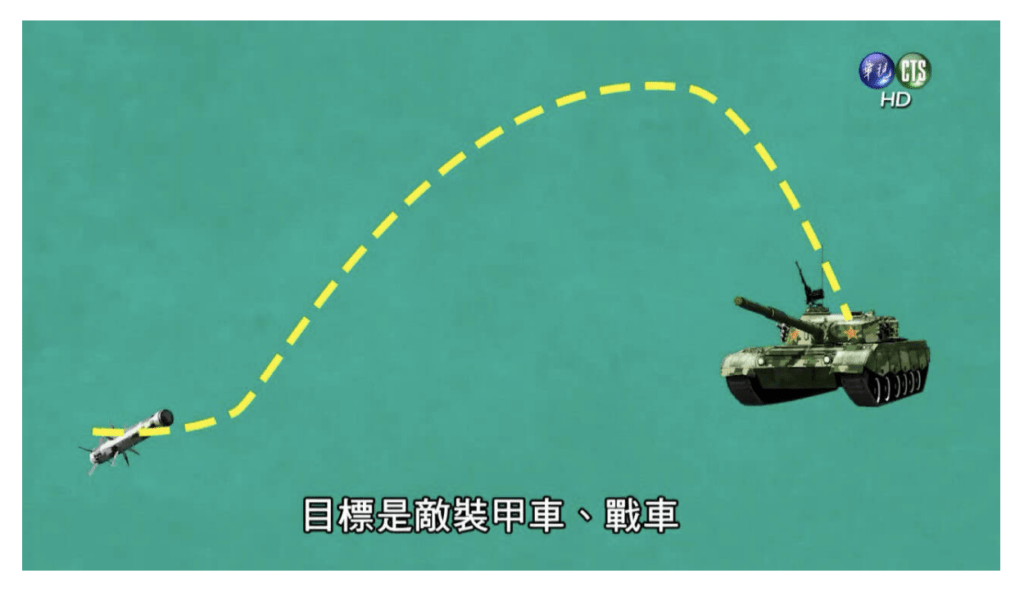
This is the Javelin missile’s “top-attack mode”; because of its high speed and the disappearance of its exhaust plume, it is harder to see with the naked eye.
Fact-check reporter: Szu-Tung Sung
Managing editor: Wei-Ting Chen
The original publication can be read here.
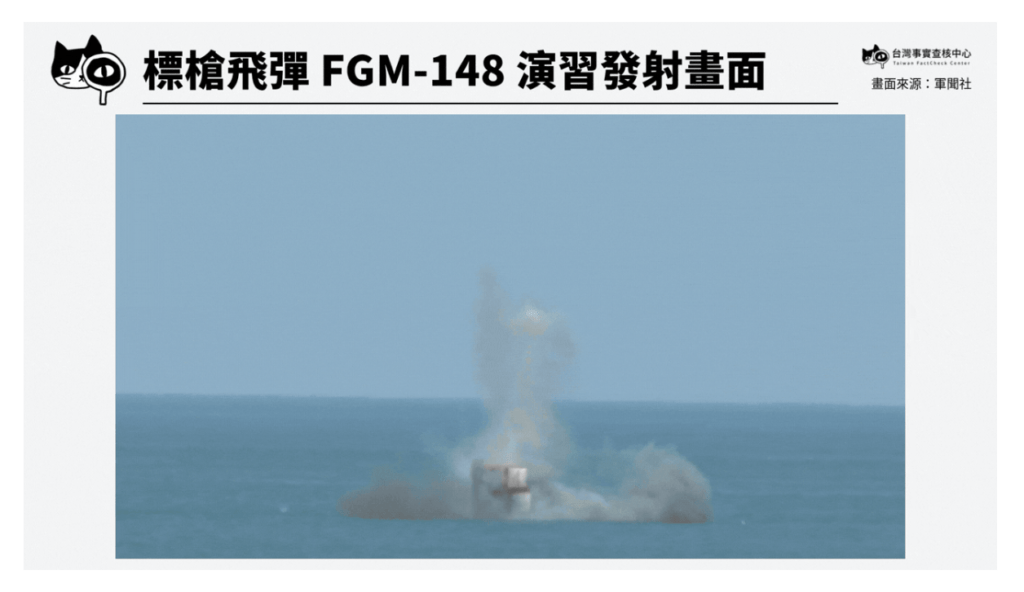
The military recently test-fired the FGM-148 Javelin missile. A video circulating online claims that the missile disappears after launch and that the target on the sea surface self-destructs inexplicably. Military experts say this is a characteristic of the Javelin missile’s “top-attack mode”: after launch, the missile climbs above the target, then loses power and its exhaust plume disappears, before immediately diving from above for a precision strike. The missile did not disappear.
- The circulating content is footage of an FGM-148 Javelin missile test-firing, released by the Military News Agency on June 3. The circulating footage shows the Javelin missile’s “top-attack mode.” In the early phase, the missile follows a trajectory resembling a parabola; once it reaches a point above the target, it dives from above for a precision strike.
- Military experts point out that during the dive, because the exhaust plume disappears, the Javelin missile is harder to observe directly; moreover, during the final dive, it relies entirely on inertia and gravitational acceleration, so its flight speed is extremely fast. Without high-frame-rate slow-motion camera equipment, it is difficult to capture the moment of movement or impact.
Through the footage and a false narrative, the circulating message distorts the Javelin missile’s strike characteristics, claiming that the missile self-destructed or that the whole thing was staged, in an attempt to confuse the public. It is therefore rated “False.”
Background
A video of a military Javelin missile firing recently appeared online; after launch, the missile’s exhaust plume disappears, and then the target on the sea surface explodes. After being edited, the video was overlaid with wording such as “the missile is gone” and “the target self-destructed,” and spread on social media platforms.

Fact-check
Verification point: The original context of the circulating footage
The circulating footage comes from the Military News Agency and shows an FGM-148 Javelin missile drill.
(1) The circulating footage comes from an FGM-148 Javelin missile drill video posted on June 3 on the official Facebook page of Taiwan’s Military News Agency, which was then widely reshared online, with some media outlets following up with reports.
If the original video is opened in 1080P high definition, color-graded, and played at 0.5x speed, you can see that after the missile’s exhaust plume disappears, a small black dot plummets rapidly from the sky.

(2) On June 6, the Military News Agency provided another firing angle from the same day; if that video is enlarged to full screen and the playback speed is slowed, one can observe the black shadow of the missile diving. In the footage from the Youth Daily News, one can also see the black shadow rapidly approaching the target and then exploding.
The Javelin missile’s “top-attack mode” climbs and then immediately dives, striking straight into the top of the target.
Su Hsiao-Huang, an associate research fellow at the Institute for National Defense and Security Research and a military expert, said the FGM-148 Javelin missile is a weapon mainly used to strike modern armored vehicles.
Su said that, judging from the attack trajectory in the circulating video, this is the Javelin missile’s typical “top-attack mode.” In the early phase of launch, the missile moves slightly forward, then rises rapidly, following a trajectory resembling a parabola; after climbing to the top, it immediately transitions into a high-angle dive phase, penetrating from above for a precision strike.
As for why the missile’s descent cannot be clearly observed, Su believes there are two reasons. First, in the circulating video, the Javelin missile’s fuel is exhausted, and its exhaust plume goes out with it, making it inherently harder to observe.
Second, during the final dive, the Javelin missile flies entirely on inertia and gravitational acceleration, so it descends extremely fast. Without high-frame-rate slow-motion camera equipment, it is easy to miss it in the gaps between frames, making it difficult to capture the moment of movement or impact.
In the related videos, Chinese state media distorted the narrative and, lacking expertise, served as mere “content carriers.”
After this footage was released on June 3, it sparked heated discussion on Taiwan’s social media from the next day. Some of the circulating videos were overlaid with wording such as “the target self-destructed,” and some domestic media outlets followed up with reports.
Starting June 6, Chinese state media such as Huanqiu.com (Global Times online), Taihai Moment, Southeast TV, and Ifeng.com also began citing the footage heavily, adding the same wording in the videos, such as “the missile is gone, the target self-destructed” and “mocked as putting on a show,” along with sarcastic narratives.
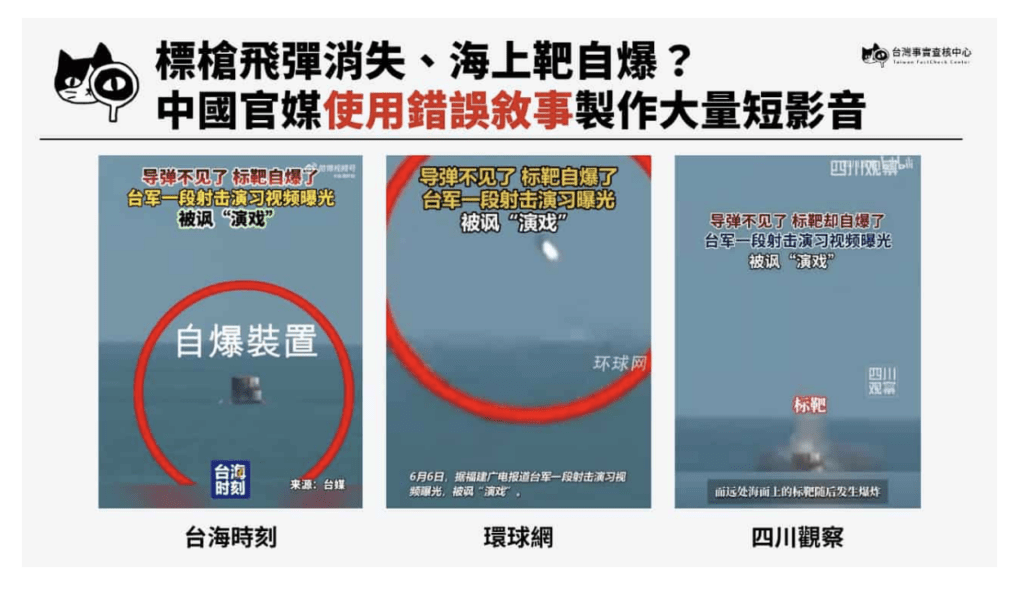
These decontextualized Chinese short videos, led by Taihai Moment’s content, not only circulated on Chinese social media platforms but were also “carried over” by many simplified-Chinese accounts to social media such as Facebook and Threads, in order to drive public opinion.
Su Hsiao-Huang pointed out that in recent years many so-called “military fan pages” or online KOLs have appeared on the internet, but these accounts generally lack basic knowledge of weapons and equipment and cannot substantively interpret professional military content; at most they can convey superficial military information, playing the role of “news carriers.”
Especially with videos of this kind that attract a lot of attention, these accounts use them for traffic manipulation; when faced with genuine military tactical drills, technological principles, and professional defense knowledge, they lack the ability to interpret in depth or analyze objectively.
Additional information
The modern anti-armor weapon, the “Javelin missile”
After the 1980s, the U.S. military began developing a new generation of anti-armor weapons, and the Javelin missile is one of the mainstays. Taiwan’s Army began introducing it in 2002.
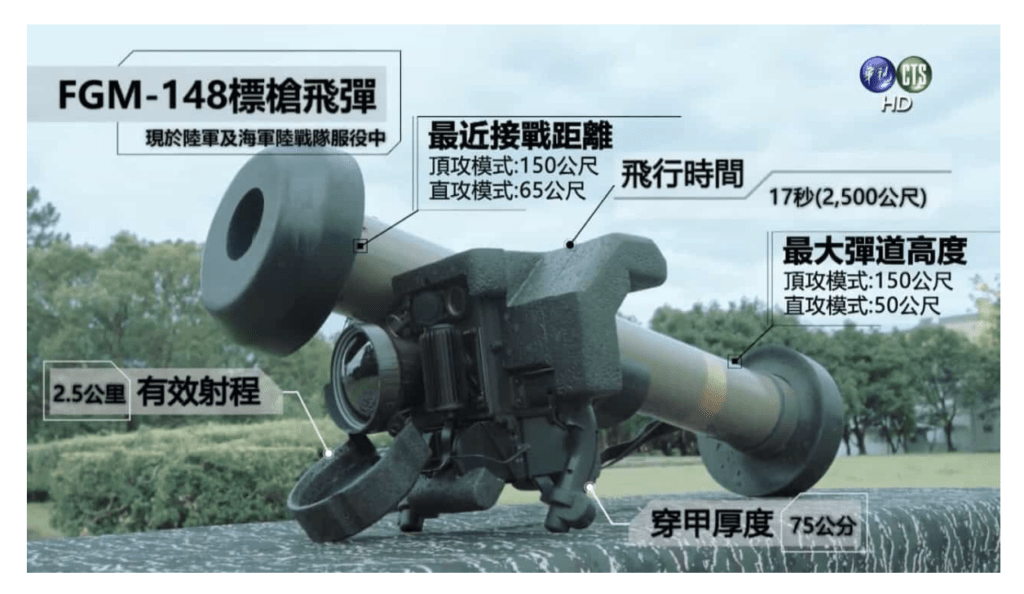
Su Hsiao-Huang pointed out that modern armored vehicles are usually strongest at the front, next strongest at the sides, weaker at the rear, and most vulnerable at the top. The Javelin missile’s top-attack mode was developed on this basis; by diving down from above the target, it increases the chances of a successful attack and penetration, and can also be used to attack the enemy’s bunkers and buildings.
According to the Ministry of National Defense’s Military Little Vanguard program, the Javelin missile is mainly composed of the launch tube, the missile, and the Command Launch Unit (CLU). The missile uses the CLU’s “thermal imaging seeker” to lock onto the target, and adopts an infrared, autonomous “fire-and-forget” guidance system: once the target is locked before launch, the shooter no longer needs to perform any further control.
In terms of firing mode, the Javelin missile mainly uses “soft launch,” which reduces the flame behind the launch tube, and employs two-stage ignition, making it less likely to injure the shooter with an overly large flame.
In the early phase of launch, the Javelin missile first uses the eject motor to eject the missile; only once the missile is several meters away from the shooter does the flight motor ignite and sprint into the air. But the sprint fuel is quickly exhausted, and the exhaust plume goes out with it, after which it enters the terminal guidance and dive phase.
[Update note 2026/06/10] Added an enlarged-view graphic of the original circulating video, added information on the message’s narrative and spread on Chinese social media, and adjusted the wording describing the Javelin missile’s characteristics and trajectory.
Reposted from the TFC website in collaboration with StopFake as part of the Ukraine–Taiwan Initiative for Election Information Resilience.