
Reporter: Ho Hui-an
Editor: Chen Wei-ting
The original publication can be read here.
South Korea held local elections on June 3. Because some polling stations ran short of ballots, voting was interrupted, and citizens were unable to cast their votes smoothly, sparking days of protests across South Korean society and calls for a re-vote. This electoral controversy quickly made its way onto Taiwanese social media platforms, where it merged with Taiwan’s existing anti-China sentiment, national security anxieties, and discussions of Chinese election interference — even giving rise to political rhetoric justifying martial law.
As of June 22, the Taiwan FactCheck Center and MyGoPen had jointly published 12 related fact-check reports, verifying rumors such as “Chinese nationals impersonating South Korean police,” “South Korea’s turnout rate reaching as high as 130%,” and “ballots thrown in the trash,” as well as footage claimed to be from South Korean protest scenes. The fact-check results show that although South Korea did indeed experience ballot shortages and protests, many of the claims circulating on Taiwanese social media diverge from what actually happened. Some even repurpose old footage or unverified conspiracy theories, packaging the South Korean electoral controversy as “evidence” of Chinese infiltration — striking a chord with citizens worried about the Chinese threat.
Ballot shortages at some polling stations trigger a serious electoral controversy in South Korea
South Korea held elections on June 3 for local government heads and councilors, along with National Assembly by-elections. However, on election day, some polling stations experienced ballot shortages and other problems. According to South Korea’s National Election Commission (NEC), of the roughly 14,300 polling stations nationwide, 50 experienced ballot shortages and 22 temporarily suspended voting. Some voters were unable to vote smoothly due to long waits or being unable to obtain a ballot.
The incident prompted questions across South Korean society about election administration. The chairman of the National Election Commission has already resigned to take responsibility, and President Lee Jae-myung ordered a thorough investigation into the incident and called for the study of electoral reform measures.
Nonetheless, the controversy has continued to ferment in South Korean society. Although the South Korean government has stressed that the incident was an administrative error in election operations, with no evidence of ballot fraud or systematic manipulation found so far, some citizens and political groups believe the incident has already compromised the fairness of the election and are demanding a re-vote; protests have appeared on the streets of Seoul and elsewhere.
How South Korea’s “unfair election” rhetoric and protests took shape in Taiwan
It is nothing new for information and rumors to circulate in Taiwan when neighboring South Korea experiences an election controversy. But after entering Taiwan, this was no longer merely a news story about South Korean election-administration errors. According to the FactCheck Center’s monitoring, the South Korean election rumors circulating on Taiwanese social media can be roughly divided into four types:
Electoral controversy and “evidence” of fraud: These rumors are mostly accompanied by fragmentary on-site footage claiming electoral fraud, but lack full context and follow-up investigation results. Examples include claims that ballots were stamped but had no crease, that ballots were thrown in the trash, and that ballot-box seals were torn open and then large numbers of ballots were inserted.
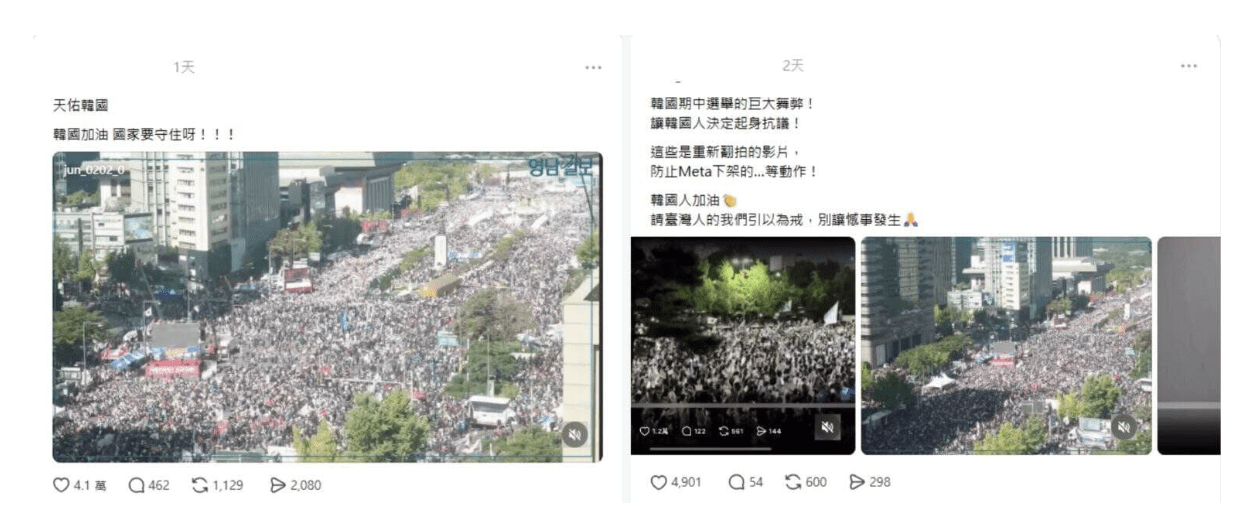
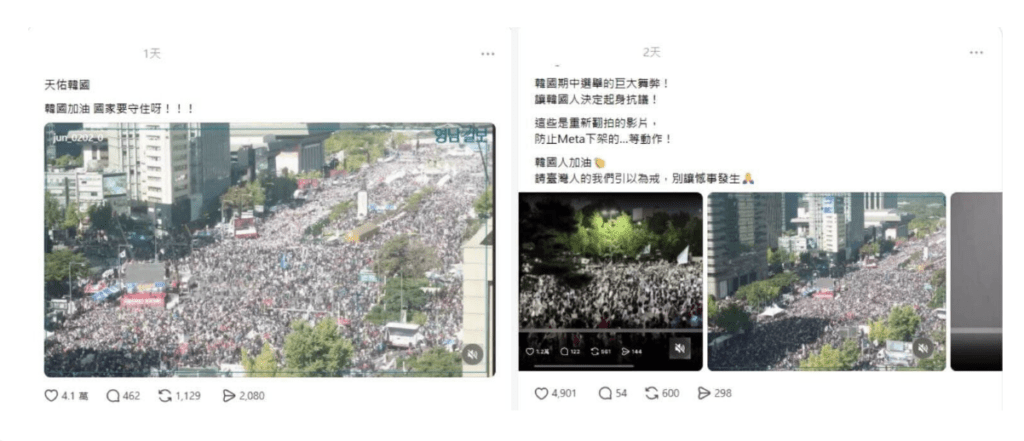
Protests and social mobilization: This content mostly uses protest footage as material, but some of it repurposes old footage or AI-generated imagery — for example, tens of thousands protesting electoral fraud at Gwanghwamun, or the Olympic Handball Gymnasium being surrounded.
Chinese election interference and infiltration: This links the South Korean electoral controversy to the “China factor,” reinforcing the impression of external forces manipulating the democratic system. Claims include that absentee voting or ballot-stuffing by Chinese nationals drove South Korea’s turnout as high as 130%, that Chinese nationals influenced the election after obtaining residency, and that Chinese journalists or public-security officers impersonated South Korean police, or that South Korean police had been infiltrated by China.
Democratic failure and the justification of martial law: Building on the above, this uses the South Korean electoral controversy as evidence of Chinese infiltration, going further to justify former President Yoon Suk-yeol’s imposition of martial law — for example: Yoon was right to declare martial law, and only hardline measures can solve the election/China problem.
| Rhetorical theme | Cases |
|---|---|
| Evidence of electoral fraud | Ballots stamped but with no crease; ballots made of “shape-memory paper”; ballots thrown in the trash; ballot-box seals torn open and large numbers of ballots inserted |
| Protests and social mobilization | Footage of tens of thousands protesting electoral fraud at Gwanghwamun; aerial footage of South Korean citizens surrounding a sports venue in protest |
| Chinese election interference and infiltration | South Korean protesters shouting “Down with the CCP”; South Korea’s turnout reaching 130% / Chinese nationals stuffing ballots / Chinese nationals influencing the election after obtaining residency / the South Korean incident demonstrating the consequences of “absentee voting”; South Korea gradually becoming a second Hong Kong; Chinese journalists impersonating South Korean police / South Korean police infiltrated |
| Martial law is justified | Yoon Suk-yeol was right to declare martial law; only hardline measures can solve the election problem |
South Korea’s electoral controversy fuels anxiety over Taiwan’s absentee-voting legislation
Much of the rhetoric in Taiwan centers on Chinese election interference and infiltration. For instance, starting in the early hours of June 4, the claim that “South Korea’s turnout even reached 130%” began appearing on Taiwanese social media platforms, accompanied by content such as “overseas Chinese-Korean ballots were stuffed in,” “South Korea is becoming a second Hong Kong,” and “South Korea is demonstrating for Taiwan the consequences of being pro-China” — insinuating that China-linked absentee voting or ghost ballots were responsible.
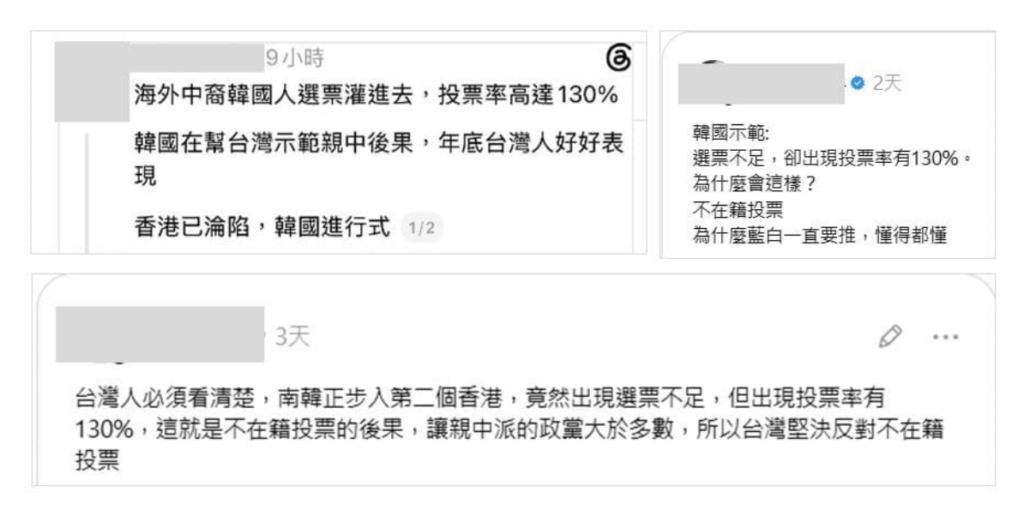
However, the circulating rumors offered no supporting evidence. According to the FactCheck Center’s verification, based on data released by South Korea’s National Election Commission, the national turnout rate this time was 61.0%. The highest turnout among districts was Gangwon Province at 64.5% — not the 130% claimed online.
The rumor likely originated from a South Korean conspiracy theory. Before the election, claims of turnout exceeding 100% had already begun circulating in South Korea. In reality, this was because South Korea’s early voting allows cross-district voting, which can cause a small administrative district to have more ballots than its population. But these are ultimately counted within a larger administrative district, and the final ballot count does not exceed the population. South Korean authorities have already clarified this.
As for the claim that “Chinese nationals influence the election after obtaining residency,” according to MyGoPen’s investigation, South Korean law in fact grants voting rights in local elections to foreign nationals aged 18 and over who have held a permanent residency visa for at least three years. According to a May 2026 report by South Korean broadcaster MBN, 150,000 foreign nationals were eligible to vote in this local election, with Chinese citizens making up the largest share.
After spreading to Taiwan, this conspiracy theory was again linked to narratives such as “Chinese nationals stuffing ballots” and “absentee voting may increase the risk of vote-rigging.” Some social media discussions also expressed concern about Taiwan’s upcoming absentee-voting legislative reform.
Chinese journalists impersonating South Korean police? The Sinophobic narrative amid South Korea’s election controversy
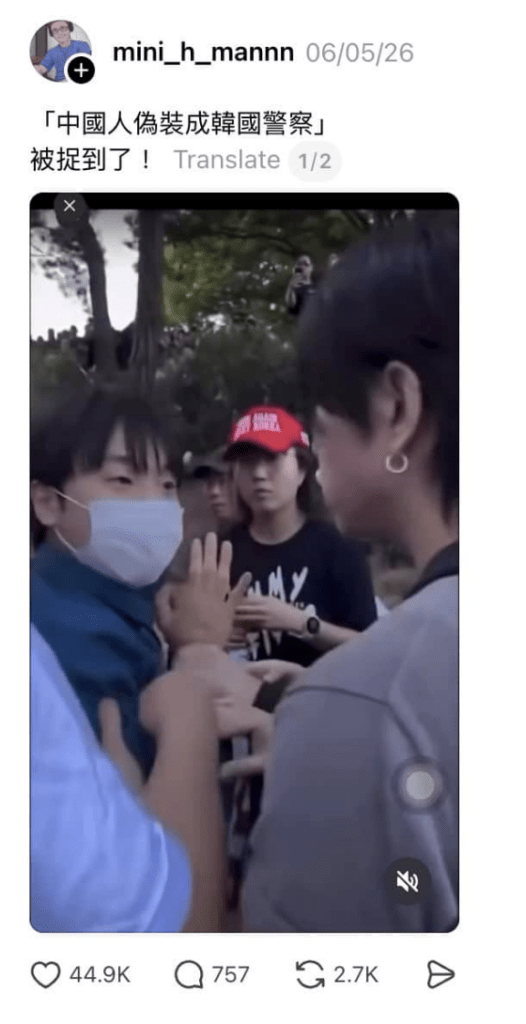
Another claim widely circulated on Taiwanese social media was that “South Korean police have been infiltrated by China,” accompanied by various pieces of visual “evidence”: one photo claimed that a China-based journalist stationed in South Korea appeared at a protest scene wearing a South Korean police uniform; another rumor claimed that South Korean police officers’ names were “mostly Chinese transliterations”; and there was video claiming that “a Chinese national disguised as South Korean police was caught,” and that “Chinese authorities dispatched large numbers of ethnic-Korean Chinese police to disguise themselves as South Korean police.”
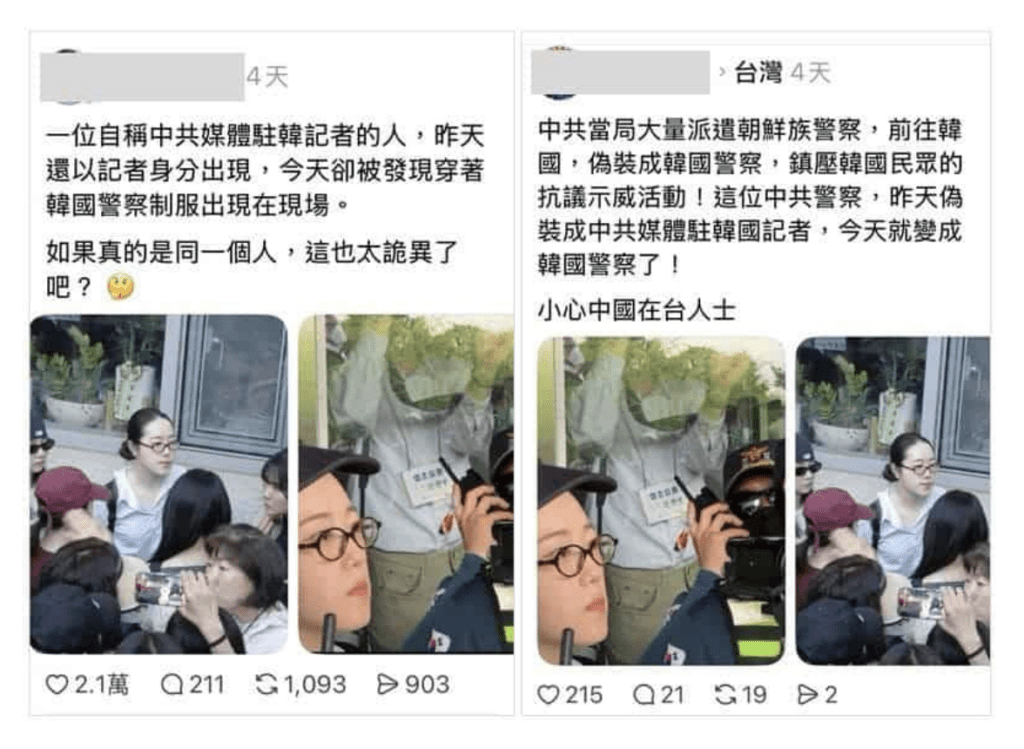
However, these rumors have all been debunked or clarified one by one. After verifying the photo of the alleged Chinese journalist in a South Korean police uniform, the FactCheck Center found that the woman in the image was, in fact, a reporter for South Korea’s JTBC — not a Chinese national — and had not impersonated a police officer. What appeared to be a police cap on the reporter’s head was actually the cap of a police officer standing beside her; the circulating photo had cropped out the officer, and the misalignment made it look as though the reporter was wearing the police cap.
As for the other video claiming that “a Chinese national disguised as police was caught,” according to fact-checking organization MyGoPen’s investigation, the South Korean netizen who first posted the video later deleted it and issued a statement saying the man in the video was a real police officer. However, the video had already made its way into Taiwanese social media, and the Taiwanese netizens who saw the related messages did not necessarily know that the original poster had already deleted the post and clarified.
The Chinese-interference narrative circulates not only in Taiwan but is also prevalent within South Korea
Notably, conspiracy theories about Chinese election interference have also been heating up in South Korea in recent years.
On June 8, the Korean National Police Agency issued a statement clarifying that various online allegations of “fake police” and “Chinese police” had emerged, but that after reviewing all the questioned cases, all were confirmed to be South Korean police, and the online allegations were not factual.
South Korea’s JTBC fact-checking team recently published a fact-check report debunking another conspiracy theory about Chinese election interference. A politician had claimed that Chinese nationals transported ballot boxes in advance, accusing the government of handing over South Korea’s sovereignty to China. After actually interviewing the driver being insinuated about, JTBC found that the individual was a naturalized South Korean citizen of Chinese descent, that the ballot-box transport was supervised throughout by election officials, poll watchers, and police, and that it was impossible for him to have had sole access to the ballot boxes or to have influenced the election results.
According to reporting by Yang Chien-hao, an independent journalist based in South Korea, the South Korean far right believes that Chinese-factor interference and manipulation of the elections have repeatedly benefited Lee Jae-myung and the Democratic Party, and they therefore defend the legitimacy of Yoon Suk-yeol’s declaration of martial law. But in fact, since the electoral-fraud claims first emerged, there have been a total of 126 related lawsuits over five years, all of which were dismissed by the courts. After the martial-law upheaval, the Constitutional Court also ruled that “electoral fraud does not exist,” finding the claims inappropriate. Both the justification and the procedure for Yoon’s declaration of martial law were unlawful.
South Korea’s electoral controversy did indeed stem from a real administrative lapse, which in turn sparked public discontent and political dispute. However, once the related information crossed borders into Taiwanese social media, much of the discussion no longer focused on South Korea’s election-administration problems themselves, but was reinterpreted as evidence of Chinese election interference, democratic failure, and even the legitimacy of martial law. Some unverified conspiracy theories, repurposed footage, and disinformation also found room to spread amid existing political positions and security anxieties.
Reposted from the TFC website in collaboration with StopFake as part of the Ukraine–Taiwan Initiative for Election Information Resilience.