By Danyil Kulinka
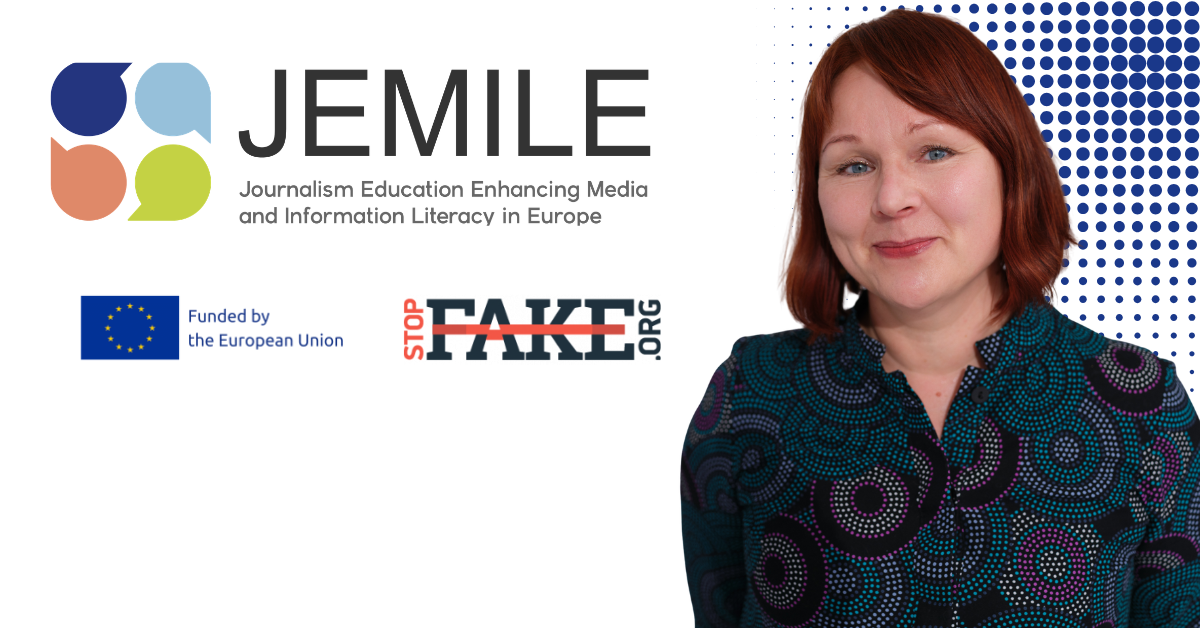
Information threats are evolving faster than traditional approaches to media literacy, prompting educators to look for new ways of engaging with audiences. Anne Leppäjärvi, Journalism Degree Director at Haaga-Helia University of Applied Sciences and President of EJTA, initiated the JEMILE project. In an interview with StopFake, she discusses journalism education today and the future of media and information literacy.
What is EJTA’s main mission? Do you already see the changes that have taken place during your presidency?
The organisation brings together around 80 educational institutions. The point of it is to uphold what we consider real journalism when we teach journalism. We are defending something that is extremely important for democracy. And when we teach it, we need students who understand that this isn’t just communication and it isn’t just writing — it’s the responsibility of a professional journalist. During my presidency the world has been changing for the worse, and I think we’ve had to take certain measures in response. But I also want to stress that we need to do more than respond: we need to act. This approach to media literacy is exactly that kind of action. If we don’t talk about media literacy, and simply assume that we are providing people with information and that the information reaches them on its own, we’re being very naive. Others don’t think that way — the people spreading disinformation, for instance. They work hard to understand how people process information, and how strongly emotions shape what we know and what we want to know. That’s a different game altogether. What we’re trying to do at EJTA right now is to come together without idealising things, and to assess realistically how the world actually works. It isn’t only about keeping journalism strong. It’s about rethinking the process, rethinking the product, understanding a journalist’s mindset and understanding the audience. For me, media literacy is the tool for that rethinking.
What are the main challenges facing journalism education in Europe, and what role does EJTA play in addressing these challenges?
Right now we’re facing authoritarian regimes and a shortage of democracy — a wave the world is going through. All of this seems to happen in cycles, and we’re now at the stage where we need to fight back, after twenty years of “good times” when everything seemed to be moving in the right direction for human rights and democratic societies. Money is the other challenge. Audiences don’t pay for journalism, because they don’t fully see what separates journalism from other media content. There’s a genuine lack of understanding: why should I pay for this? And the problem isn’t really that people have no money — we all pay monthly for Netflix and everything else. The problem is not understanding how this information differs from what I can get for free. Which brings us back to media literacy: if you valued the information you get more highly, you would feel that it does something for you. We’re working on both of these at EJTA, because our main task is to protect journalism programmes and keep the standard of education high in a world where all kinds of things are happening. Then there’s artificial intelligence — but what matters more than AI itself is how it’s used. First of all, we have to learn to use it ourselves. We are the ones who can explain to people how it’s being applied.
Finland is considered a leader among European countries in the field of media literacy. What exactly contributes to this, and which approaches are the most successful?
There’s an index in which Finland has come first every year since 2017 — until this year, when we slipped to second by a fraction of a point. Which is a good moment to stop and ask: what is that index actually measuring? Forty percent of the ranking is based on press freedom. That sometimes surprises people, that press freedom carries such a large weight. To me it’s obvious. Without a free press it’s impossible to develop media literacy, because there’s no way to verify information, no way to compare one piece of information against another. And it works in the other direction too: if people lack media literacy, it’s very easy for a country to end up in a situation where press freedom declines, because nobody is defending it. Another forty-five percent comes from education. And here is where I think the index becomes a bit of a trap for Finland. When someone asks us, “What have you done?”, it’s easy to answer, “Well, eighty-five percent of it is education and press freedom” — as if the work were already finished. That’s not the situation we’re actually in. In my view the most important factor in the index is the ten percent that measures trust between people. That’s what determines everything else. If there is trust, people vote for a government that wants to develop education, that is willing to collect taxes, that wants to protect press freedom. That trust is what we have built. We pay a lot of taxes, and this civil society takes care of people — at least it has so far. I can be reasonably sure that if something bad happens to me, someone will take care of me. That kind of glue matters for everything else in a society. Then there is our neighbour. Russia, the Soviet Union, which once took close to a tenth of our territory. If you’re looking for something positive in all of this: we in Finland have a common enemy, and no illusions about it — at least not right now. It took a long time, but I think Finland has genuinely freed itself from Russia, and we’ve started speaking openly. It’s a shared realisation: we used to have this enemy looking over our shoulder, and now we’re free to say what we think. That ability to express your thoughts openly is central to media literacy. And that is also where the trap lies. Finland has been doing well for so long that we easily assume it will always be this way. This year’s ranking is a small reminder that nothing is permanent. It’s a daily job. Media literacy is like air — you realise its value when you begin to lose it.
What are the current trends in media literacy, and how much have they changed recently?
To me, the paradigm shift in media literacy is above all a matter of realising: yes, this concerns me personally. I need to understand how I process information, and I need to accept that nobody is going to come to me and hand me the “correct” version. My own thinking about audience engagement is built on recognition. If you genuinely recognise another person, you understand them — you empathise with them. That doesn’t mean you have to agree. You can disagree as much as you like. Students sometimes ask me, “But he’s a racist. How can I interview someone like that? Do I really have to publish what he says?” That’s a slightly different question, and it calls for a more mature conversation — one where you make your arguments and explain your reasoning. You show that the idea exists without promoting or defending it. It’s genuinely difficult. But I think it’s a new skill, and not only for journalists. It’s a new skill for audiences too: being open to this kind of thing, when these days we take offence very easily at someone thinking differently. That’s the maturity I’m talking about.
What teaching methods for journalism are currently used at European universities?
When I was starting out, it was easier to talk about tools: how do you verify a source? How do you find out more? It isn’t like that anymore, because it’s no longer easy to see that something is unprofessional — everything looks so good. With artificial intelligence this only gets harder, since it can generate convincing-looking content very quickly. So media literacy now means being more aware. Not necessarily more critical, but more aware: aware of yourself and of what’s going on with other people. It also means being more curious about the fact that other people may think differently. When I teach media literacy, I want to focus on the process of how people think. We talk about critical thinking — perhaps we should start with thinking itself.
Are there methods that have proven ineffective and are no longer used?
I think it was all oversimplified: “Do this, this and this, and then you can trust me.” As if there were some absolute truth available. Each of us has our own reality, and words can capture only part of it. Words are all we have, so we can try to describe how I see the world. That leaves two things. The first is the ability to be informed, and to understand what that actually means. The second is to take seriously how heavily we are influenced by what surrounds us. This changes the examples you use when you teach. You don’t claim to possess the truth, but you also point out that what you see isn’t the truth either. And sometimes you do have the truth and can say it — but you say it in a way that makes people notice they are being influenced. We can’t tell people, story by story, what is correct and what isn’t. They have to do that themselves. Media literacy isn’t just something pleasant that makes you happier. It isn’t a soft skill. It’s something nobody can do without in today’s world. That has genuinely changed — and it also means there is more funding for media literacy and that it’s taken more seriously.
What media literacy competencies should be mandatory for future journalists?
It comes down to understanding the audience. That means recognising that they aren’t statistical data but real people — and because they are people, you have to be able to recognise the emotions they’re feeling. They may become defensive, or judge too quickly whether something is good or bad. So how do we add a new stage to the journalistic process, one where we analyse not only the information itself but who it matters to — and how, and why? That analysis is what I think we’re missing, given how much audiences differ. We assume too easily that because we now have this information, we should rush out and share it. We behave like soldiers of information. And so we don’t take the time to really connect with people. That’s a question of journalistic skill, but it’s also a question of media literacy.
Are there methods that allow journalism, in today’s unstable world, to remain completely objective without becoming a mouthpiece for chaos or causing panic in society?
This is really about news avoidance, which is a big phenomenon and getting bigger. If this is my story, how will people react to it? Is there a chance they’ll say, “I don’t want to read this, it makes me uncomfortable”? You can’t turn it into a positive story — that isn’t the answer. But is there a way to make it visible? Not by repeating that it may make you uncomfortable, but by showing empathy in a professional way: a deeper understanding of how the reader will receive this information, built in from the very beginning. That’s where journalists should find their motivation. Do it one way and you’ll have some readers; do it another way and you can be more confident that people are actually trying to understand the story, analyse it and reflect on it. It can mean something to them. Our job is to get information to people and to find a way of doing it — and, as I said, that isn’t only about providing information but about presenting it so that people are more receptive to it. It isn’t that we need to protect people from bad things. I truly believe the answer lies in this interaction with the audience — for media literacy, for news avoidance, and for the sheer oversaturation people feel. In the end you can’t avoid the news. You need to know what’s going on around you.
Do you have any advice for modernizing Ukrainian journalism education programs? Has Ukraine’s experience been helpful in developing new programs?
I think the main question is how familiar the Ukrainian audience is with journalism: how well they understand what happens when someone does what we call journalism, and what it means in a democratic country. So the task is to prepare future journalists to understand their audience in that context too — what the audience expects, what it knows about journalism, and how it can support journalism. You have to present your material in a way that helps people see the difference between this and my neighbour’s Facebook post. I think education systems fail to explain that journalism is a human right: that the right to information is a human right, and that you also have a right to be able to evaluate that information.
To build an audience and serve it, we need to acknowledge these questions and understand them better. This is a weakness in journalism education in every country, but societies differ. In Finland our educational structures are strong enough that teaching this is easier for us than it may be in Ukraine, where people are living through a terrible situation and have so many other concerns — although perhaps that is exactly when they need information most.
We really need to start understanding who we’re doing this work for. They aren’t sitting around waiting for their lives to change, and they aren’t saying, “Give me journalism, give me journalism.” We have to reach out to them, and we’re starting from a minus: people don’t trust us, and they may even be disappointed in us.
What role does EJTA play in the JEMILE program?
EJTA is a supporting partner, which means that through its member schools and its media literacy working group, JEMILE is already up and running across the network. JEMILE is presented twice a year to all these teachers, and we facilitate those discussions.
What EJTA gives us is help in thinking on a broader scale. This project requires us to try things out, and EJTA is where that feedback comes from — instead of us having to explain ourselves from scratch every time. I hope that through EJTA and this network we’ll be able to genuinely change something in European journalism education.
What are your hopes for the JEMILE project? How do you see its future development?
My greatest hope is to make the things we’ve been discussing the norm, so that every journalism educator understands this is something we have to talk about.
There’s an idea that media literacy isn’t even worth thinking about — that it’s someone else’s responsibility, that the education sector will handle it. I think that’s a form of blindness, an inability to see the world as it really is and always has been. We have reached the end of the road where we can assume that people want to read our stories simply because we are journalists. That isn’t the reality.
I think the resistance to media literacy comes from people seeing it quite differently than we do at JEMILE. We start from what journalism education can actually achieve, and what journalism itself can contribute — because there are several actors
involved: teachers, audiences, policymakers. We all have our part. So what exactly is ours? That’s what we’ll explore at JEMILE, and I hope we’ll be able to formulate recommendations, and concrete learning outcomes, that we’d like to see added to European journalism curricula.
What does JEMILE project mean to you personally?
For me this project means: finally. I started out as a journalist and a teacher, and I’ve always thought the two are so closely related — when I’m a journalist I’m teaching people, and when I’m a teacher I’m conveying information. It’s all about information, about giving people the chance to discover things for themselves and think for themselves.
When I started teaching future journalists, that was always my main goal. I wanted them to be proud that they could change the lives of people who want change — that their role could be a remarkable one. Gathering information for other people is an extraordinary thing to do. It’s a kind of gift. And people can use that information to do remarkable things.
But right now we are fighting just to reach them. People want someone they can trust, and journalists can be those people. If people know who they can trust, then we’re fine.